Lofty sells shares of single rental properties on Algorand, paid daily
Lofty sells tokenized membership interests in individual American rental properties on Algorand, pays rent daily, and lets owners vote on repairs and sales. Shares trade on Lofty's own order book rather than open pools, so how easily a holder can sell depends on each listing's order book.
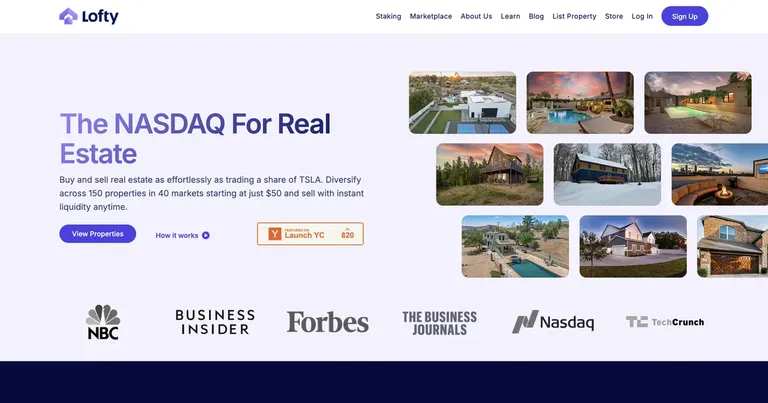
Lofty sells pieces of individual American rental properties. You pick a listing from its marketplace1 — a duplex in Silvis, Illinois, a commercial building in Everett, Washington — buy one share or several, and rent, once that property's expenses are paid, arrives in your account every day. What you hold is a membership interest in the limited liability company that owns that one building, issued as a token on Algorand rather than as a line in a fund. DefiLlama2 puts the value held on the platform at about $101.1 million, and the property tokens it sells today are reissued ones whose issuer has permanently given up the power to freeze or claw them back.
What a share is
Each property sits in its own LLC, and ownership is issued as Algorand Standard Assets, the chain's native token type. Rent is distributed once a day, around midnight UTC, net of management, insurance, tax and reserves. Behind each property sits a master smart contract whose stored fields include a rent account, a reserve account and an emission rate. Owners vote on repairs, rent changes and whether to sell; any fraction of a share carries a vote once identity verification is done, and no investor may hold more than 15%3 of a property. Sellers — usually the current owner, who may keep managing the building — list up to 90% of a property's equity and must keep at least 10%4, so they stay exposed alongside the buyers. Every listing publishes financials, an inspection report and rent history, and a third-party manager handles tenants and repairs; owners can vote to replace that manager. Lofty's explainer5 sets out the sequence from account to first payout.
Buying in, and what it costs
An account opens with Google, Apple or an email address. Lofty's FAQ says anyone in the U.S. or abroad may invest except residents of sanctioned countries, must be 18 or older, and must complete identity verification for bank deposits, positions above $200 and withdrawals; withdrawals go to a bank, and standard transfers take up to four business days. Buying in starts at $50, and new accounts are offered a credit on a first purchase. The first rent payment lands with the next daily run, usually within 24 hours.
Trading settles in USDC, and a seller is paid in USDC, which can be converted to dollars elsewhere. Lofty charges 2.5%6 on purchases and 3%7 on sales, with no assets-under-management fee, and a market order for an instant fill carries another 2.5%8 paid to market makers. A patient buy and sell therefore costs 5.5%9, and a round trip done with market orders on both sides costs 10.5%.
What the ledger shows
The property tokens have been reissued. On 27 August a holder's 226 units of the original 91710 Pawnee Ave token went to Lofty's issuance address. At 16:07 that day, in one atomic group, the same wallet opted into a new six-decimal token with the same name and received 22611 units of it from the issuer; total supply stayed at 2,16012. The change makes each share divisible to six decimal places. For the properties where this has happened, the token that older references show is the retired one, and it is now the wrong place to look for who owns a building.
The current tokens are where the trading is: four of them recorded between 99 and 204 transactions each in the 30 days to 29 October, the latest on the 28th or the 29th.
The reissued property tokens carry no freeze address and no clawback address, and both roles are permanently empty: nobody, including Lofty, can freeze a share in a holder's wallet or move it without that holder's signature. That is not true of everything the company issues. Of the 41313 assets Lofty's issuance address has created, 18 carry a clawback role and 314 a freeze role, each held by Lofty itself, and its dollar token, USD Lofty, keeps both. Fifteen of those 18 are older property tokens that some holders still have; the other three are Lofty's platform tokens. The property shares and the dollar token should not be described alike. Marketplace trades settle in USDC, per the disclosure on each listing.
PXke has written about the contract Lofty built for the other exit: when owners vote to sell a whole building, holders swap their tokens on-chain for their share of the proceeds rather than waiting on title and brokerage.
Who is behind it
Lofty AI, Inc. was founded in 2018, is backed by Y Combinator, and says it has run a fractional real estate marketplace continuously since 2021.15 Its team page16 names Jerry Chu as founder and chief executive, Max Ball as chief operating officer and Mark Keane as founding engineer.17 The company reports more than $100 million18 invested, $5.2 million19 in cumulative rent paid, and more than 40,00020 investors. Those are its own figures and unaudited; its X account said in July that the platform had crossed $100 million21 in volume.
What an exit costs, and who answers for it
'Sell anytime' is a price, not a promise. On the live order book for 2820 Rucker Ave in Everett2223, the best bid was 1.84824 shares at $46.0025 — about $85 of buying interest — against a best ask of 12.65626 shares at $50.0127, a $4.0028 spread on a share quoted near $50, with filled orders from 23 to 29 October running between 0.13 and 4 shares.
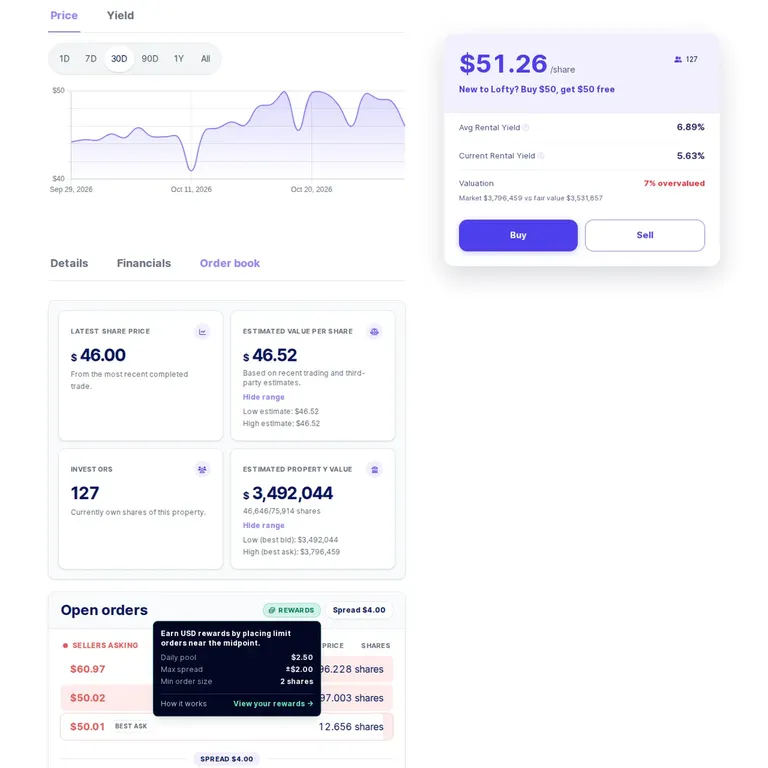
A holder can always list; whether a few hundred dollars of shares find a buyer at the top of the book is a property-by-property question. Crossing that spread is a second cost on top of the fees above.
DefiLlama records no audits for Lofty, and its property tokens trade on Lofty's own marketplace rather than in open DEX pools. Its separate lending page29 reports 'Total Liquidity $030' and 'No active pools available', so that $101.1 million is not a pool a seller can draw on; it is the value of the property interests held on the platform.
Lofty's site states it is not a registered broker-dealer or investment adviser, and its terms31 add that it is not registered with the SEC, does not broker orders and does not guarantee best execution. A California regulator acted in 2022. A California consent order dated 14 November 2022 named Lofty AI, Jerry Chu and Max Ball, imposed a $37,50032 joint-and-several penalty and ordered them to stop offering Lofty Holding LLC interests in California until qualified or exempt. It followed a finding that from April 2021 to March 2022 the company offered interests in at least 7533 Delaware LLCs, at least $12.6 million worth, without qualification; the respondents neither admitted nor denied the findings.
The category has a cautionary case. RealT raised roughly $140 million against Detroit rental properties and announced voluntary liquidation on 2 July 2026, with a wind-down escrow holding about $640,00034 for between 14,000 and 22,00035 investors. Lofty's own blog36 has published a post-mortem of that collapse.
Lofty's FAQ5 answers the obvious question by saying investors would not lose their holdings if the company went out of business, because each property's LLC stays independent. Each property's operating agreement is published, for example for 2820 Rucker Ave37.
A comparable
Arrived sells shares in individual homes and in funds, reports 1 million38 registered investors, $490 million39 invested and $125 million40 distributed, and lets holders request redemption in quarterly windows subject to approval after six months — a slower, gated exit than an open order book.
Lofty figures from Lofty's own pages; Arrived figures from Arrived's site, read 29 Oct 2026.
- What you own: Lofty: Share of one LLC; Arrived: Shares in homes/funds.
- How often you are paid: Lofty: Daily; Arrived: Monthly cash flow.
- How you get out: Lofty: List on order book; Arrived: Quarterly, approval.
Alongside houses, the marketplace also lists Lending DAO tokens, which are shares in a loan book that lends to property owners rather than stakes in a building.
Where it fits
For someone who wants to own a named property rather than a fund, be paid daily, and hold for years, Lofty's structure is unusually direct, and the renounced roles on the current property tokens mean the holding itself cannot be taken from a wallet by the platform. The trade-off is at the exit, where the spread and fees above decide what a sale actually returns, and DefiLlama lists no audit. The depth of each property's order book is where a holder's exit gets priced.
32 figures in this story are checked. 5 were read straight from the chain.See every check
Sources
- 1Real Estate Investing Marketplace | Lofty lofty.ai↩
- 2defillama.com/protocol/lofty defillama.com↩
- 5How Lofty Works: Fractional Real Estate Investing Explained | Lofty lofty.ai↩
- 16About Lofty | The team behind fractional real estate lofty.ai↩
- 222820 Rucker Ave in Everett, WA | Lofty Investment Properties lofty.ai↩
- 29lending page amm.lofty.ai↩
- 31Terms & Conditions | Lofty lofty.ai↩
- 36The RealT Liquidation Explained: What Happened, and What Token Holders Can Do | Lofty lofty.ai↩
- 37Lofty AI | LFTY0477 2820 Rucker Ave Operating Agreement asset.lofty.ai↩
Further sources (6)
- Real Estate Investing Blog | Lofty lofty.ai
- Crypto real estate empire collapses as $140 million tokenized property venture enters… cryptobriefing.com
- Is Lofty Legit? An Honest Answer From the People Who Built It | Lofty lofty.ai
- Lofty Review 2026: The $50 Tokenized Real Estate Platform (The Good, The Friction, The… crowdfundedwealth.com
- learn.lofty.ai/en/collections/7492346-proactive-market-maker-pmm-liquidity-pools learn.lofty.ai
- Lofty (@loftyai) / X x.com