One Full Algorand Block Holds About a Ninth as Many Post-Quantum Payments
On October 21, 2026, one Algorand block filled to 99.9 percent with 1,590 transactions, 1,565 signed with Falcon keys. Each such payment takes about 3,340 bytes, so a block holds roughly 1,569 of them against some 14,770 ordinary payments.
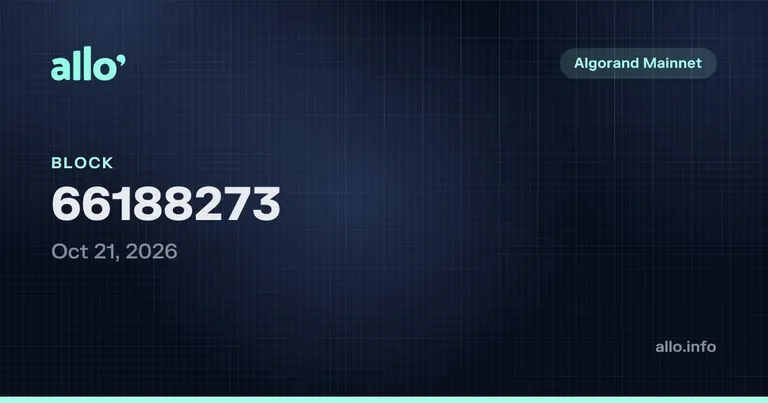
On the morning of October 21, 2026, block 66,188,27312 came within a rounding error of Algorand's block limit. Its header recorded a Load of 999,4613, where 1,000,000 means a completely full block. Load is a protocol field: the share of a block's 5,242,8804-byte transaction budget that it has spent. This one used all but a sliver of it. It held 1,590 transactions5, 1,5656 of them carrying a Falcon signature.
A Falcon account is a new kind of Algorand account, made to authorize payments with a post-quantum key instead of the classical one nearly all traffic still uses. A payment from one costs more than the protocol's minimum fee, Algorand's fee guidance says, because the type of signature now matters. What that difference costs in room inside a block is the question here, and one morning's blocks answer it.
At the roughly 3,340 bytes one of those payments occupies, the budget holds about 1,5697 of them. Algorand has recently kept block times near 2.76 seconds, which turns that budget into some 568 payments a second. An ordinary payment, at about 3558 bytes, would fit about 14,770 to the block, roughly 5,300 a second.
Three near-full blocks, and the quiet ones after
PXke bought badge-farming orders from AlgoRoll's Quantum NFT Farm9 for this test, including a 20010 ALGO order, and AlgoRoll shared its report on that order; the transactions those orders made are now part of the post-quantum count Algorand cites.
Two other blocks that morning came nearly as close, both dominated by Falcon signatures. One filled 98.7 percent of the cap; the other11, 98.9.
The block after the full one read 155,360 on the same scale, about 16 percent; the one after that12, 1,151. Other blocks from the same morning sat in the low thousands on that scale. Whether a sender could hold a full-block pace across several consecutive blocks is unknown, and on this morning the traffic fell away at once.
The pace was the sender's. Two 20 ALGO orders had reached the same farm wallet earlier, and seven seconds after the 20013 ALGO arrived the farm sent 159 ALGO on to the account that pays out Pera's badges. Around that, the rewards app behind those badges made small claim payments all morning, an inner payment of 0.1 ALGO leaving its account each time 0.1 ALGO came in.14
Where the bytes go
A Falcon-1024 public key alone runs to nearly two kilobytes, and the signature adds about 1,280 bytes more, all of it charged to the block. An Ed25519 key and its signature together come to under a hundred bytes. Algorand's roadmap table15 gives the same signature size. The key travels with every transaction because the address is a hash of the key rather than the key itself, so the signer presents the key at spend time. That extra material rides in every payment, and it is why a block filled with Falcon payments holds roughly a ninth as many as one filled with ordinary ones.
Falcon also cannot be batch verified. Algorand's protocol engineers16 state it plainly: Ed25519 signatures can be checked in aggregate, and no such trick is known for Falcon, so every signature is verified on its own. A thousand of them cannot be folded into one cheaper check.
Algorand has priced the space rather than hidden it. According to Algorand's protocol engineers, a post-quantum authorization adds 2,000,00017 of usage to an ordinary transaction's 1,000,00018, so it pays three minimum fees instead of one. The v5.0.0 explainer1920 says quantum-resilient signatures 'take up significantly more space in a block, and that added block space is what the extra fee accounts for21'. The developer guidance22 is that the minimum fee is no longer enough for normal-size transactions 'because the type of signature now matters23'.
The 3,34024-byte figure is inferred rather than read off one transaction. It follows from block fullness, the two-extra-minimum-fee surcharge and a 35525-byte ordinary baseline, and it agrees within a few bytes across three full blocks.
What the throughput figures assumed
Algorand's headline numbers were arithmetic on much smaller transactions. The 2022 article announcing the 5 MiB block2627 said it would allow roughly 26,00028 transactions per block at peak, or 6,000 a second, and named 10,000 a second as a goal. Fitting 26,00029 into 5,242,88030 bytes implies about 202 bytes each; at 3,340 bytes the same block holds roughly a seventeenth as many.
A July 2026 post still described a network built to handle up to 10,000 transactions per second3132. At Algorand's roughly 2.833-second block time, 10,000 a second would need a block averaging under 200 bytes a transaction, below the 35534 bytes an ordinary payment measures now.
The Foundation has been candid about the tension. Its Falcon explainer35 says larger keys 'could make running a node less accessible if the block size is increased... or could reduce performance (TPS) if the block size is preserved'. On the blocks, each Falcon payment takes about nine times the room.
What it changes for a holder
Little, today, because Falcon accounts are optional and still rare. The Foundation counted36 1,80037 quantum-resilient accounts and 1.24 million38 quantum-resilient transactions between August 20 and September 7, against 32.9 million39 transactions on the network in August. That is about 690 transactions per quantum account over nineteen days, which reads as a small number of busy accounts rather than a broad migration. How that count is assembled, and the printers behind it, is set out in our earlier article on the count.
What has not been published
No published Algorand document sets out a plan to raise the 5,242,88040-byte cap, or a throughput figure for a network dominated by Falcon traffic. The cap itself, the protocol's own limit on how many bytes of transactions a block may carry, has stayed put in the consensus parameters from version 33 through the future version, according to the protocol's source code. Whether it rises, or whether Falcon aggregation ever makes it unnecessary, is unknown.
27 figures in this story are checked. 3 were read straight from the chain.See every check
Sources
- 1allo.info/block/66188273 allo.info↩
- 51,590 transactions mainnet-idx.algonode.cloud↩
- 9Quantum NFT Farm · AlgoRoll algoroll.com↩
- 11the other mainnet-idx.algonode.cloud↩
- 12the one after that mainnet-idx.algonode.cloud↩
- 15Algorand Post-Quantum Cryptography Roadmap algorand.co↩
- 16Getting ahead of the (elliptic) curve: what's in the next consensus upgrade algorand.co↩
- 19Algorand v5.0.0 is here. Here’s what it means for you. algorand.co↩
- 22Enhancing on-chain flavor in Algorand 5.0 — Part 4: Heat algorand.co↩
- 26developer.algorand.org/articles/algorand-boosts-performance-5x-in-latest-upgrade developer.algorand.org↩
- 31Why the agentic economy will be built on Algorand algorand.co↩
- 35What is Falcon? A NIST-endorsed digital signature algorithm for quantum security algorand.co↩
- 36August 2026 Algo Insights Report algorand.co↩