Haystack bundles swaps, staking, and launches into a mobile Algorand trading app
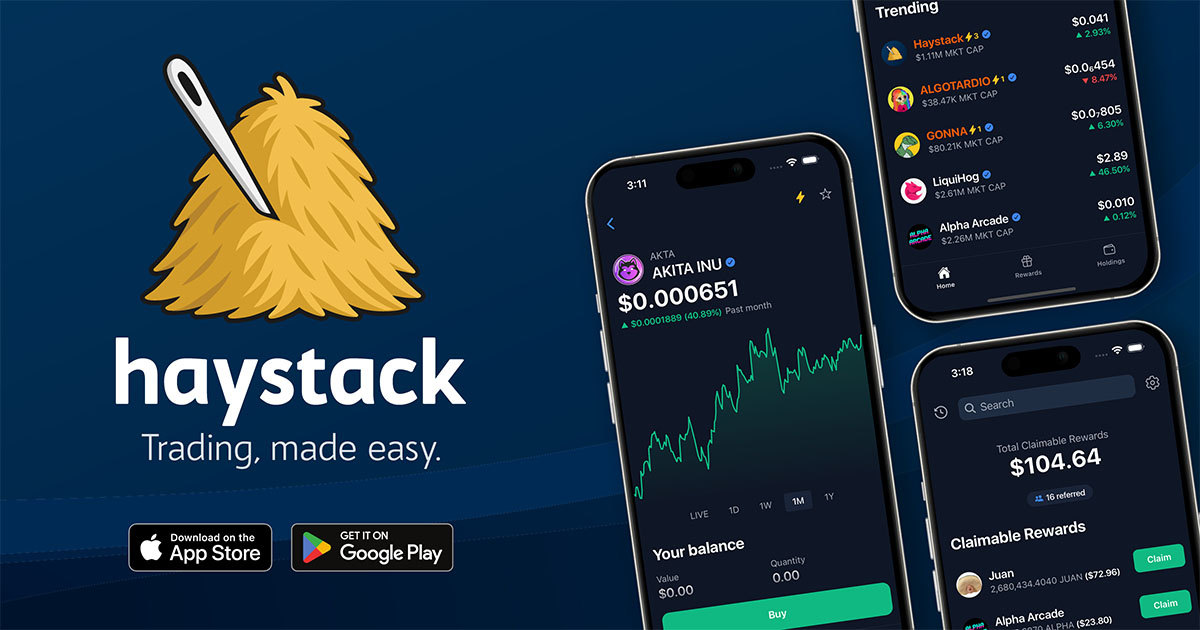
A trading terminal in your pocket
Most crypto users do their trading on a phone, yet Algorand's DeFi ecosystem grew up as a collection of desktop-first web apps — discovery on one site, swaps on an exchange, staking on yet another. Haystack, the mobile-first trading app from TxnLab, was built to collapse all of that into a single self-custody wallet. When it launched on iOS and Android in 2025, the first two tranches of its $HAY token sale sold out in under 10 minutes each, according to the Algorand Foundation's 2025 year-end recap. The product now runs as both a phone app and a companion web interface at hay.app, bundling token discovery, router-powered swaps, staking, a launchpad, and player-versus-player price markets into one screen.
The app is deliberately frictionless at the front door. Users sign in with a Google or Apple account through Web3Auth, a decentralized identity service whose multi-party computation splits the wallet's key across parties instead of handing the user a seed phrase; the wallet stays non-custodial and the key can be exported at any time. The tradeoff behind that convenience deserves naming up front: key recovery depends on a third-party MPC infrastructure, and TxnLab's own whitepaper lists reliance on Web3Auth as an operational risk. Fiat moves in via credit card, Apple Pay, or a Coinbase account, cash can be withdrawn back to Coinbase, and NFDomains integration lets an address display as a human-readable name like 'sal.algo' instead of a 58-character string.
Built by the team behind NFDomains
Haystack is the consumer face of TxnLab Inc., an Algorand infrastructure shop founded in 2021 that already operates several layers beneath it: NFDomains, the .algo naming service with 68,000-plus domains registered; Réti Pooling, a staking protocol that reports securing 450M+ ALGO across 50+ validators; and use-wallet, a wallet-connection package the company calls the most adopted on the chain. In July 2025 TxnLab acquired Deflex — the order router originally built by the teams behind the Defly wallet and Alammex — rebranded it as the Haystack Router, and made it the execution engine inside its own app.
The app's core surfaces:
| Concept | Real-World Implication |
|---|---|
| Screener with live rankings | Ranks assets by total value locked (TVL — the dollar sum of deposits sitting in a protocol's pools), volume, and 24-hour movement, so a newcomer sees what is actually trading instead of guessing what to buy |
| Router-powered swaps | One swap form quotes the best executable price across Algorand's fragmented liquidity, then settles the entire route in a single transaction |
| Staking | HAY holders stake into a rewards pool denominated in HAY and USDC; current participation and rates are detailed in their own section below |
| PvP markets | A surface for betting on an asset's price direction against a deadline; the shared-pool mechanics are explained below |
| HayLaunch | A launchpad where new Algorand Standard Assets (ASAs — tokens issued natively on Algorand's base layer) run public token sales — the same mechanism that sold $HAY itself |
| Auto Yield | An automation, added in January 2026 per the Foundation's January report, that opens yield positions automatically whenever a user buys, sells, sends, or receives assets |
The iOS build carries 41 ratings averaging 5.0 on the App Store, and its v2.1.4 release notes (April 2026) introduced PvP Markets. The listing also carries a disclosure worth quoting: 'Haystack is a visual interface to decentralized exchanges on Algorand and does not exchange, develop, create, maintain, or endorse any digital asset.'
The router underneath
The swap box is the product's most consequential piece. Algorand's trading liquidity is spread across several automated market makers — protocols that price tokens algorithmically from pooled reserves rather than matching buyers and sellers — and each pool prices assets slightly differently. Rather than quoting a single exchange, the Haystack Router computes a route that can split an order across pools and hop through intermediate tokens, then settles the whole path as one atomic transaction group in a single block. Its documentation describes roughly 1-2 second quotes, fixed-output swaps even on DEXs that lack native support, and a single aggregated slippage check on the final output. It charges a default fee of 10 basis points on the output, split 75% to the protocol and 25% to whoever referred the user.
The router's lineage carries caveats this publication has previously documented. The original contract was audited by Vantage Point, but both audits predate TxnLab's acquisition and nothing in the docs indicates the current V2.2 contract was re-audited after the change of control. The inherited Deflex limit-order protocol is also switched off — 'limit orders are currently disabled and no longer supported' — its on-chain registry preserving 2,407 filled and 7,853 cancelled orders as history rather than current functionality. Development is nonetheless active: the haystack-js SDK shipped v2.0.5 in February 2026 and receives regular commits, and the Foundation's June 2026 ecosystem report records that Akita integrated Haystack's router into its own app — the router is infrastructure beyond the one consumer front end.
The $HAY token and its economics
HAY is Algorand Standard Asset 3160000000, a 100-million-token utility asset created by treasury.haystack.algo with no freeze or clawback roles set on the chain. The whitepaper priced the initial fully-diluted valuation at $2 million and sold 30% of supply publicly in three tranches beginning September 3, 2025 — at $0.02, $0.04, and $0.06, with one-week cooldowns between them — and no private sale.
Chart: HAY token allocation (100M total supply)
The allocation behind that public sale:
| Concept | Real-World Implication |
|---|---|
| Community pool — 35M HAY (35%) | Long-term incentives, rewards and airdrops, released gradually over a 10+ year schedule |
| Public sale — 30M HAY (30%) | Three transparent on-chain tranches at rising prices; tokens available immediately on purchase |
| Team — 20M HAY (20%) | 12-month cliff, then 24 months of linear vesting |
| Liquidity — 10M HAY (10%) | DEX and CEX market-making reserves |
| Marketing — 5M HAY (5%) | Growth initiatives and partnerships |
The token's utility is built around holding it. Holdings buy trading-fee discounts on a sliding scale — $10 in HAY earns 5% off, $100 earns 10%, $1,000 earns 25%, $10,000 earns 50% — and gate access to staking pools, airdrops ('Haydrops'), and PvP fee discounts. Platform trading fees are themselves tiered by trade size before any HAY discount applies:
| Trade size (USD) | Base fee |
|---|---|
| $0 – $24.99 | 1.00% |
| $25 – $249.99 | 0.85% |
| $250 – $2,499.99 | 0.75% |
| $2,500+ | 0.50% |
The whitepaper also promises that 25% of all platform fees (Haystack and router combined) are programmatically applied to daily $HAY purchases and permanent burning. On-chain inspection today shows Algorand's standard burn address holding zero HAY, so no buy-and-burn has flowed to that address so far — the mechanism is documented, not yet observable.
Current state on the app's own asset page: a price around $0.007, roughly 1,000 holders, 29.3 million tokens circulating, about $99K in total liquidity, and a market cap near $206K against a fully-diluted value near $702K — well below the $2 million initial FDV. The creator treasury still holds 8.25% of supply, and the next-largest single account holds about 4.9 million HAY. In the same token-economics vein, a governance vote opened August 19, 2026 on the DorkFi lending platform asks UNIT holders whether to raise the collateral supply cap it applies to HAY — one of four cap-lifting proposals covering ALPHA, wBTC, HAY and HOG — with the voting window closing in roughly a week.
Staking and the pools page
The staking product takes the same token and puts it to work: 19.61 million HAY — 20.63% of total supply and 66.9% of circulating supply — is currently staked, earning a net APR of 4.63% paid in HAY and USDC (3.75% average). Rewards drip continuously: the page shows 0.000202 USDC and 0.000495 HAY per second accruing to the reward pools. The pools directory ranks hundreds of Tinyman liquidity pools across 342 pages, with the USDC/ALGO pool at $1.86M TVL leading the list and the HAY/USDC pool at $70.7K TVL offering a 12.58% total APY, most of it (10.86%) from a farming program.
PvP markets
PvP is Haystack's most unusual surface — a prediction market where anyone can open a market on whether an asset's price rises or falls before a deadline, then take a side. Per the in-app explainer, all deposits go into a shared pool; entrants deposit USDC, which converts into shares (1:1 for the first 10% of the pool, decaying to 0.02x by expiry); a 2.00% fee is taken at entry, split 1.90% to the protocol and 0.10% to the market creator; winners get their deposit back net of fee plus a cut of the losing side; and cancelled markets refund the net deposit but not the fee. Categories span Crypto, ASAs, Stocks, Commodities and Exotics. As of this writing the market list is empty — 'No active markets. Be the first to create a PvP market.' — so this is live infrastructure awaiting its first position; the Foundation's April 2026 report notes that leaderboard and PnL tracking were added to it.
Whose incentives are these?
A fair reading has to name the alignment problem built into the token design. Every HAY utility — the fee-discount tiers, staking rewards, Haydrop access, PvP fee discounts — financially rewards holding the same token the company sells on its own launchpad and still retains through its treasury. The 'fair launch' framing is accurate as far as it goes: there was no private sale, and the public tranches sold out in minutes. But 'no private sale' is not the same as no insider allocation — the team is entitled to 20% of supply after the 12-month cliff, the treasury holds 8.25% today, and the burn the tokenomics promise is not yet visible on-chain. Add the router caveats from earlier (pre-acquisition audits, limit orders switched off) and the current emptiness of the PvP board, and the honest summary is a mature infrastructure team shipping a genuinely mobile-native product with real but early traction — about 1,000 HAY holders, roughly $370 in daily volume on its own asset page, zero active PvP markets — rather than a finished network effect.
None of that makes the project static. NFDomains and Réti already operate at ecosystem scale, the router has at least one integration beyond Haystack itself, the SDK is under active development, and the launchpad has demonstrated a real ability to sell tokens. The gaps here are maturity gaps, not viability ones — and for a team with TxnLab's delivery record, that is the more interesting thing to watch.
Source
- Haystack
- Haystack Whitepaper
- Haystack Router docs
- haystack-js SDK
- Haystack Trading on the App Store
- Algorand Foundation: 2025 on Algorand — You shipped
- Algorand Foundation: January 2026 Algo Insights Report
- Algorand Foundation: June 2026 Algo Insights Report
- Haystack - Trading, made easy.
- Haystack - Trading, made easy.
- Haystack - Trading, made easy.
- Haystack Router
- Haystack - Trading, made easy.
- Introduction | Haystack Router
- Haystack | HAY — $0.0070
- Fees | Haystack Router
- Haystack - Trading, made easy.
- Haystack - Trading, made easy.
- Contracts | Haystack Router
- Haystack - Trading, made easy.
Source: https://hay.app/