AlgoChess settles staked chess games in ALGO on mainnet ahead of Sept. 20 token mine
AlgoChess is a browser chess site on Algorand MainNet where two players — or one player and Stockfish — stake ALGO that a contract pays to the winner. Its 20-million CHESS token, mined only by winning, opens 20 September with no sale and no premine.
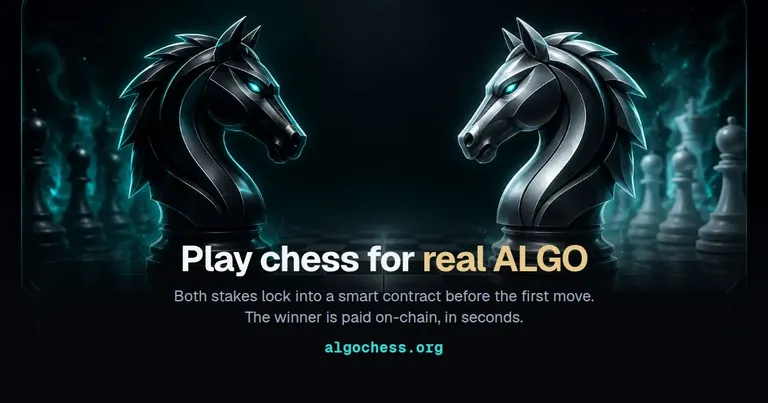
AlgoChess is a chess site where you play a normal blitz game against another person or against the Stockfish engine and can stake real ALGO on the result. Both stakes lock into an Algorand smart contract before the first move, and the contract pays the winner straight to their wallet: there is no site balance to cash out and no withdrawal request for anyone to approve.
Two things make it worth reading about this week. The two live contracts are on Algorand MainNet and the escrow does what the site says — the money sits in the contract rather than in an account the operator holds, and settlement pays the player's own wallet. And a token called CHESS opens for mining on 20 September: 20 million1 coins, no sale, no premine, and no way in except winning a staked game. AlgoChess2 is also new, small and unaudited, with no company name attached to it. That part is in here too.
What the board offers, and what each door costs
The app page3 lists five entries: play a human, beat Stockfish, challenge a friend with a link, a friendly game with no stake, and fifty historic mates to solve. Two of them take money.
| Concept | What it costs you | Real-world implication |
|---|---|---|
| Duel against another person | 1–2,000 ALGO, matched by your opponent4 | the winner takes 90% of the pot, so a 1 ALGO duel pays 1.8 ALGO5 |
| Game against Stockfish | 1–200 ALGO6 | pays your stake times a published multiplier set by the engine's rating gap, explained below |
| Friendly game against a person | nothing | no wallet, no rating change, no transaction on Algorand |
| Practice and the fifty legends | nothing | eight engine levels and fifty historic mates, no sign-up needed |
Sources: 4 algochess.org, 4 algochess.org, 4 algochess.org, 5 algochess.org +1
The clock options are 3, 5 or 107 minutes, the same blitz cadences you would play on a free site. Against the machine, the whole pricing system is one sentence — the further the engine sits above your level, the more a win pays — and it comes as four published steps.
| Concept | Multiplier | Real-world implication |
|---|---|---|
| Engine 200 rating points above you | ×2 | the closest fight on the ladder |
| Engine 300 points above you8 | ×3 | one step further up |
| Engine 400 points above you | ×5 | another step |
| Engine 500 points and up | ×10 | the long shot |
Source: 8 algochess.org
You are always shown two cards: the nearest engine above you at its ladder price, and the one after it, always at ×109. A new player rated 150010 sees SF4 at ×2 and SF5 at ×1011. Win, and the contract pays your stake times the multiplier in one block. Beating people never moves those prices — your machine level moves only on games against the machine, and every 30012 points the menu shifts one engine up. Ratings are Glicko-2, a system in the same family as the Elo numbers most players know, and the site says yours is 'recomputed from the full game history rather than stored as a number we could edit'. That describes how the number is derived, not who controls it: the computation runs on the operator's servers, so it is as editable as any stored value. What it does buy is that the same games always produce the same rating.
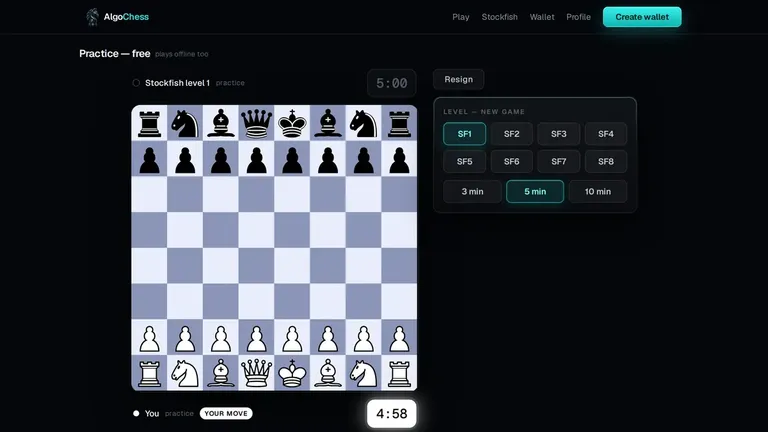
A session is quick to start. We opened the practice page13 and the board was already waiting, with SF1 to SF8 and 3, 5 or 1014 minute clocks; clicking SF2 changed the opponent in one click, and the page then flagged our move. The engine runs in the browser, so practice keeps working with the network cut.
A friendly game15 pairs you with the next person waiting on your clock, or makes a link you can send to anyone: whoever opens it takes black, and they need no account or app. Nothing is stored and nothing is scored, which the page notes is also why a free game cannot be used to move the odds you are offered elsewhere. The fifty legends16 are mates from Greco in 161917 to Carlsen at thirteen, played on a board that answers by itself; progress is kept on your device, which is why ours read 0 of 5018 solved.
The paid side is where the money is. On the duel page19 you pick a clock and a stake and create a game that waits for a taker; the machine challenge20 shows the two engine cards with their prices before you commit. Both were honest about how thin the queue is: the lobby read '6 games this week · 2 players · last one 2 days ago' and named its prime time as 9 pm New York.
To stake you need ALGO in a wallet, and the site will make you one in the browser. We did it on the wallet page21: it returned an address, a zero ALGO balance and a rating of 150022, in about ten seconds, with no app and no sign-up. The same page is blunt about what that wallet is — it lives only in that browser, clearing site data deletes it, the 2523 words are the only copy, and the browser may drop it if the device runs low on storage. The wallet library the site ships carries its own warning in the code: 'Persisting mnemonics to storage is insecure. Any private key mnemonics used should never hold real Algos (i.e., on MainNet). Use with caution!' That tells you how the wallet works — the key is generated and kept on your device, not by the operator — and the site's own copy says the wallet can vanish with the browser. Fund it by sending ALGO from any exchange, and your first staked game opts the wallet in to CHESS automatically, because an Algorand account has to opt in before it can hold an asset.
Why anyone would stake a chess game
Free chess is a solved problem, and the project's own free vs staked page24 says so: 'keep your Lichess account. Keep Chess.com too... Free platforms are the best thing that ever happened to chess.' Lichess25 and Chess.com26 will beat a new site at practice, and AlgoChess tells you to keep them for training and come here when you want the game to count. What it sells is the one thing a free platform cannot: a stake, and a payout that does not depend on someone deciding to honour it. The real-money page27 puts it plainly — 'the blockchain is the bank, not the board'.
The precedent for staked chess is not encouraging, and it is why anti-cheat decides whether this works. Immortal Game28 shut down its NFTs and play-to-earn features in December 2023 over cheating, its team writing that 'by offering large amounts of cash with no limit barrier to entry, we encouraged heavy cheating on the platform and degraded the user experience for our legitimate player base' — a failure reported at the time29 as the end of its ambition to let people earn an income from chess. AlgoChess's answer, per its FAQ30, is server-side analysis of every staked game — move accuracy, engine-agreement rate and move-timing patterns — with sustained engine-grade play freezing an account out of new staked games, stake limits that ramp up for new accounts, and wallets funded from the same source treated as one player. The tradeoff is in the site's own wording: settled money always follows the contract, so a cheater who has already been paid keeps the winnings and loses access instead. The analysis is also run by the operator, on the operator's servers.
Algorand's part in this is narrow and mechanical. Blocks finalise in about three seconds and a transaction costs a fraction of a cent, which is what makes paying out a single chess game practical rather than absurd: the settlement is one transaction in one block, with nothing to batch up. The chain's bigger chess story sits elsewhere — World Chess runs an Algorand-based loyalty programme called The Tower31, which tracks progress and rewards rather than staking money on a result.
What the contracts actually say
The live contracts are the ones the site links: EscrowDuel, app 36932525743233, for games between people, and HouseChallenge, app 36932527543435, for games against the machine. The house contract, the CHESS token and the distribution contract that feeds it were all created on the morning of 3 September. An earlier pair — an older duel contract and an older house contract — sits paused on-chain, so the deployment has already been replaced once since the domain was registered on 18 August 2026. The pages' own code talks only to mainnet hosts, with no testnet endpoint anywhere in it, which matches the site's mainnet label.
| Concept | What the contract says | Real-world implication |
|---|---|---|
| Duel stake range | 1 to 2,000 ALGO36 | the contract refuses anything outside it |
| Duel rake | 1,000 basis points | the same 10% the play page shows, written into the contract |
| Draw handling | the site says a draw refunds minus a 1% fee; the contract's drawFeeBps field reads 037 | a draw refunds in full if that field is the one that governs; every settlement note we read records a decisive game, so we could not watch one |
| Machine stake range | 1 to 200 ALGO38 | a tenth of a duel's ceiling |
| Payout ceiling | 20% of the reserve, plus a 1,000 ALGO daily cap | with 1,427 ALGO in the reserve, no single win can pay more than about 285 ALGO |
| Settlement window | 7,200 rounds | roughly five hours at the network's recent pace — the parameter behind the promise that a stranded stake can be reclaimed |
Sources: 36 algochess.org, 36 algochess.org, 36 algochess.org, 37 algochess.org
The duel contract's own account holds 0.5 ALGO, which is what a pass-through escrow looks like: stakes do not pile up anywhere, and the settlement transactions we read pay players directly out of the contract's account. Some carry a note recording the result, how the game ended — checkmate, timeout — and the whole move list, though not every settlement transaction has one.
The house contract is the funded side. Its account holds 1,427.42 ALGO, about $141 at ALGO's $0.0988 price on 9 September, and 1,424.90 of that arrived on 3 September in a single call from the project's admin address that emptied the older, now-paused house contract into the new one. That is the operator's money backing the machine payouts, not players' stakes, and the outstanding-payout counter reads zero. The ceiling and the odds meet at the top of the ladder: a 200 ALGO machine game won at ×10 implies a 2,000 ALGO payout, which the 285 ALGO ceiling cannot cover, so the largest stake the ×10 price can fully honour is about 28 ALGO, well under the contract's own maximum. Whether the contract refuses a stake that large or simply pays less is not something its published parameters say. The site discloses the ceiling and describes the reserve as what the house can lose.
Both live contracts have one admin address, which is also the treasury and the owner of the algochess.algo39 name — an identity anchored to a verified @algochess account on X — plus a separate oracle address, funded by the deployer, that signs results. That is the trust line worth understanding: the chain enforces the payout rule, but it does not judge the position, so a server the operator runs still decides who won. Beyond the pause flag, the admin's powers are not published, and neither is the contract source — which matters for the constants above, since we cannot tell from the state we can read whether the admin could change a fee or a stake limit. There is no audit that a search turns up, no public repository (a GitHub search for AlgoChess returns unrelated university coursework), no terms or about page and no company name, so the operation is identified mainly by that name-linked wallet. Searching the name also still surfaces an older project at algochess.xyz, described in a 2022 post as an NFT chess game with a pieces marketplace; nothing we found connects it to this site, and the current pages say nothing about NFTs.
The CHESS token and the 20 September opening
CHESS is an Algorand standard asset — the chain's built-in way to issue a token without writing a separate contract — and the one linked from the token page40 has a fixed supply of 20,000,00041 with six decimal places. Its manager, freeze and clawback fields are all set to Algorand's zero address, which disables them: nobody can mint more, freeze a balance or claw coins back. That is a checkable version of the promise that the supply never grows, and it is the kind of guarantee a holder can verify without trusting anyone.
The whole supply sits in the escrow account of the distribution contract, app 369325299542, and that same address is the only account the indexer returned with a nonzero CHESS balance; the two other addresses we saw had opted in and held nothing. The distribution contract publishes six values and no admin or pause key: the asset id, the pool remaining, the epoch, the two game contracts it serves, and an opening timestamp. That timestamp is 20 September at 17:00 UTC, matching the countdown on the site. The pool reserved for the first epoch already reads 10,000,00043 CHESS on-chain — half the supply, which is the site's framing of the first of twenty masters, al-Suli, holding half of everything, with Fischer's epoch last. The rules as published: playing is the only mine, every decisive staked game mines whether it is a duel or a machine game, draws mine nothing, and there is no sale, no airdrop and no team pool. The first epoch mines 144 CHESS per ALGO staked, each later epoch holds half as many coins and mines half as much, and an epoch ends when its pool empties rather than on a calendar. CHESS is not listed on Tinyman or Pact, which matches the claim that it is not sold anywhere. Another contract from the same deployer, app 3693253424, is set up around the CHESS asset with a 5% fee and has never been used — its escrow counter reads zero and its duel counter 1 — so CHESS-staked play has not begun.
You can start without a wallet today: open the practice page and play an engine level, or take a free friendly game against whoever is waiting. When you want the game to count, create the browser wallet, fund it with ALGO and post from 1 ALGO. Check first that staked play is permitted where you live, which the legal page45 asks you to do, noting that the machine challenge looks more like a wager against the operator than a duel between two people does. The next thing to watch is the date already written into that distribution contract: on 20 September the mine opens and the first CHESS becomes minable.
25 figures in this story are checked.See every check
Sources
- 2AlgoChess algochess.org↩
- 3app page algochess.org↩
- 13practice page algochess.org↩
- 15friendly game algochess.org↩
- 16fifty legends algochess.org↩
- 19duel page algochess.org↩
- 20machine challenge algochess.org↩
- 21wallet page algochess.org↩
- 24free vs staked page algochess.org↩
- 25Lichess lichess.org↩
- 26chess.com chess.com↩
- 27real-money page algochess.org↩
- 28Immortal Game ditches chess NFTs and crypto token over heavy cheating, Decrypt decrypt.co↩
- 29Web3 chess game developer shutters play-to-earn due to heavy cheating, Cointelegraph cointelegraph.com↩
- 30FAQ algochess.org↩
- 31The Tower from World Chess, Algorand Foundation algorand.co↩
- 323693252574 allo.info↩
- 343693252754 allo.info↩
- 39algochess.algo on NFDomains app.nf.domains↩
- 40The CHESS token algochess.org↩
- 45legal page algochess.org↩
Further sources (12)
- Legend of the day #4: White to play and win algochess.org
- AlgoChess — play chess for real ALGO algochess.org
- mainnet-idx.algonode.cloud/v2/accounts/WULONDKUYGWKID2XSZEGOURROQ76KL24XCJKLKUK34NS4P5HT7VSEHOXEI/transactions mainnet-idx.algonode.cloud
- mainnet-idx.algonode.cloud/v2/accounts/WULONDKUYGWKID2XSZEGOURROQ76KL24XCJKLKUK34NS4P5HT7VSEHOXEI mainnet-idx.algonode.cloud
- mainnet-idx.algonode.cloud/v2/accounts/K4THEIQYKNHQSJ4WDZNPDBUXXWJIPXXQOMSAVDN5I2ONNMZCDKCZPUQNMM mainnet-idx.algonode.cloud
- AlgoChess — play chess for real ALGO algochess.org
- mainnet-idx.algonode.cloud/v2/accounts/J4GI4GNYJ2GTLLLAZ5KNCOT55RKZ5D7HCTQV6F62WARH754KTXN2BGYOMY/transactions mainnet-idx.algonode.cloud
- mainnet-idx.algonode.cloud/v2/applications/3693252754 mainnet-idx.algonode.cloud
- mainnet-idx.algonode.cloud/v2/assets/3693253069 mainnet-idx.algonode.cloud
- mainnet-idx.algonode.cloud/v2/accounts/N5WSOMIPO2APE7EEXGE3MMDM3V5WGRUCQUYUFS2LX4GKGLFVPLUJTZHUGA/transactions mainnet-idx.algonode.cloud
- mainnet-idx.algonode.cloud/v2/transactions/B7CQGKQ3I44JBWBXV4LNTYEHAYNTQ6BI42LHKJDOC6GFPZTS2LHA mainnet-idx.algonode.cloud
- mainnet-idx.algonode.cloud/v2/transactions/4REGKBSQ4M7SEQ56WGDIWFBRRU4V7LUTGU7RT36LPR5ZXSPFZUTA mainnet-idx.algonode.cloud