SubQuery winds down its decentralised network to bet on a plain-English AI query app

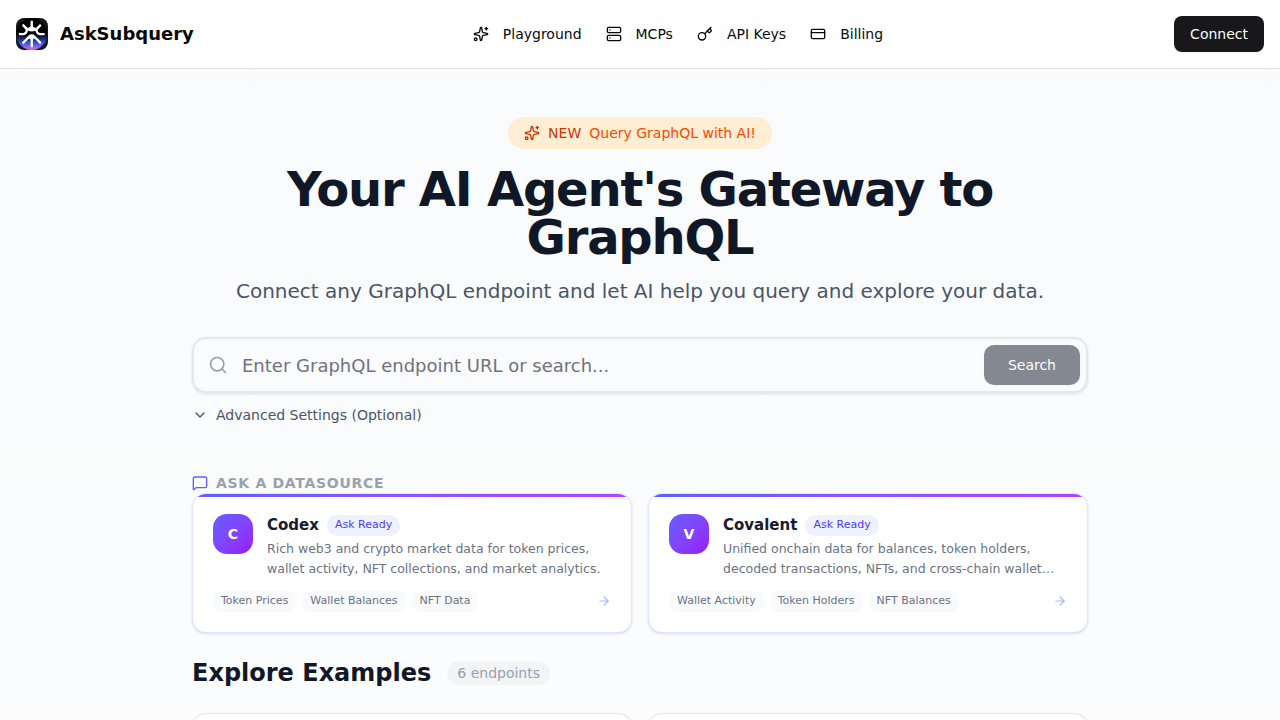
AskSubQuery is a website where you type a question about blockchain data in plain English — 'What are the top 5 tokens by TVL on Uniswap?', 'What is the current floor price and liquidity for the Bored Ape Yacht Club collection on Ethereum?' — and an AI writes the GraphQL query, runs it against a data provider and hands back the answer. GraphQL is the query language most blockchain data services speak; the point of AskSubQuery is that you never have to learn it.
It is the front end of a pivot. SubQuery, the Singapore-headquartered data infrastructure company behind the site, said on 19 May 2026 that it is winding down the decentralised network it launched in 2024 — the network whose token sale sold more than $5 million of SQT in under two hours to 3,964 buyers — and that asksubquery.xyz is where it is going instead. That makes this small AI tool the surviving public face of a company that spent four years building blockchain indexing infrastructure.
What AskSubQuery looks like when you open it
The home screen is a text box with a 'Start Asking' button, sitting above a panel headed 'Ask a datasource' where the endpoints are already wired up. Each card carries an 'Ask Ready' badge: Uniswap, ENS, The Graph's core subgraph on Arbitrum One, market and wallet data from Codex and Covalent, Creator.Bid, and SubQuery Network itself. The tool first opened in closed beta on 8 December 2025, when a beta code was needed to get in, and the example pages are now open to anyone with a browser.
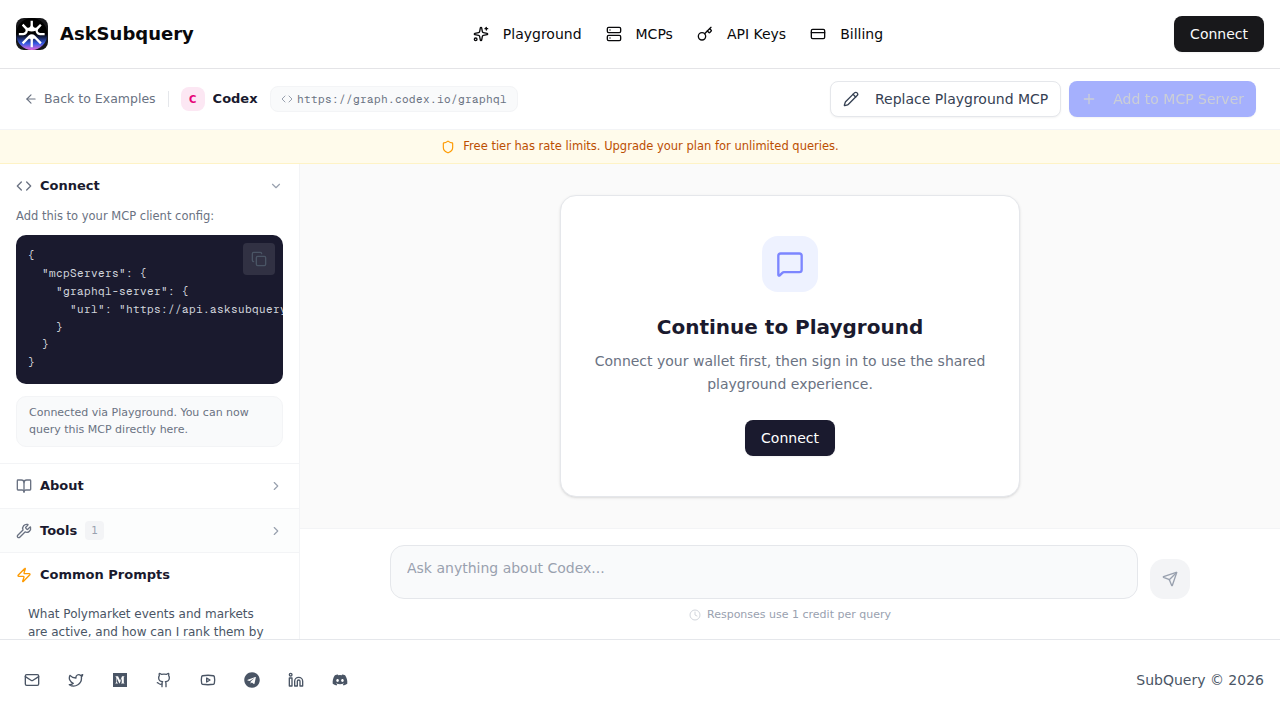
Clicking one of those cards opens a playground for that endpoint, and the Codex page is the clearest look at how the product is meant to be used. Its address carries an MCP server endpoint, and the page prints a config snippet to paste into an AI client: an MCP server at api.asksubquery.xyz, with the datasource's GraphQL endpoint as a parameter. MCP — the Model Context Protocol — is an open standard that lets an AI assistant call outside tools; here the tool is a GraphQL service. Put that line into a chat client and the assistant can answer the questions the Codex dataset supports, including realised profit and win rate for a wallet address, the floor price and liquidity of a collection, and which Polymarket markets have the highest open interest.
What it costs, and where the gate is
Two ways to pay are advertised: developers pay as they go with a credit card, and holders of SubQuery's SQT token get free daily queries. Each response uses one credit.
The playground itself is gated — 'Connect your wallet first, then sign in to use the shared playground experience.' The picker offers MetaMask, Coinbase Wallet, WalletConnect, Talisman and Rainbow, and the page's code contacts mainnet.base.org, Base's public mainnet RPC, so this is a real EVM wallet connection rather than a testnet sandbox. Without one you can read the prompt library and the MCP configuration but not ask a question. A direct request to the Codex MCP endpoint returned a live status response on 17 September 2026.
One detail is worth knowing before you pay: SubQuery's own documentation for the GraphQL Agent still labels the paid service as coming soon, with subscription tiers and payment methods listed as planned.
The indexer SubQuery is retiring
SubQuery's original product was an open-source indexer — a service that organises and indexes blockchain data so applications can search it quickly, reading a chain block by block and writing the results into a database you query with GraphQL. It is the layer between a chain and a dashboard, and building it yourself is slow enough that most teams rent one instead. SubQuery's networks page lists 304 supported chains, and the company markets the indexer as running 3.9 times faster than The Graph. It also ships a subgraph-compatible query service, so a team can move an existing subgraph across without immediately rewriting the app that reads it.
| Concept | Real-World Implication |
|---|---|
| EVM — 196 networks | One project can cover Ethereum-style chains, including Base and BNB Chain |
| Polkadot — 50 networks | Parachain data indexed the same way as everything else |
| Cosmos — 48 networks | Zone data, including IBC transfers between chains |
| Stellar (3), NEAR (2), Concordium (2) | Smaller ecosystems that rarely get a dedicated indexing tool |
| Algorand, Solana, Starknet — 1 each | Supported, with a single integration and one quick-start guide apiece |
Algorand is one of those single integrations. The quick-start guide walks through indexing every transfer of the PLANET token, and the Algorand starter project on GitHub has one star, one fork, and was last touched on 31 January 2025. The Algorand types package behind it is downloaded about 2,500 times a month.
Algorand developers who want a free public data API already have one in Nodely, which this paper has described as answering more than 115 million requests a day.
What the wind-down means if you ran something on it
What the wind-down means in practice is in SubQuery's own documentation: 'SubQuery Managed Service has become the OnFinality Indexer Service.' The May post points teams at managed hosting from OnFinality, which is offering three months free to paying customers switching off the network, at private deals with node operators, or at self-hosting the open-source indexer.
The indexer itself is still being worked on — the SDK's node package shipped a release on 1 April 2026 fixing a SQL injection issue in how it appends dynamic datasources — and SubQuery's published case studies name teams running it: the derivatives exchange Fufuture, whose multi-chain dashboard runs on five SubQuery indexers, and OpenZeppelin, which built client-side access control across more than 30 chains on SubQuery's data layer.
If you have SQT staked
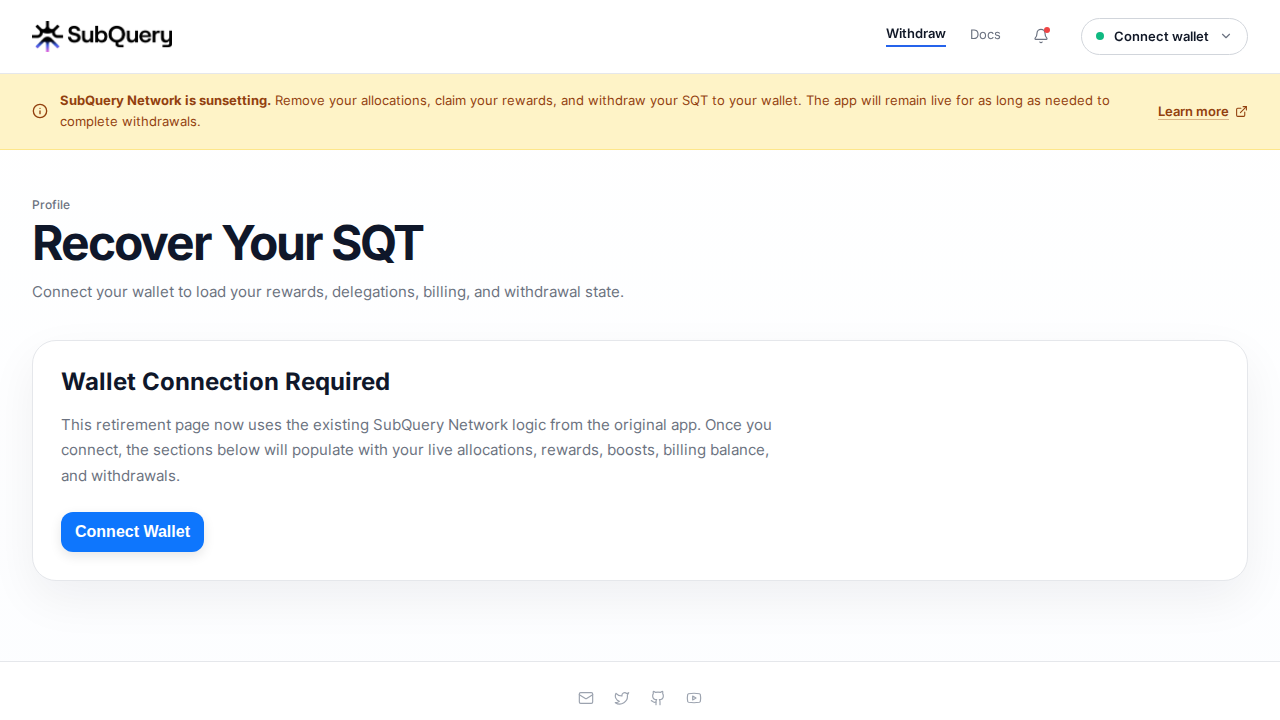
One number matters and SubQuery's pages disagree about it. The network's current parameters page still lists a 14-day unlock period and a 0.1% unstake fee, while the wind-down announcement says unbonding is instant, with no fees and no locking period. The app that app.subquery.network now resolves to describes itself as a retirement page and shows your live withdrawal state once you connect a wallet.
The April 2026 exploit, and the fix
On 12 April 2026, five transactions drained 382,433,441 SQT — about $134,000 at the time — from SubQuery Network contracts on Base. The cause, per SubQuery's own disclosure, was a missing onlyOwner check on a function called setContractAddress() in the contract that stores which addresses the protocol trusts for roles such as StakingManager and RewardsDistributor. Anyone could call it.
An independent trace by DARKNAVY shows what that permitted: the attacker pointed both roles at a helper contract of their own, used the RewardsDistributor slot to open an unbond request against the Staking contract's entire liquid balance, withdrew it, restored the original addresses before the transaction ended, and let the attacker's contracts self-destruct.
DARKNAVY puts the Staking drain at 218.29 million SQT, about $131,200. No private keys were taken, and SubQuery says 272 individual staker and delegator wallets and the deployment boosters were also hit.
The fix — onlyOwner added to setContractAddress() and to the batch version beside it — is in the public contract source, alongside what the contract's owner can still do: repoint those role addresses and blacklist wallets. SubQuery said it would make every affected user whole with automatic on-chain credits beginning 14 April and finishing no later than 15 April; our search found no later confirmation that the distribution completed.
What SQT is worth now
SQT changed hands at about $0.0000095 on 17 September 2026, according to CoinGecko, with a market capitalisation near $35,900 and 24-hour volume near $76.
Ethplorer counts 3,952 holders of the Ethereum-mainnet token, where the largest single address holds 43.6% of supply. The token's original job — the medium of exchange between data consumers and the network's node operators — is being retired along with the network it paid for.
Chart: SQT price (USD), March–September 2026
The economics behind that price are worth knowing if you hold any. In December 2025 SubQuery's CTO wrote that the network ran a 1% annual inflation rate, producing more than 100 million new SQT a year, about 70% of it undistributed and so creating what he called 'silent dilution' for holders, and said a Tokenomics 2.0 proposal would fix supply at 10.2 billion SQT and permanently disable minting by setting the Ethereum mainnet contract's minter to the zero address. The parameters page, updated in April 2026, still lists a 1.2% network inflation rate, and we could not read the token contract's minter directly to check whether minting is off.
What happened to the Hermes subnet
SubQuery began 2026 by launching Hermes, a subnet on Bittensor — Subnet 82 — that trains and scores AI agents for querying blockchain data through GraphQL, with AskSubQuery as the interface on top. 'Hermes is the engine. AskSubQuery is the car,' the company wrote in January.
Whether Subnet 82 is still SubQuery's is unclear: the Bittensor explorer taostats renders netuid 82 as 'Compelle', a separate compelle-validator repository has commits through 27 August 2026, a hermes-subnet repository has had no commits since 9 April 2026, the hermes-subnet.ai site no longer resolves, and SubQuery's own Hermes documentation page says only 'Coming Soon' while a marketing page for it is still live. On Bittensor, a subnet that loses its slot is deregistered and its alpha tokens are swapped back to TAO for holders. Whether Hermes was renamed, sold or deregistered, we could not establish.
What is next
The 2026 roadmap names two things for AskSubQuery: clearer subscription plans with transparent billing, and a public showcase of an integration with Manus. Neither carries a date, and the roadmap's stated goal is to 'convert the strength of our infrastructure into scalable, monetizable intelligence'.
Until the paid tiers ship, everything a curious reader can do is on the free side: the example pages list their prompt libraries and their MCP addresses before you connect anything, so the cheapest first step is to open one, read what it answers, and only then decide whether to hand over a wallet.
Source
- SubQuery
- AskSubQuery
- The Next Chapter for SubQuery
- SubQuery Network security incident: full disclosure and recovery plan
- DARKNAVY's trace of the Settings access-control drain
- Current network parameters
- SubQuery GraphQL Agent documentation
- Supported networks
- Algorand quick start
- SubQuery 2026 roadmap
- Tokenomics 2.0: a letter from the CTO
- Ask SubQuery
- About SubQuery | Web3 Infrastructure Team and Mission
- Ask SubQuery
- Blockchain Indexer List for Mainnet & Testnet | Public Data Endpoints
- Ask SubQuery
- Ask SubQuery
- Our 2026 Roadmap: Scaling SubQuery With Purpose | SubQuery Blog
- SubQuery Algorand Data Indexer
- SubQuery Network Security Incident: Full Disclosure and Recovery Plan
- defillama.com
- The Next Chapter for SubQuery
- Introduction | SubQuery Documentation
Source: https://subquery.network/