Gora's staking videos still point at gora.fi, a domain that expired on Sept. 14
Gora is a network of independently operated computers that run an application's code off the blockchain, agree among themselves on what that code returned, and sign the answer so a smart contract or a wallet can act on it. It began on Algorand in 2023 as a price-feed oracle called Goracle and now sells itself to people building AI agents — the kind of program that observes, decides and acts without anyone pressing a button. Its testnet — a test network, where assets carry no monetary value — is live, and the part of it a non-developer can use today is a fund you open in a browser and watch make trading decisions. The project's own staking tutorials, meanwhile, still send holders to a domain that no longer answers.
The app you can open in a browser today
Gora Trading Bot is an AI fund on the testnet. You open it, watch it decide, and deposit GORA — the project's token — to receive shares at the fund's current net asset value, or NAV: the price of one share, and therefore the rate your deposit buys at.
| Readout | What the page says | What it means for you |
|---|---|---|
| Fund NAV | 1.0266 GORA per share, up 2.66% over 48 steps | The price of a share, and the rate a deposit or a withdrawal settles at |
| Assets under management | 25.7k GORA | Tokens that came out of the network's faucet |
| Depositors | 40 | How many wallets have taken a share of the strategy |
| Steps | 48 | Decision rounds, each one logged separately below |
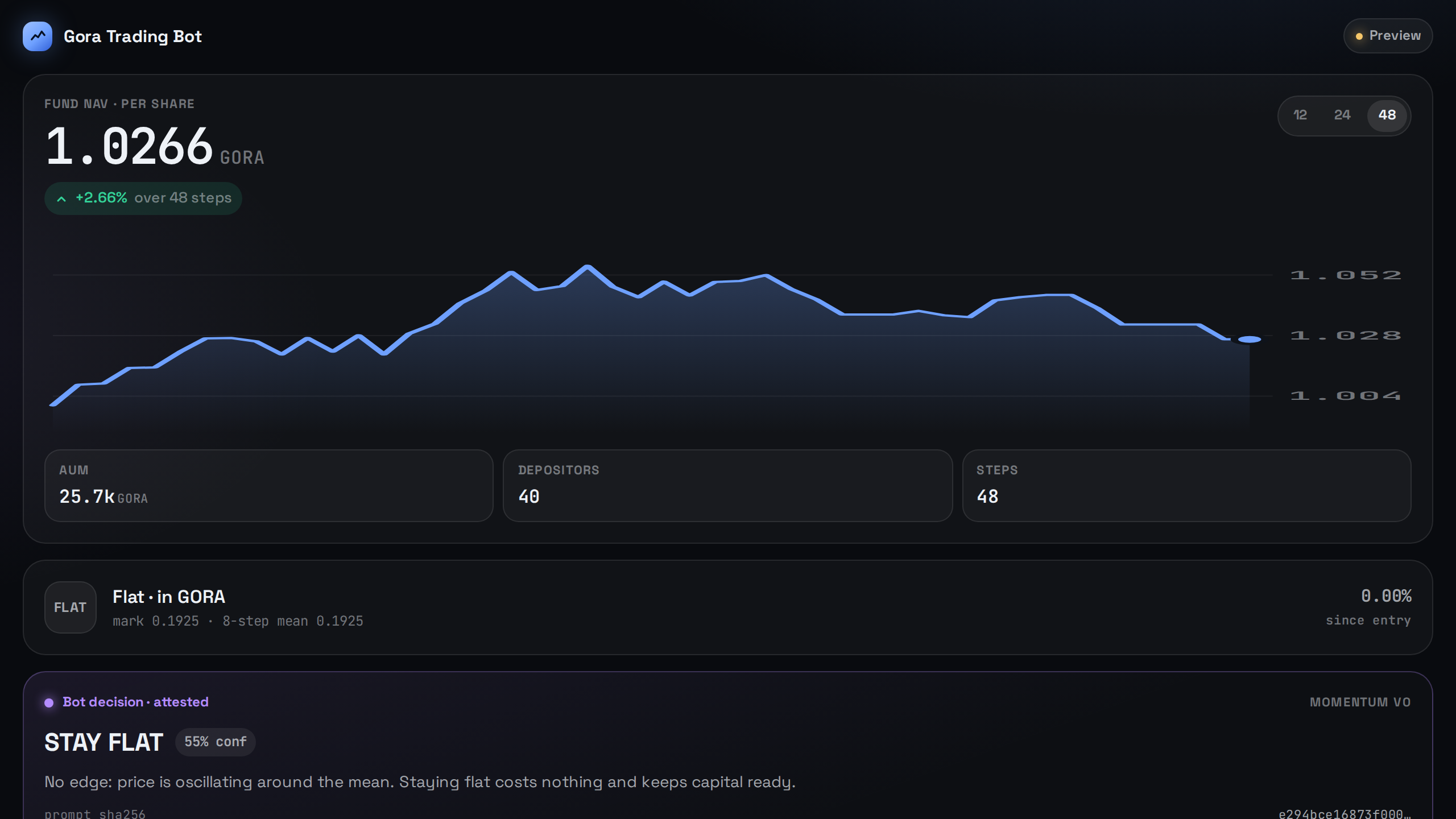
Below the figures sits the live decision. The strategy is MOMENTUM V0, the call is STAY FLAT at 55% confidence, and the reasoning is printed as a sentence rather than hidden: 'No edge: price is oscillating around the mean. Staying flat costs nothing and keeps capital ready.' Two truncated SHA-256 hashes follow — one for the prompt the model received, one for its response — and the inference is attributed to 'Gora validators (P1)'. A hash is a short fingerprint of a message: publish it and anyone holding the original can check that the two match, which is what makes the prompt and the answer checkable later.
Every entry in the decision log beneath carries its own pair of hashes and an 'attested' tag, and one of them records a depositor joining with 1,250.00 GORA and shares minted at a NAV of 1.0142. A button invites you to run a strategy step yourself and watch the log take it. Deposits settle at the current NAV, withdrawals are available any time with no lockup, and the GORA comes from a faucet the same bridge exposes for Algorand. A published manifest for the app says who pays for what: the Gora node does not hold user keys and does not cover a user's gas, leaving the depositor — or an account they pre-approve on-chain — as the default fee payer.
Deploying your own app takes one line and no signup
The same network is open to developers. The docs state the mechanism in one sentence: 'Gora runs your app code off-chain, produces a committee-attested result, and gives wallets or contracts the information they need to act on-chain.' You install a command-line tool with a single curl command, add it to your path, and point it at the public testnet endpoint — a bare IP address under a free nip.io wildcard hostname rather than a named domain. There is no signup, no GORA to buy and no local blockchain to run: the docs state that no virtual machine, no local chain stack and no tunnels are required. Your identity on that testnet is a developer token you invent, any string you like, and the first token to deploy an app id owns it — only that token can upgrade it, so nobody else can overwrite your work.
| Part of a Gora app | What it is | What it does for you |
|---|---|---|
| Off-chain app | JavaScript, TypeScript, Python or WebAssembly code that returns JSON | The decision itself, and the code the validators run |
| Manifest | Describes the app id, the compiled artifact, its capabilities and its contracts | Tells the network what it is running and what it may bind to |
| Policy | Allowed actions, chains, per-transaction and per-day limits, payment rules | The bound on what a buggy app could do |
| HTML UI, chain contract, mobile approval | Optional parts | Let a person review and sign an action, or let a contract store and check the result |
The policy is the part worth knowing about, because it is what limits the damage a buggy app could do: which chains it may touch, which actions it may request, how much it may move per transaction and per day, and which recipients it may pay. An app returns JSON — an instruction, not a transfer — and the docs are explicit that app code 'must not hold private keys or sign transactions directly'. When something needs to move value, the request goes to a phone for review; 'Neither flow gives Gora the user's private key.' The examples page carries one reference app, a raffle, and the docs' own rule for building more is that app logic stays outside the Gora node.
What Gora is, and why it is aimed at agents now
An oracle is a service that fetches facts a blockchain cannot produce for itself — a price, a weather reading, a match result — and delivers them to the smart contract that needs them. That was Gora's original business as Goracle, and the traces are everywhere: its GORA token has traded on Algorand since 2023 as ASA 1138500612, 100 million of it, verified on Tinyman and added to Pera Wallet. Algorand Ventures' investment was reported in January 2024; a June 2026 profile puts the company's funding at $1.5 million from Algorand and Borderless Capital against 12 active competitors; and an ERC-20 version of the token went live on Ethereum in April 2024. Last year the project said it had joined the Mastercard Sandbox as a service and was providing the oracle infrastructure behind Bookie AI, an AI-run sportsbook on Base — its own announcements, not anything this research could independently confirm. Not everyone here was a fan: a 2023 Algorand forum thread used Gora as the worked example of how the network's governance rewards were out-competing the projects building on top of it.
What the website sells today is a different thing. Its journal has exactly one entry, dated April 20, titled 'The network built for agents', arguing that programs which observe, decide and act without a person pressing a button are outgrowing infrastructure built for apps and need execution the people affected can verify — 'not because someone said so, but because the execution is independently verifiable'.
The mechanism is not a chain of its own, and the docs say so plainly: 'The Gora network is not a blockchain — it agrees on app outcomes and writes attestations to whichever chain the result targets.' Anyone who stakes GORA can run a validator, staking on whichever of three chains they already use, and their total across all three is their voting weight.
| Entry chain | Where the stake sits | What that means for a validator |
|---|---|---|
| Solana | a gora-staking Solana program | Stake GORA you already hold there; sign with a Solana ed25519 wallet |
| Base | a GoraValidatorStaking contract | Sign with a Base secp256k1 account |
| Algorand | a gora-staking Algorand app | Sign with an Algorand ed25519 wallet |
Each round picks a small committee from the active validators; the committee runs the app, agrees on a result and signs it; anyone holding the validators' public keys can check those signatures, on-chain or off. On Algorand that check is built into the virtual machine: the testnet gateway app files each request in its own box and verifies the committee's signatures with ed25519verify_bare, so a contract can reject an answer that arrives without them. A validator carries two keys — an owner key kept cold for staking and registration, and a hot participation key inside the validator process that signs its votes and the round's randomness. That randomness comes from a verifiable random function, which takes a validator's secret key and an input and produces an output that looks random but is fixed by those two things: anyone with the validator's public key can confirm the output was computed from that key, and the output cannot be swapped for a different value once it has been published. Drawing committees from those outputs is what keeps the selection out of the operators' hands. The bridge's own staking configuration for the testnet sets a minimum stake of 100 GORA with a one-hour unbond delay and lists five funded test wallets, each minted 1,000 GORA; it also declares chain id 31337 — the identifier Hardhat, a local development chain, uses — beside an RPC address for Base Sepolia, which is a fair measure of how much of this is rehearsal.
Old Gora is still online beside the new one
The older oracle business runs a dashboard of its own, and walking its pages is the fastest way to see which parts of Gora are current.
| Page | What it holds today |
|---|---|
| Dashboard | Active Nodes 159, Total Gora Staked 14,720,015, and a Current Rate of Return tile reading 10% |
| Feeds and price beacons | Price beacons plus DeFi, sports, weather, flight, NFT and credit-score categories; 49 price entries, each dated Sept. 16, 2026 |
| Vesting portal | Three claim categories — token sale, incentivized testnet, initial locked tokens — under 'No tokens currently vesting' |
| Node portal and DAO portal | Both open on a connect-wallet prompt |
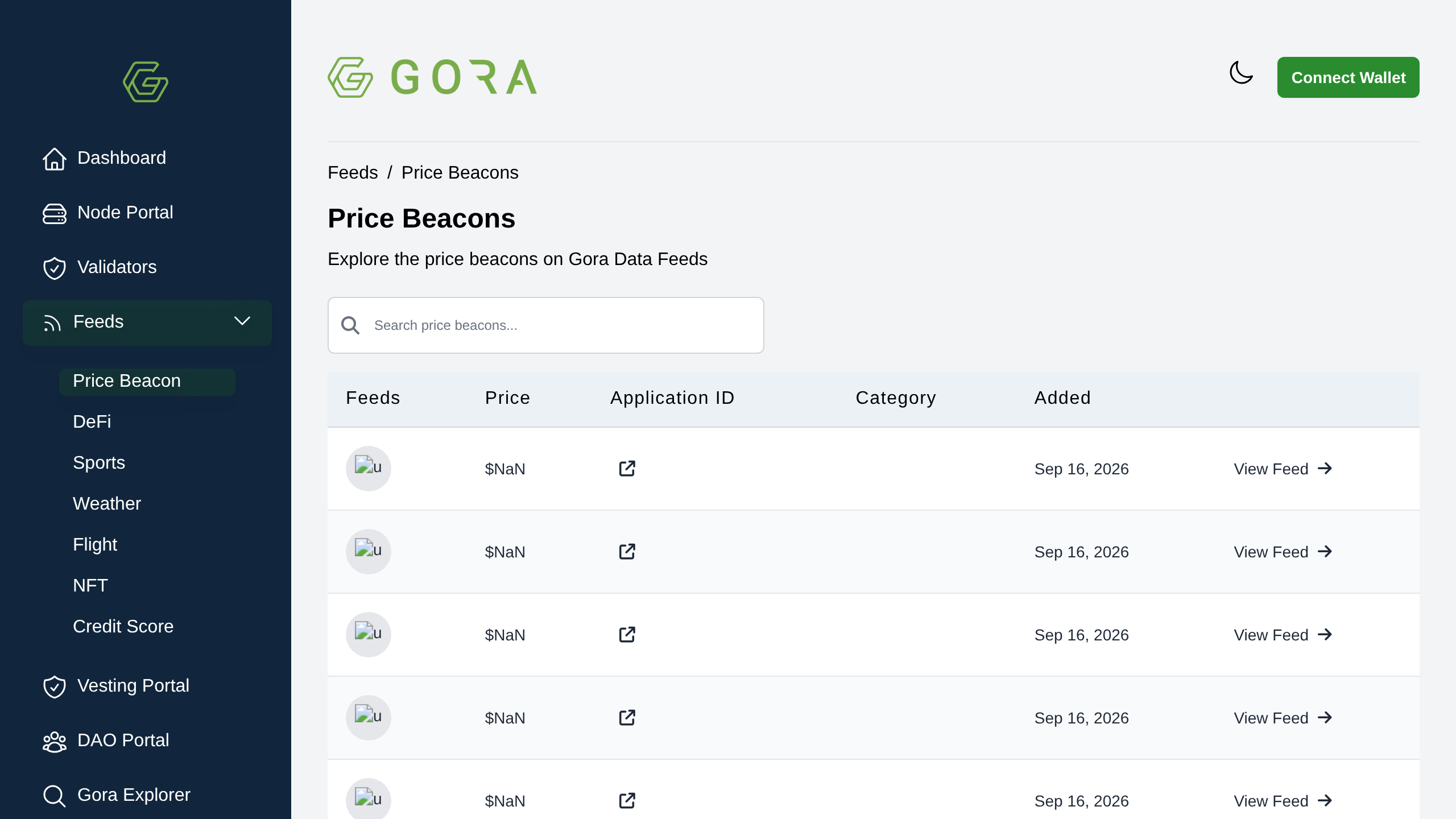
'$NaN' is what a program prints when a number fails to compute, and it stands in for the price on every one of those feed entries. The dashboard's own 'More Stats' panel, below the tiles, is candid about the rest: 'More stats, such as consensus speed, average voters, uptime and rewards handed out will be visible.' Contacting the team or joining the newsletter is what it asks for in exchange. Read next to the return tile, that sentence advertises a yield whose inputs the page does not show — not what the percentage is paid on, by whom, or over what period.
Every page of that dashboard still lists a 'Validators' entry pointing at gora.fi/stake, and a Gora Explorer link to a subdomain that does not resolve either.
The GorAcademy videos, and a staking flow with no on-chain trace
The staking destination those pages point at is the one the project's own tutorials teach, and it has no successor. Gora's YouTube channel lists 35 videos, among them 'GorAcademy - How to stake GoraBot NFTs purchased on secondary market' (92 views, posted about a year ago), whose description reads: 'In this video, we will show you how to stake on www.gora.fi, the GoraBot NFT that you have purchased on the secondary market or that has been sent to you and not minted on the primary tool.' Its companion, 'GorAcademy: How To Stake Your $GORA on Ethereum via GoraFi' (100 views, two years ago), is a tutorial on staking GORA on Ethereum through Gora.Fi using MetaMask. gora.fi registered on Sept. 14, 2023 and its record ends on the same date three years later; it does not resolve in DNS, and its nameservers are Vercel's. Archived copies show it was already a blank shell reading 'GoraFi Platform' by April 2026, and its /stake page a 'Loading...' shell back in December 2024. The project's earlier documentation site no longer resolves either.
That walkthrough is about GoraBots, a collection of 870 items. What it is worth depends on where you look.
| Marketplace | Floor | Lifetime volume | Also reported |
|---|---|---|---|
| Downbad | 200 ALGO | 448,900 ALGO | 186 owners, with 16 of the 870 items listed for sale |
| Exa Market | 4,710 ALGO | 13,440 ALGO | a 5,000 ALGO highest sale |
| Rand Gallery | no page found for the collection | — | — |
Two readings of the same 870-item set differ by more than twentyfold on the cheapest available item.
The address that created 725 of the collection's assets is also the owner of its on-chain name record, which verifies the X handle @gorabots as genuinely that address's, and it holds about 74 GORA. It is opted into two applications. One, 552635992, was created by a different address and stores no state at all. The other, 829144306, was created by a third address and records an admin account and 722 opted-in accounts — and that application's own escrow address holds nothing, has made no transactions and has no boxes. Of forty sampled items out of the 725-asset set, every one left the creator's wallet within seconds on Aug. 21, 2024, and all forty have changed hands since. That is a trace of distribution and trading, not of a staking contract, and wherever the staking described in that video ran, this research could not find its on-chain footprint. The URL on the collection's name record is a domain registered in September 2025 that now serves a Namecheap parking page.
Who is actually here
The community is real and concentrated in one room.
Chart: Where Gora's community actually is (members or subscribers)
The Discord server is the largest of the four by an order of magnitude, and its own invite preview still describes Gora as 'a premiere oracle network launched on the #Algorand blockchain'. The Telegram rooms are quiet: the announcements channel last posted on June 20, 2026 and the main group on June 20, 2024. None of those numbers speak to the new network, and nothing in the on-chain records says how many people are running apps on it.
How it compares
Verifiable AI is a crowded field. Chainlink, the largest oracle network, describes the same idea in its own material — routing AI inference through a decentralized set of nodes so that no single server is a point of failure. 0G markets verified compute, persistent memory and on-chain settlement for agents on a mainnet its announcement says has run since September 2025. On Algorand, the Foundation's AC2 protocol, released Aug. 25, addresses the neighbouring problem: letting a person approve an agent's actions with a passkey while the keys stay on their device. Gora's difference is placement rather than capability. It does not ask an agent to move to a new chain; the answer its validators sign is written to whichever chain the requesting contract already lives on, and a validator's stake can be spread across Algorand, Base and Solana at once.
The catch
Gora's docs are direct about what is not finished. The current arrangement is a 'testnet v1' trust model; outbound HTTP calls work for WASM apps only; and the quorum-fetch mode, which would let several validators independently pull external data, is 'the target design and are not all wired yet'. No security audit of the project turned up in this research, and the new network's code is not something a stranger can read: the project's GitHub organisation holds 15 public repositories with 20 stars between them, the most recent push to any of them was April 1, 2025, and the installer for the CLI looks for a repository that is not public — the prebuilt binary it fetches is at version 0.1.1.
How a validator is paid is the one question a person deciding whether to stake GORA would need answered, and the documentation does not answer it; the only return figure published anywhere in this material is the legacy dashboard tile described above.
| What the record shows | The reading | What that means for you |
|---|---|---|
| Control over the GORA asset | no manager, freeze, clawback or reserve key | Nobody, the team included, can mint more of it, freeze a holder's balance or reclaim tokens from a wallet |
| Token transactions | 158 in a 20,000-round window, roughly the last fifteen hours | It is still being used, in modest amounts |
| Largest holder | 118,049 GORA, a 0.118% share on the holder-share lookup | No single address dominates the top of the list, and that list returns 100 addresses without claiming to be the whole set |
The most recent transfer landed at 14:53 UTC today, and the largest single moves in that window were around 102 and 157 GORA. The market around it is thin.
| Where | The day's reading |
|---|---|
| Tinyman pool | $2,939.66 of liquidity, with $75.22 traded in the past 24 hours |
| Vestige's aggregate | a market value of $556,825, with $3,768 traded across every pool it indexes in 24 hours |
| Pact | ten GORA pairs, every one showing a liquidity figure of zero |
What to watch
Gora's homepage still opens on 'Launching Soon' under a 'COMING 05/01' marker while the docs describe a live testnet — the front door sits behind the product. The thing to watch is whether the agent network gets a mainnet with a date, and whether the older feeds, portals and staking links are repaired or retired, because they are what an existing GORA or GoraBot holder meets first.
If you want to try it, the docs walk through the whole of it: install the CLI with the one-line command, set a developer token, choose a token, deploy. If you would rather watch the idea work before opening a terminal, the fund page and its decision log are open to anyone with a browser. And if you hold a GoraBot, the staking route in the tutorial has no successor; the collection's on-chain name record verifies the X handle @gorabots, which is where a replacement would surface.
Source
- Gora
- Gora developer docs
- Gora Trading Bot demo
- Gora legacy dashboard
- Gora on YouTube — hosts the GorAcademy walkthroughs 'How to stake GoraBot NFTs purchased on secondary market' and 'How To Stake Your $GORA on Ethereum via GoraFi'
- GoraBots on-chain name record
- github.com
- The network built for agents. -
- Connect to the testnet - Gora Docs
- app.nf.domains
- How Gora apps work - Gora Docs
- gora.mintlify.app
- github.com
- gora-bridge.74.241.248.103.nip.io
- gora-bridge.74.241.248.103.nip.io
- gora-bridge.74.241.248.103.nip.io
- Gora Network Official: X, Facebook, Twitter | Linktree
- Gora Nodes Connect | Gora
Source: https://youtu.be/