NodeKit runs an Algorand node from the terminal and hands key signing to a wallet
NodeKit, the Algorand Foundation's open-source terminal tool, installs and syncs a node, generates participation keys and watches its health, then hands registration to Lora or Pera to sign. An offline page walks through that registration step without a node.
NodeKit is the Algorand Foundation's1 terminal program for running an Algorand node. It installs the daemon, syncs it, generates participation keys and hands the registration to a wallet the operator already holds, then watches the node's health. A person runs it on a Linux or Mac machine, answers prompts in a text interface, and signs the key registration in Lora or Pera. The signing happens in the wallet, not in the terminal. Algorand's own documentation is plain that this step is not a setting: a default installation is an ordinary, non-participating node, and becoming a validator is a dynamic operation of hosting participation keys for an online account. The chain's staking page routes node-runners here.
From a bare machine to an online account
The install is a shell one-liner from nodekit.run2. The script downloads the binary for your platform into the current directory, marks it executable and starts ./nodekit bootstrap. Bootstrap uses the local package manager to install Algorand, starts the node and offers a fast catchup. The quick-start guide3 says a full sync usually takes multiple days to weeks, while fast catchup takes 30 to 604 minutes. One limit: bootstrap accepts only the default data directory, /var/lib/algorand. A validator node wants 85 vCPU, 16GB of RAM, a 100GB NVMe SSD and a low-latency link around 16 Gbps. A Foundation guide from November 2024 put a cloud machine of that spec at roughly $15-207 a month.
From there the terminal shows status and health, and g generates participation keys for the account address you give it. The guide recommends key durations of 30 to 908 days and says a 30-day key takes about four to six minutes. Pressing r produces a link into Lora's transaction wizard, or a QR code to scan in Pera, and the key registration is signed there. By default the account is made rewards-eligible, which the guide writes as a 2A fee and go-algorand's consensus parameters set at 29 algos; the -n flag opts out.
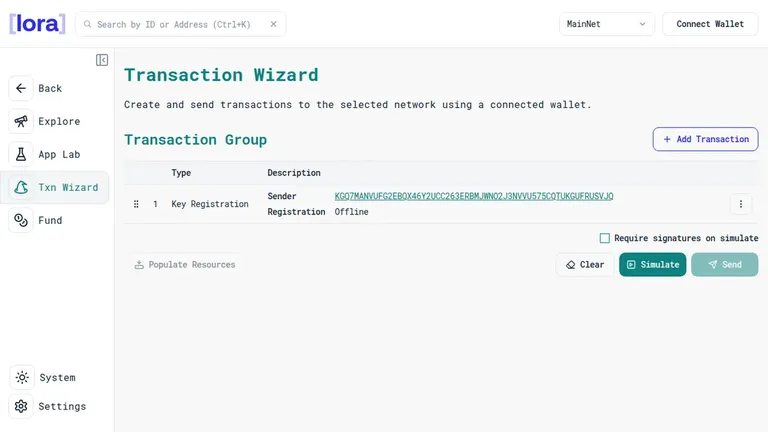
The offline key-registration page10 is the cheapest way to see the shape of that step. It finds an account by address or NFD name and hands the registration to Lora, needing no node, and says a registration takes 32011 rounds to take effect. Typing foundation.algo there returned a balance of 198.182 ALGO and 'Participating: No', which agreed with the chain's reading of that account to the millialgo. The Register Offline button then opened Lora's transaction wizard on MainNet with a single Key Registration pre-filled for that sender and marked Offline, and nothing was signed.
What it owns, and what it leaves to a wallet
NodeKit's job is the maintenance half. It installs and configures the daemon, manages fast catchup, generates participation keys, registers them through a handoff and displays node health, all in one terminal. Algorand's staking page calls it a streamlined experience to install the core node, register keys and monitor performance. The tool talks to the local node with the admin token it reads from the node's data directory. It learns which network it is on from the node's genesis file rather than from a setting of its own, and a default Algorand install is MainNet, with TestNet a data directory away.
Read as a design, NodeKit is a first-party wrapper around the operational half of validation — packaging, catchup, key generation, health display, a supported upgrade path — with signing left to a wallet the operator already trusts. For a chain that wants independent validators rather than delegated stake, owning the maintenance and not the keys is the part worth copying.
Who publishes it, and how old it is
The publisher is the Algorand Foundation: the repository sits in its GitHub organization, is MIT licensed and is written almost entirely in Go. No individual maintainer is named on the project's pages; the repository lists 1112 contributors and the commits carry handles. Its vision document calls it a renewal of node-ui, an earlier terminal tool for remote node management whose last release, v0.2.0, is dated 2023-07-07.
The first public release was v1.0.0-beta.1 on 2024-12-05, and its notes already list the Lora transaction wizard, QR-code signing, fast catchup and key generation. Within five weeks it was renamed algorun and then nodekit; the changelogs give no reason. The current v1.7.01314, out on 2026-10-21, adds a logs command and a restart command, and roughly thirty fixes, most of them in the log reader. That is upkeep of a tool whose shape was set about two years ago.
Adoption is modest, and the figures count downloads rather than people. Eight days after v1.7.015, its four binaries showed 12116 downloads between them, 88 of them the Linux x86-64 build; the repository shows 5517 stars, 1718 forks, six open issues and four open pull requests. An automated AlgoScan weekly report ranked nodekit first among Algorand repositories for the week of September 7–13, 2026, with 48 commits.
The bar to earn
A node can join consensus on very little, but it earns on a much higher bar. The protocol's minimum balance to receive block payouts is 30,000 ALGO, a threshold set by a community vote in Governance Period 10. The payout is half the block's fees plus a bonus that decays, and stake above 70M19 ALGO per account counts for nothing extra. At the 2026-10-29 price of $0.09973220, 30,000 ALGO came to about $3,00021 — a threshold, not a fee.
- Fee to become rewards-eligible: 2 ALGO (paid once per key registration).
- Minimum stake to earn: 30,000 ALGO (set by a GP10 vote).
- Block fees paid to the proposer: 50% (plus a decaying bonus).
What can go wrong
The README is the first caution: NodeKit says it is 'still a work in progress22' and to expect bugs and rough edges, which matters because the tool is what installs, starts and stops the daemon your keys sign with. The install script downloads a binary from the latest GitHub release and runs it without checking a checksum or a signature. A node started or restarted on a version older than Go-Algorand 5.0.3 cannot validate DNSSEC and so cannot connect to the network. A notice23 from Algorand Inc's devops account on 2026-10-12 lists ./nodekit upgrade among the fixes. An ineffective node is removed from consensus and forgoes its rewards.
NodeKit's security policy24 asks for vulnerability reports by email rather than in issues, and lists no advisories; no audit of the tool is stated there. Telemetry, when enabled, goes to Nodely: the command that turns it on warns that it ties information about the node, including participating accounts and an approximate location, to an anonymous identifier. Loading the offline registration page, the only host it contacted was nodekit.run.
A dashboard instead of a terminal
Anyone who would rather click than type has a like-for-like alternative in FUNC25: an MIT-licensed cross-platform service that installs Algorand or Voi node software, keeps it running as an auto-starting service and exposes a local web page at localhost:3536 where a wallet connection handles key registration; its author says it shipped before NodeKit. Its repository shows 66 stars, 14 forks and 75 tags. The difference is a dashboard that starts the node on boot against a terminal that hands signing to Lora or Pera.
Where that leaves a reader depends on the wallet. Someone with no server and no stake can point an address at the offline page and see how the registration step feels without installing anything. Someone with the stake and a spare machine gets the whole loop from one binary. Below the floor, the same Foundation page that recommends NodeKit sends people to liquid staking, staking pools and delegated staking instead.
17 figures in this story are checked.See every check
Sources
- 1GitHub - algorandfoundation/nodekit: Terminal UI for Algorand Nodes · GitHub github.com↩
- 2nodekit.run nodekit.run↩
- 3NodeKit Quick Start | Algorand Developer Portal dev.algorand.co↩
- 10NodeKit - Quick Keyreg Offline nodekit.run↩
- 13Release v1.7.0 · algorandfoundation/nodekit · GitHub github.com↩
- 23MainNet and TestNet Update: Go-Algorand 5.0.3 - Announcements - Algorand forum.algorand.co↩
- 24Security Policy · algorandfoundation/nodekit · GitHub github.com↩
- 25github.com/GalaxyPay/func github.com↩