Memento Mori Puts the World Population On-Chain as One Algorand Token per Person
A Token for Every Living Human
'Memento mori' — Latin for 'remember that you must die' — is the ancient Stoic exercise of keeping mortality in view. On Algorand, the phrase has been turned into something more literal: Memento Mori, a token whose circulating supply is pegged to the number of people alive on Earth at this moment.
An ASA, or Algorand Standard Asset, is a built-in mechanism for issuing tokens directly on Algorand's base layer, inheriting the same speed and finality as ALGO itself. Memento Mori (unit name MORI, asset ID 1018187012) uses that mechanism with a fixed total supply of 11,200,000,000 units and zero decimal places: one whole, indivisible token per person. The project calls itself a 'world's first on-chain population simulator,' and its stated intent is that 'every human being on the planet and orbiting it' is accredited with a MORI.
The project took shape in January 2023, when the mementomori.algo name was registered on January 17 and the mementomori.page domain followed four days later — a Gandi registration that expires in January 2027. The site is served today from Netlify.
How the Population Gets Minted
The mechanism is deliberately simple. Once an hour, a transfer moves a number of MORI from a reserve account to a receiver account; the amount is the hour's net demographic change — 'newborn people minus deceased' — following a projection curve based on United Nations Population Division data. The receiver's balance is, in effect, the on-chain world population, while the reserve holds the supply not yet minted. The project says the reserve is funded to run until year 2100 or until the total supply is reached.
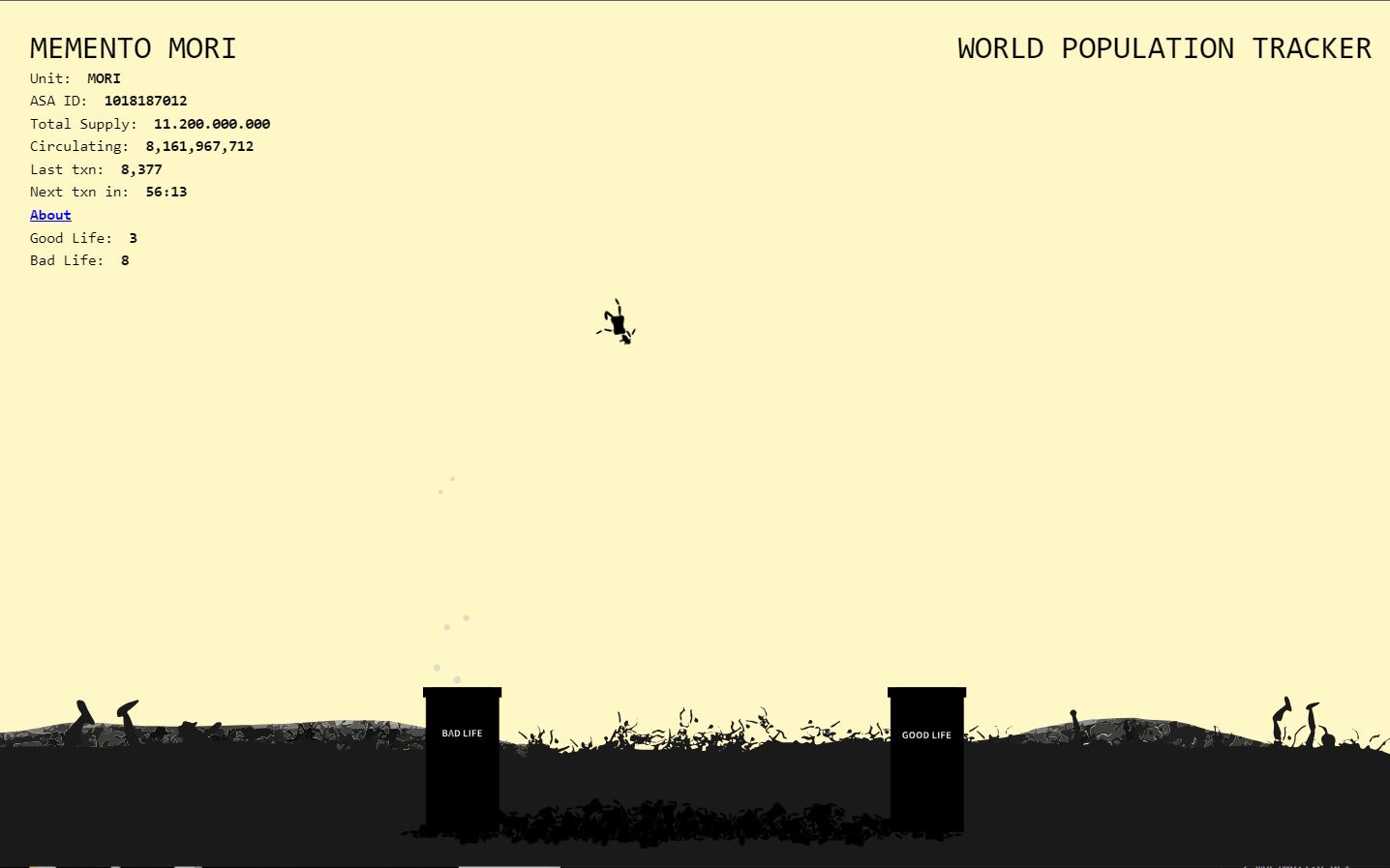
One boundary is worth making explicit: the population math does not live on the chain. Memento Mori is a plain ASA with no smart contract attached; the hourly number is computed off-chain by a script and the chain records only the resulting transfer. The homepage animation — which the project says 'drops 2 hampelmen every second,' corresponding to the real-world birth rate — is also cosmetic, with ragdoll physics credited to 'Null.'
The design choices produce a public data feed with specific properties:
| Concept | Real-world implication |
|---|---|
| Zero decimals and a fixed supply cap | No fractional humans exist in the model, and minting stops when the cap is reached |
| Hourly reserve-to-receiver transfers | Net births minus deaths become a regular, observable on-chain event |
| Receiver registered as mementomori.algo | Any wallet can subscribe by adding the human-readable NFD name as a watch account — the project's instruction is to 'Add mementomori.algo as a watch account' |
| No listing on Tinyman or Pact | Consistent with the pledge that it will never trade, the token has no market price |
Chart: MORI minted per hour (net births minus deaths, on-chain, Aug 8–9 2026)
The fifteen hourly ticks shown above, spanning the evening of August 8 through the morning of August 9, 2026, ranged from about 6,000 to just under 10,000 MORI per hour — an average near 7,500, a pace that implies roughly 65 million net additions per year. The chain is doing here what a ledger does best: making the planet's demographic arithmetic visible to anyone in real time.
What the Chain Shows
The full observed supply sits in two accounts:
| Concept | Real-world implication |
|---|---|
| Creator account (DEAXD24NWYIBUKALDZEMEMZCM6D4ANNTDB2VUKXOH3YO3SUONGZSXQZLGU) | Holds manager, freeze and clawback authority over the asset; holds 0 MORI |
| Reserve account (LOGOSKGASR2WUTFBRQQSGOJT7QBXWQV7HWGTLYRBVGLJQFVLH2BR5NGQZQ) | Holds the 2,892,024,441 MORI not yet emitted and sends the hourly transfer |
| Receiver account, aka mementomori.algo (ORBISXYDPXH4MGICPYHQLLSHH7IYMXECPJIG5N5M3GMKZ7MHRLBFHZLOFE) | Accumulates the standing balance — 8,307,975,559 MORI at the time of writing — the figure the project calls the current world population |
The two holding balances sum exactly to the fixed total, so the entire supply is accounted for. For calibration, the World Bank's most recent published estimate, for 2025, is 8,215,424,893 people; the on-chain count of about 8.31 billion is ahead of that figure, which is what a projection curve extending into 2026 is expected to be. The homepage itself displays em-dashes in its 'Circulating' and 'Last txn' fields at the time of writing, so the live figures have to be read from the chain rather than the landing page.
Control, Custody, and the Limits of 'On-Chain'
Transparency has boundaries. The asset's manager, freeze, and clawback parameters all point to the creator address. Clawback, in Algorand's asset model, is a designated authority to reclaim tokens from holders; freeze can block transfers from an account; the manager can change asset parameters. The project's stated reason for keeping all three is 'to keep options for further development open.' For an asset that will never be listed, retaining them is a genuine design choice that concentrates power in the operator.
Who actually exercises that power is visible on the ledger, and it is a smaller circle still. Rekeying lets an Algorand account delegate its signing authority to a different key, and the ledger records which key signs. The chain shows the creator account and the receiver account rekeyed to the same signing address, so a single key controls both the token's administrative roles and the account that tallies the population. The reserve, which holds future emissions, is rekeyed to a separate address.
In practice, Memento Mori is a centralized model whose output is recorded on a decentralized chain — not independently verifiable ground truth. The signing key can pause the mints, change the curve, or claw back the entire supply, and nothing on-chain can stop it. For an asset whose whole supply sits in the operator's own accounts, that authority is largely theoretical today. The real limitation is that the project's central claim — that the hourly number equals the world's demographic change — rests on an un-audited off-chain script and the word of pseudonymous operators. The credits name Hampelman (idea), RunVnc (token script and population data curve), and Null (ragdoll physics and website prototype); searches surfaced no public profiles clearly tied to any of the three. The asset's page on the Allo explorer labels its related addresses 'AdValar Solutions' — the closest thing to an operating name in the public record — and the NFD record carries no verified social links.
Sustainability is likewise a closed book with a visible balance. The reserve was seeded with 190 ALGO by the creator account and holds roughly 57 ALGO today. At Algorand's ordinary minimum fee of about 0.001 ALGO per transfer, that covers tens of thousands of hourly mints — years of operation at the one-per-hour cadence — though a change in Algorand's fee structure could shorten the runway, a risk the project itself flags.
The Worth of a Human Life
Seen in that light, the decisions above — no trading, control retained, a finite fuel tank — stop looking like unfinished tokenomics and start looking like the medium. Memento Mori will never price a life, and that is the statement. It counts the living and lets the ledger keep the count. Every limitation of the project is also a memento: the simulation, like its subject, will end. The name says it plainly — remember that you must die — and on Algorand, the token does the remembering.
Source
Source: https://mementomori.page