Hackathon recognized FART NFT MAKER for minting browser fart sounds as Algorand NFTs
The Sound of Rebellion, On-Chain
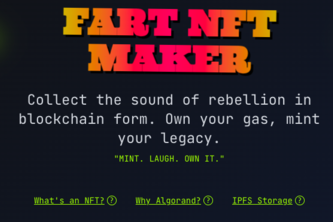
FART NFT MAKER opens with a literal call to action: 'Collect the sound of rebellion in blockchain form. Own your gas, mint your legacy.' The one-page site, live on Netlify under the tagline 'MINT. LAUGH. OWN IT.', lets a visitor record a few seconds of audio, wrap it in a title and cover image, and mint the result as a permanent token on the Algorand network.
The premise is a joke, but the project around it is structurally serious. In July 2025 the Algorand Foundation and Bolt’s World's Largest Hackathon named it one of five 'exemplary' projects from over 500 teams in their blockchain challenge, alongside Algopay, Storyloom, RandCash.app, and BioPay. Each of the five received AWS credits and bridge services from Algorand, per the announcement. The grand prize in that challenge, $25,000, went to a different project, StartSnap.fun.
How a Fart Becomes a Token
The project's Devpost write-up, by developer Laurent Goulenok, documents the full minting flow. A user connects a wallet, clicks a round 'Record Fart' button, and the browser's MediaRecorder API captures roughly three seconds of audio. They add a title and drag in a cover image, then mint. The app uploads both files to IPFS, creates an ARC-3 asset whose metadata points at the sound and the cover, and groups a 1 ALGO fee to the project's treasury wallet alongside the asset-creation transaction.
The fee is where the joke collides with network architecture. On Algorand, a standard transaction costs a fraction of a cent, so the 1 ALGO charge is not network gas in the Ethereum sense — it is a fixed product fee, bundled into a single transaction so the user pays once and the treasury receives it in the same operation. The team says the whole loop, from pressing record to owning the token on a mobile 4G connection, takes under 45 seconds.
The Stack Behind the Gag
| Concept | Real-World Implication |
|---|---|
| Browser MediaRecorder API, encoded as WebM/Opus | Users record without installing anything; the compact format keeps uploads small enough for mobile |
| IPFS storage via nft.storage | Sound and cover art live on a decentralized file system, so the media outlives any web host |
| @perawallet/connect + Algorand SDK | The frontend talks directly to the chain — no backend, no database, no API key to leak |
| ARC-3 metadata kept under 3 kB | The metadata JSON stays within ARC-3's practical size limits while embedding both media references |
The architecture is stateless by design: a static React and Vite app on Netlify, wallet connection through Pera, and all state living on-chain or in IPFS. The team reports two production decisions worth noting — they switched from raw WAV capture to WebM/Opus after finding raw audio too large, and they had to add a tap-to-arm step because Safari's iOS browser refuses to start audio recording without a user gesture. They also claim to have kept the entire bundle under 230 kB gzipped.
Why Algorand Made the Fixed Price Work
Single-block finality is the mechanic that makes a flat 1 ALGO fee feel sensible. On chains with probabilistic settlement, a token mint is not guaranteed to stick for many seconds or minutes; on Algorand, each block is final as soon as it is produced, with no forks. A fixed, upfront price is viable because the underlying transaction fee is itself small and predictable, and the user sees their asset exist instantly. That is also the property that lets the app operate with zero infrastructure — an NFT project's classic problem is running and paying for a minting backend, and here the chain itself is the backend.
The Devpost frames it the same way: the point was to 'showcase Algorand's fast, cheap media-NFT capabilities in a single click.' Before building, the team says, they were inspired by projects that turn everyday noises into blockchain collectibles — 'tracks, voice notes… so why not farts?'
What Exists Today, and What Doesn't
A year after the hackathon, the picture is mixed. The demo site still runs, still lists Pera Wallet and Exodus Wallet support, and the Wayback Machine confirms it has been up since at least July 17, 2025. But three promise-shaped gaps remain. First, the team announced in June 2025 that they had 'already reserved' the domain fartnftmaker.entry for a production launch; that domain returns no DNS record today — it was never registered. Second, their roadmap — auto-EQ, a 'Mega-Fart' fusion mechanic that burns five regular farts to mint a remixed collage, a Friday leaderboard, and a charity toggle donating 10% of fees to gastrointestinal research — has no public delivery. Third, and most consequential, no treasury wallet address or asset ID is published anywhere on the site or the submission, and a search of Algorand assets by the name 'Fart' surfaces unrelated tokens (FARTCOIN, 'Farton Trump,' 'Ghostmane Fart Drop') rather than a collection matching this project. The claim of being the 'first-ever on-chain fart sound collection on Algorand' thus rests entirely on the team's own statement; there is no verifiable on-chain footprint for readers to check, and no public source repository was found.
What remains is a working demonstration that a user could mint audio as an NFT on Algorand under a minute for a fixed price — the serious lesson tucked inside a ridiculous subject. One may yet mint. Laugh. Own it., but the promised production launch remains, for now, more legacy than living.