Data History Museum hits 21,715 auto-minted quake and flare artifacts on Algorand
A Greek Quake Is Minted Within Hours
On the morning of August 7, 2026, a 4.4-magnitude earthquake struck five kilometers southwest of Lárdos on the Greek island of Rhodes. Within roughly five hours, the Data History Museum was logging the event on its homepage among its most recently minted artifacts. A 5.0-magnitude quake seven kilometers northwest of Cabacao in the Philippines and a C1-class solar flare with a 12-minute duration that peaked at 19:29 UTC on August 6 were minted in the same stretch. None of them passed through human hands: the pipeline is, by design, fully automatic.
The museum, built by Melbourne consultancy MakerX, exists to argue that blockchains can produce the digital equivalent of physical historical artifacts. Physical artifacts are unique objects whose own data verifies their historical significance, but they decay and their provenance is fragile. The project's answer is the NFT — a unique digital token recorded on a blockchain that proves ownership and authenticity of an item — and so its stated goal is to mint NFTs 'as an immediate and automatic response to an event worthy of the historical record'. Its tagline: 'Curating artifacts produced by major historical events, as they happen in real-time.'
MakerX CTO Rob Moore frames the project as a corrective to digital-era forgetting: 'As our world is becoming increasingly digital, we're actually losing information. Blockchain is the only way to digitally mimic a historic artefact.' The team also includes CPO Jess Panni and lead engineer Altynbek Orumbayev, and the project published a whitepaper in 2022 laying out why NFTs qualify as historical artifacts. The first NFT series, covering earthquakes, launched in May 2022; solar flares followed.
How a Sensor Feed Becomes an On-Chain Record
Earthquake data comes from the U.S. Geological Survey's open API, and solar-flare data from the U.S. National Oceanic and Atmospheric Administration's Space Weather Prediction Centre. When an event clears the museum's criteria, an Algorand Standard Asset (ASA) is minted — Algorand's built-in mechanism for issuing tokens directly on its base layer, inheriting the same speed and security as the ALGO token itself. Each artifact has a total supply of exactly one, its name encodes the event, its unit name labels it QUAKE or SOLFLARE, and its URL points to a rendered image or video of the event. The artifact pages carry the full event metadata — magnitude, depth, coordinates, origin time for quakes; class and duration for flares — alongside a link back to the verifying agency's own event page. The sampled artifacts carry no freeze or clawback accounts, so the museum holds no standing ability to freeze or reclaim a piece after it is issued. The project also runs an alerts account on X, @DHM_Alerts, that broadcasts each new artifact.
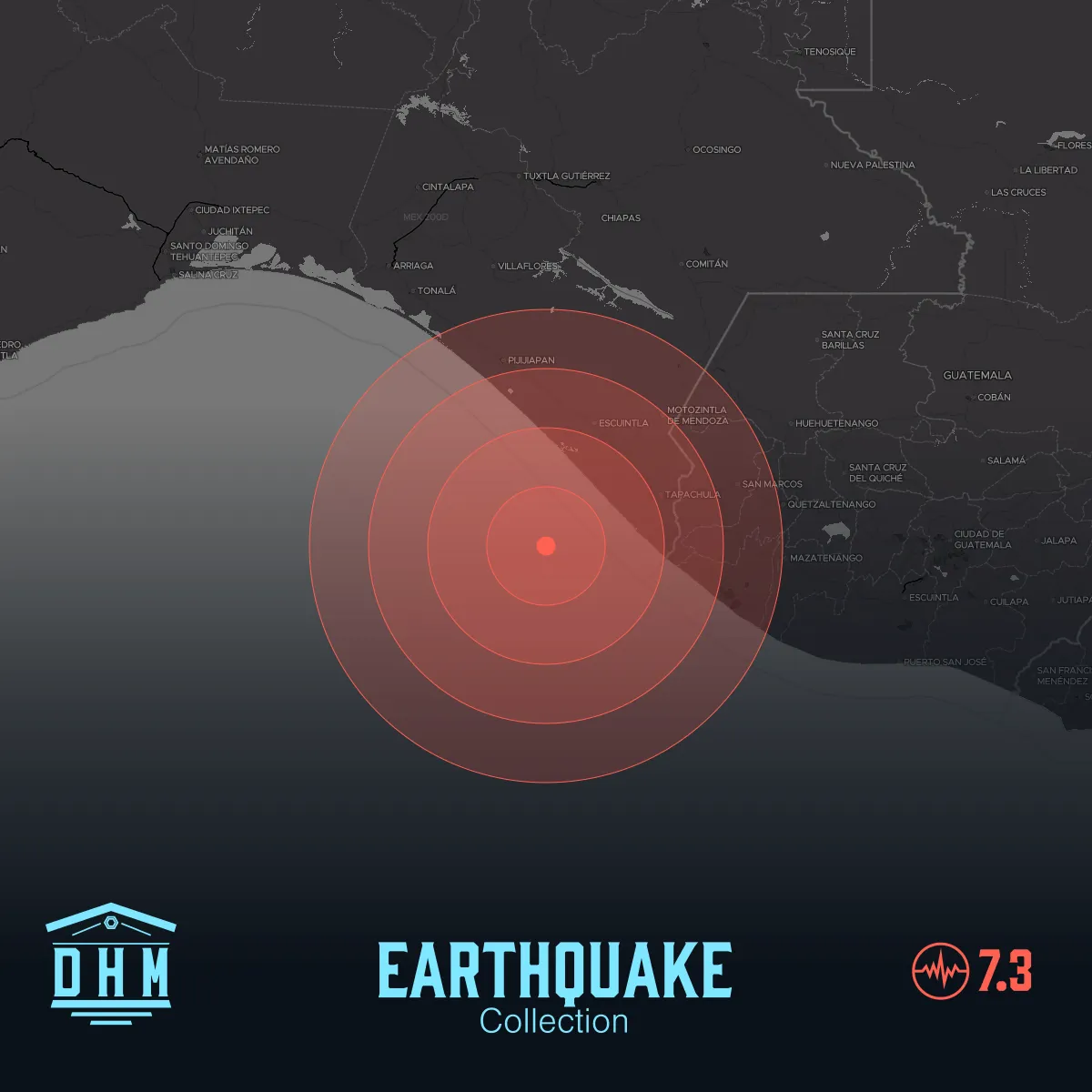
Speed is the point. When the 7.3-magnitude quake hit 58 km WSW of Puerto Madero, Mexico, on July 17, 2026, the USGS logged the event at 14:48:39 UTC; the museum's NFT went on-chain at 14:58:13 UTC — under ten minutes later. Algorand's Pure Proof-of-Stake consensus finalizes every block in about three seconds with no forking, and fees are negligible, which is what makes an automated minting operation viable: the museum's exhibition page currently counts 21,715 artifacts.
An Auction Where Every Hour Cuts the Price
Each artifact sells through a Dutch auction — a declining-price sale that opens high and drops by set steps, here hourly, until someone buys it or it reaches a floor. Opening prices scale with the event's significance: the C1 flare and the M7.3 quake opened at 5,000 ALGO, M5 earthquakes at 2,000, a magnitude-4.4 event at 400. Floors run from 25 ALGO for the major-event series to 200 ALGO for the smaller earthquake band, which keeps the more common pieces cheap enough to function as archival objects.
| Concept | Verified event data | Real-World Implication |
|---|---|---|
| 4.4 quake, southwest of Lárdos, Greece | Depth 10 km; Aug 7, 2026, 07:10:56 UTC | Listed at 387.5 ALGO at the latest check, still falling hourly toward its floor |
| C1 solar flare, 12-minute duration | Peaked Aug 6, 2026, 19:29:00 UTC | Listed near 1,476 ALGO at the latest check, still sliding from its opening price until a buyer stops the clock |
| M7.3 quake, 58 km WSW of Puerto Madero, Mexico | Depth 18.6 km; Jul 17, 2026, 14:48:39 UTC | Its auction has already run down from the opening price to the floor |
The museum's stated policy directs a fifth of each sale to external causes — 10% to disaster-relief charities and 10% to the scientific institutions whose detection feeds make the artifacts possible. The payment flow behind the Buy Now button on each page is not described on the site.
Mostly an Archive, Occasionally a Sale
The museum is first and foremost an archive, and most of what it mints never sells at all: the three July 17 earthquake artifacts remain in the museum's own account, each unsold at its floor. Against that background, the confirmed sales stand out. The flagship — an X9-class solar flare, the most intense category of flare, captured on October 3, 2024 and called by MakerX the most powerful since 2017 — was minted and sold the same day, and its current holder on the Algorand ledger is an address outside the museum. A separate C1 flare that left the museum's account on August 3, 2026 has also reached an outside holder, and a magnitude-4.5 quake token from July 2022 has passed through a chain of owners, most recently in January 2025. The museum's Discord server counts 115 members — a small community for a collection this size.
The operation's economics illustrate why a project like this runs on Algorand at all. The minting account holds 21,716 assets, and its roughly 2,271 ALGO balance is almost entirely consumed by the network's minimum-balance rule, which forces accounts to lock about 0.1 ALGO per asset as a spam deterrent. Only about 100 ALGO of working balance remains — the entire museum, tens of thousands of artifacts deep, operates on a four-figure ALGO budget.
The Next Artifact Is Already Waiting
The museum's scope, per its site, will grow from earthquakes and solar flares to 'later other terrestrial, cosmic and social events'. When that day comes, the mechanics will stay the same: a sensor feed, a threshold, an automatic mint. Whatever one makes of the market for ALGO-priced earthquake collectibles, the underlying proposition is hard to dispute — an event happens, and within minutes an immutable, independently verifiable record of it exists on an open blockchain.
Source
- Data History Museum
- All Artifacts exhibition
- MakerX blog: Pioneering Digital History with the Data History Museum
- Data History Museum launch announcement, PR Newswire, May 2022
- USGS event page: M 7.3 — 58 km WSW of Puerto Madero, Mexico
- Artifact | Data History Museum
- Artifact | Data History Museum
- Data History Museum Reimagines Museums by Launching the World’s First NFT-Powered Collection of Earthquake Artifacts
- M 7.3 - 58 km WSW of Puerto Madero, Mexico
Source: https://museum.datahistory.org/