Algo Leagues launches live PVP Arena with ALC season passes on Algorand
From Discord Battles to a Real-Time Arena
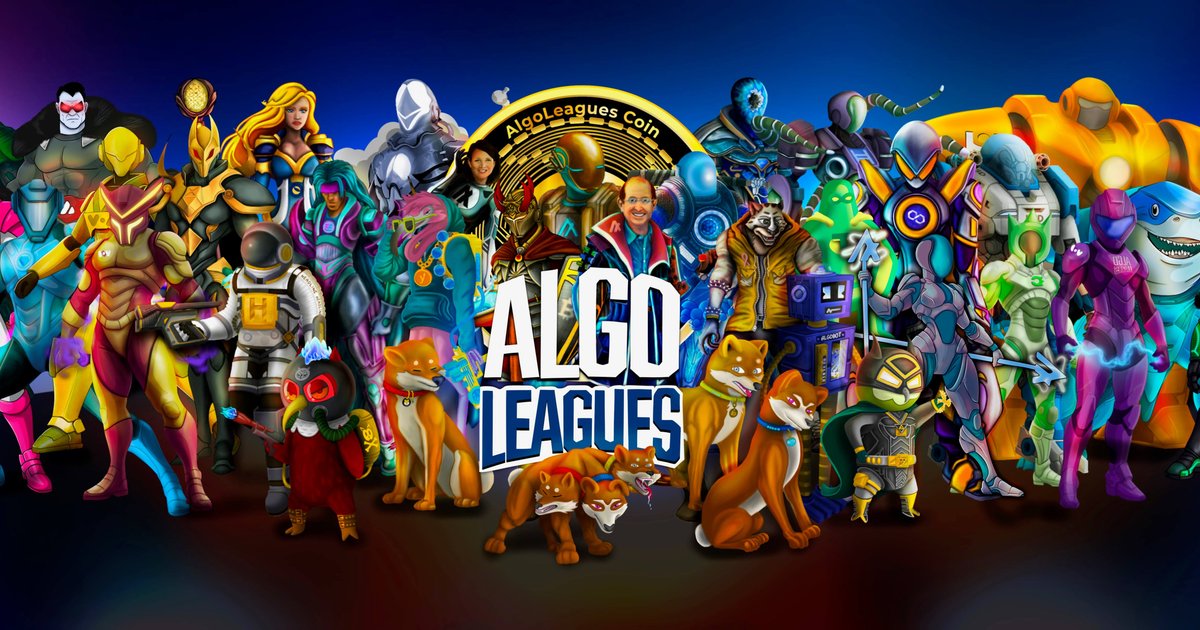
Algo Leagues has been one of Algorand's quietly persistent NFT gaming experiments since 2021, and its homepage today reads like an esports product rather than a collectible drop: a token with a supply-distribution chart, season-pass pricing, leaderboard prize splits, and a real-time battle arena. The project's own counters claim more than 1M transactions on Algorand and 39 unique characters across its card sets, and its Discord community holds roughly 2,566 members.
The game grew out of Block Wars, a Discord team battle that runs every 12 hours. Players need at least one Algo Leagues NFT to enter, pick a faction — Heroes or Villains — and the bot derives combat stats from the player's entire on-chain collection. When the event resolves, everyone receives ALC from the prize pool, with the winning faction paid twice as much per player as the losing side.
A Card Battle With Real-Time Tactics
The newer Leagues PVP Arena moves the same characters into real-time 1v1 combat on the web. Each player builds a three-card deck of owned NFTs and picks an action every 30-second turn, and the choices form the tactical core of the game:
| Action | Attack | Defense | Damage taken | The tradeoff |
|---|---|---|---|---|
| Strike | 1.0x | 1.0x | 1.0x | Balanced baseline |
| Guard | 0.3x | 2.0x | 0.5x | Plays safe but hits weak |
| Surge | 1.5x | 0.6x | 1.3x | All-in offense, exposed |
| Special | varies | varies | varies | Unique per card, extra mana |
The whole team shares one mana pool that regenerates continuously — Clash Royale style — so cheap Rare cards and expensive Legendaries have to be sequenced, and running out of mana forces an Exhausted state with halved stats. A damage floor guarantees every strike lands at least 5% of the attacker's ATK, so no turn gets wasted. A 'confidence' system then layers on high-stakes play: either player can raise the stakes mid-match from 1x to 4x, and the opponent can match, fold, or raise back. The multiplier applies to leaderboard points and prize standing, not directly to token payouts. Notably, the battles themselves run on a Node.js WebSocket server, while NFT and token transfers settle on-chain.
Cards as First-Class Chain Assets
The cards are native Algorand Standard Assets, the chain's built-in token format. That design choice shows up directly in player experience: the NFT is simply a balance in a wallet, tradable instantly on any ASA-compatible marketplace with no wrapping or contract approvals — and Algorand's single-block finality means a sale is final the moment it confirms. The site's marketplace prices reflect the rarity ladder: Rare characters list at 35–45 ALGO, Epics at 70, Legendaries at 125–180 ALGO or 20 USDC.
Holding a card also earns weekly ALC drops automatically — 50 for Rare, 100 for Epic, 200 for Legendary, 350 for Neapolitan — with no lock-up. Owners get Discord roles with 2x giveaway entries, access to rain and bounty events, and automatic qualification for the upcoming Chaos Room, a free-for-all battle mode for up to 20 players scheduled for Q3 2026. Two deeper mechanics round out the collectible layer: fusion, which combines cards to mint rarer ones, and rarity upgrades, where holding all three Catalyst types advances a card to the next tier on the website. Catalysts themselves act as a team-wide stat boost of +33% in PVP, rising to +40% when a Catalyst card is in your deck.
The ALC Economy
Underneath sits the utility token ALC (ASA 445905873, a total supply of 1 billion units with 6 decimals). The site's own definition is the cleanest summary: 'the in-game token. Earn it by holding NFTs and winning battles; spend it on Season Passes, wagers, boosts, and cosmetics.'
The receive side runs through the holding drops above, battle rewards, leaderboard placements, and a spread of integrations — a Tinyman LP program splitting 500K ALC weekly to providers 'while supplies last', a Myth Finance dualSTAKE pool, a Reti Pool consensus stake, and play-to-earn through Cosmic Champs and ViewReward.App's ad-watching. The spend side covers the season pass, private wagers, boost potions and cosmetics, in-game purchases, and even a real-world discount at Dora's Tacos. Wallets link via Pera and Defly, and website pricing converts from USD to ALC at live market rates.
Season passes are the main revenue loop, sold quarterly with a single pass covering both web and Discord. Standard costs $5, VIP holders $2.50, and ALMega collectors — 75+ NFTs — $3.75, paid in ALC at the live rate on the web or at fixed ALC amounts (100,000 / 50,000 / 75,000) through the Discord bot. The project publishes the full split of where pass proceeds go:
| Revenue share | % of passes | Destination |
|---|---|---|
| Prize pool | 40% | Top 3 split: 1st 25%, 2nd 15%, 3rd 10% of the pool |
| Match rewards | 25% | Per-match: 1% win vs human, 0.5% vs bot, 0.2% loss |
| Treasury | 15% | Development and token burns |
| Staking | 10% (future) | ALC stakers |
| NFT drops | 10% (future) | NFT holder airdrops |
Private wager matches run on a separate track: two players stake between 10 and 5,000 ALC, the winner takes 90%, and 10% funds the treasury.
A Discord Bot That's Also Infrastructure
Much of the ecosystem lives in Discord, and the bot there is its own product layer. The project says its community-management tools power more than 200 projects on Algorand and VOI. Any project can opt any ASA into the bot for 20,000 ALC — no approval required — after which the token works in rain events, loot drops, giveaways, auctions, raffles, and escrow-backed bounties across every server the bot occupies. Server Premium runs 50,000 ALC per 30 days and adds role-weighted giveaways, holder verification that assigns Discord roles automatically from on-chain balances, and auctions with escrow and anti-snipe timing.
Two caveats belong alongside those features. The bot is custodial in practice: members hold balances in-bot and withdraw to linked wallets, so funds sit with the operator between events. And automatic role assignment cuts both ways — the bot revokes roles when a wallet drops below its threshold, so a holder who sells, or simply sees token balances pushed down by market swings, can lose gated perks on a temporary dip. Nothing in the public materials indicates a third-party audit of the bot, its escrow, or the token treasury.
The On-Chain Reality Check
The token's footprint is real but thin. The Tinyman ALC/ALGO pool is verified but tiny, holding roughly $745 in liquidity with about $3 in 24-hour volume and $50 across the past week per aggregator data; Pact lists the token but shows $0 TVL across its ALC pools. That context is what makes the earn section's disclaimer — 'rewards are not guaranteed and may vary' — more than boilerplate: staking payouts, leaderboard prizes, and LP rewards all settle in a token whose entire public DEX liquidity is under a thousand dollars.
The Myth Finance dualSTAKE pool makes the tension concrete. It has genuinely staked about 38,825 ALGO across 9 holders, and node-running rewards are swapped into ALC automatically — roughly 629K ALC purchased with ~47 ALGO over six swaps in the past week. That auto-swap gives the token steady buy pressure, which is the point for the game's tokenomics; the cost is that stakers' yield is priced entirely in a token with thin exit liquidity, subject to 6.5% rewards, 4% node-runner, and 2.5% platform fees. If ALC's market dries up, the real value of the yield evaporates with it.
Who Builds It, and What's Next
The team is small and community-rooted: creator Eddie (BitHero), art director 0Designz, lead developer EasyTiger, and art-and-development studio 3BUXStudios. The technical stack pairs a SvelteKit front end with a Node.js WebSocket server for PVP, AWS DynamoDB for player data, and dual price oracles from Pera and Vestige. The roadmap tracks three phases: foundation work through 2024, an active phase covering the arena, the Reti consensus pool, and VOI support, and an upcoming phase promising a website 3.0 launch, cross-chain expansion to Base, and Set 8 of the cards. The most recent visible shift on the site itself: the homepage moved from pitching the Discord bot to leading with the token economy and arena.
Five years is a long arc for Algorand NFTs, where most games faded after their first drop. Algo Leagues kept shipping — a Discord game, a bot network, a token, and now a real-time arena with a season economy. The honest caveat is the one the project prints itself: rewards are not guaranteed, and with current liquidity they are also not large. But the game, the bot, and the token all run, on-chain and off. On a chain that has buried a lot of NFT gaming projects, that alone is the story.
Source
- Algo Leagues
- Whitepaper
- Algo Leagues Discord
- Tinyman ALC/ALGO pool
- Myth Finance alcALGO dualSTAKE
- Nodely Reti Pool validator page
- Algo Leagues — Algorand NFT Trading Card Game | PVP Arena & Block Wars
- Whitepaper — Algo Leagues
- Discord Community Bot — Algo Leagues
- Roadmap — Algo Leagues
- Arena Guide — Algo Leagues PVP
- Characters — Algo Leagues
Source: https://algoleagues.com