Lute is a browser wallet for Algorand whose gold theme comes from a 200-unit token
Wallets & Payments Round 65,942,635 8 min read 15 sources
Lute is a free wallet for Algorand that runs in a browser tab at lute.app1 or as a browser extension in Chrome2. A person adds an account, holds ALGO and Algorand tokens, connects to applications and signs what they ask for. The keys stay on the device, and the setup asks for no email address and no account with Lute. The Algorand Foundation's start-here page3 lists it as one of five wallets for a newcomer, beside Pera, Defly, Ledger and Exodus.
One part of Lute is not a setting at all. The wallet's gold theme belongs to the holders of a fixed 200-unit Algorand token, and the wallet decides whether to show it by reading a balance from the chain. There is no license server and no account check, so the entitlement is a thing its holder can keep, sell or give away. Anyone can look up who holds one.
One license, 200 tokens
Settings4 carries the line the feature rests on: 'Gold theme for Lutier holders only.' The theme opens to an account holding one of the 200 units of Lutier, an Algorand Standard Asset. Lutier was created in June 2024 and handed out through a claim contract. The wallet's own code checks the connected account's MainNet balance and drops back to the dark theme when it finds none.
Software entitlement normally runs the other way. A vendor keeps a record tied to a customer's email and can switch that customer off. Here the record is the chain. The builder cannot revoke a unit or take one back. The freeze and clawback roles are empty, and on Algorand an empty role can never be filled later. The manager is the wallet's own address.
The distribution is small, public and still moving. The holder list runs to 197 wallets51 across the 2002 units, and the creator still holds two. The chain records 2333 transfers that moved units, the most recent at round 65,590,005, which the indexer dates to October 2, 2026. The token was claimed from a contract and resold at least once. Some names on the holder list are familiar Algorand wallets, including deal.algo, gavin.algo, nodego.algo and mandarin.orange.algo, each with one or two units.
A license you can sell is worth what a buyer will pay, and no venue prices one yet. Tinyman and Pact, where Algorand assets usually trade, show no pool for it. Downbad, Rand Gallery and Exa Market show no market, and Pera's explorer reports no sales data. One marketplace lists a unit as for sale without showing a price. Nothing in the asset would pay the creator when a unit moves, so a resale earns the builder nothing.
Two limits come with the idea. The check runs in the wallet's own code on the user's machine, so altered code could show gold without a unit. The second is the missing market described above, which leaves the license unpriced.
What a person sees first
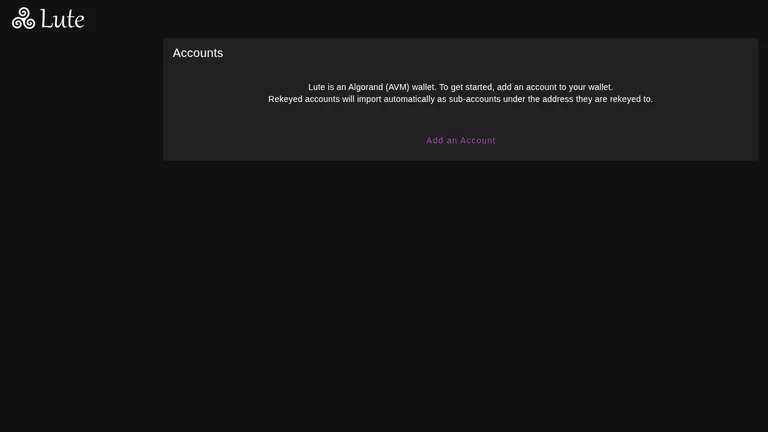
lute.app opens on an Accounts list. With nothing added, the page reads: 'Lute is an Algorand (AVM) wallet. To get started, add an account to your wallet.' A line underneath says rekeyed accounts import automatically as sub-accounts under the address they are rekeyed to. A single button sits on the screen, Add an Account.
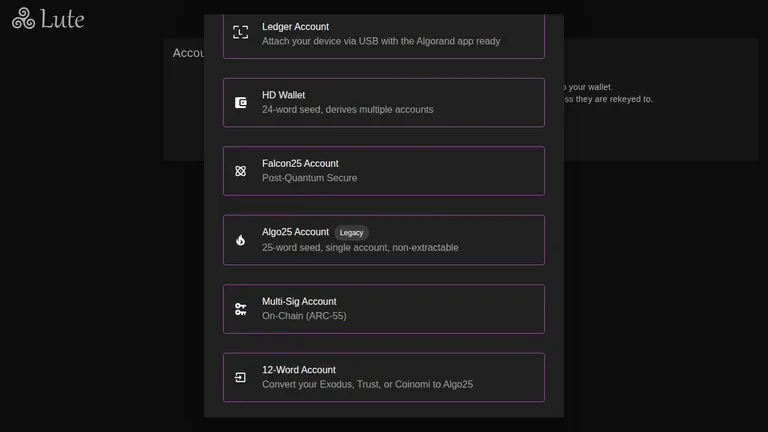
That button opens the account menu, and the order of it states the wallet's priorities. Ledger comes first, with the instruction to attach the device by USB with the Algorand app ready. Then an HD wallet on a 244-word phrase that derives several accounts, then a Falcon account, which the menu labels Post-Quantum Secure. Behind a More toggle sit a legacy hot wallet on a 255-word phrase, multisig accounts, and addresses added for watching only.
One of those options carries a caveat. Lute's X account6 said on August 16, 2026 that Falcon accounts could not yet send transactions, because both networks were still being upgraded, and a commit on September 24, 2026 added fee simulation for them.
What the wallet does
From an account, Lute sends and receives ALGO and Algorand tokens, and it connects to applications so they can ask for a signature. That connection runs through the project's own library, lute-connect7, rather than the WalletConnect bridge most Algorand wallets use. The project says the difference avoids the expired sessions the bridge produces. Developers downloaded the library 16,9116 times in its latest week and 51,5017 times in its latest month, counts of machines rather than people.
The rest of the feature list reads as a tour of the ecosystem's habits. An asset inbox lets an account receive a token without opting in to it first, which most Algorand tokens otherwise require. NFD names let a sender type a readable name such as lute.algo instead of a long address. Vaults, custom networks and data signing fill out the list, the last for approving a message rather than a transaction. A multisig account needs more than one key to approve a payment, and Lute keeps those approvals in a contract on Algorand.
The peer-to-peer swap is worth one look, because it works without a contract at all. One side builds two linked transactions, each address sending the other what it asked for, and shares a link. When the second person opens it, Lute decodes both, checks that each sender is the other's receiver and that both name the same network, and refuses the swap if either check fails. The second person then sees a plain summary of who is proposing, what they would send, what they want in return, and a warning to review both before signing.
Settings, networks and what it costs
Settings is where the plumbing shows. The network list runs from MainNet through TestNet, BetaNet, FNet and LocalNet to Voi MainNet and a custom endpoint, and the web app reaches Algorand's main network through Nodely. An inbox-router field creates or accepts the address of a contract that routes incoming assets, and it stays disabled outside a local test network. Snoop Mode lets watch-only accounts, which hold no signing key, connect to applications. Debug logging and a manual Ledger selector sit below that, conveniences for developers.
Nothing in the wallet costs money to use. A person pays the ordinary network fee on Algorand transactions and nothing else, with no subscription and no paid tier. The extension listing says the developer collects no data, and the web app's privacy policy8 says it uses Google Analytics for page views and referral data, which the policy says cannot identify anyone. One line on the Chrome listing is worth reading in full. The developer has not identified itself as a trader. For consumers in the European Union, that means consumer rights do not apply to a contract with it.
The repository carries a security policy with a 908-day window before a reported flaw goes public, and it runs automated code scanning. Its readme says the wallet is built on audited cryptographic libraries, which describes its dependencies. No audit of the wallet itself is named in its documentation.
Who builds it and how big it is
Lute is built by Andrew Funk, who put the project forward under that name in its funding proposal and also built FUNC, a tool for running an Algorand node. The code sits in a GitHub organization called GalaxyPay9, where the wallet repository is licensed AGPL-3.0, has 13 stars, and lists a single contributor. It is current: the Chrome listing shows version 1.26.119, updated on October 1, 2026, and the repository was still taking commits in the second week of October.
The size reads best off the storefronts, as of October 13, 2026. The Chrome listing shows 1,00010 users. The Discord linked from the site's footer10 is a guild named Lute Wallet with 33311 members, and the project's X account has 1,27212 followers. Its name, lute.algo, has 16 subdomains1113 issued under it, one of them expired.
Funding came through an xGov proposal12 that asked for 400,00014 ALGO. The xGov page labels it Retroactive and Other and reads 'Proposal Funded!'. The on-chain record of the vote shows 485,85315 approvals against 3,11916 rejections and 72817 abstentions, above a weighted quorum threshold of 356,22018. The discussion thread13 opened on the Algorand forum on February 16, 2026, and said the source would be opened, and the terms and conditions evaluated, only if the proposal passed. The repository is public today.
Where it sits among Algorand wallets
Pera14 is the closest thing the ecosystem has to a default, with 7,95319 ratings on its iOS listing against 11 for Lute's Chrome listing. The venues differ as much as the scale. Lute's niche is narrower and it does not pretend otherwise. It arrived in January 2024 for Ledger owners on desktop, as the browser options for hardware users were disappearing, and hardware is still the first account type in its menu.
Its route into applications is plumbing rather than branding. The project publishes lute-connect and an adapter for use-wallet, the library dApps use to offer wallet choices. It says Lute is available in Tinyman, Folks Finance, NFD, GoPlausible, Lora and xGov, mostly through that route.
What holds up
Lute is for the person who signs Algorand transactions from a desktop browser, and it fits best with a Ledger in hand. It delivers what it promises, since an account takes one button to add and nothing in the flow asks who you are. The token idea holds up as mechanism rather than value, for the reason the market check above gives. One event would change that judgment: a first recorded Lutier sale at a public price.
Sources (12)
- chromewebstore.google.comLute - Chrome Web Store
- lute.appLute: /faq
- github.com
- lute.appLute: /nfd-segments
- lute.appLute: /nfd
- github.comUnicorn! · GitHub
- github.com
- x.comlute.algo (@LuteWallet) / X
- github.comlute/src/components/addAccount/Ledger.vue at main · GalaxyPay/lute · GitHub
- algorand.coAugust 2026 Algo Insights Report
- algorand.coAlgorand Post-Quantum Cryptography Roadmap
- [lute.algo on X: "📢 Version 1.26.0 brings native PQ accounts to Lute.
These accounts cannot be used to send transactions](https://x.com/LuteWallet/status/208903191824764159715)
Sources (15)
- 1 lute.app lute.app Cited in the text ↩
- 2 chromewebstore.google.com browser extension in Chrome Cited in the text ↩
- 3 algorand.co Algorand Foundation's start-here page Cited in the text ↩
- 4 lute.app Settings Cited in the text ↩
- 5 explorer.perawallet.app 197 wallets Cited in the text ↩
- 6 x.com X account Cited in the text ↩
- 7 npmjs.com lute-connect Cited in the text ↩
- 8 lute.app web app's privacy policy Cited in the text ↩
- 9 github.com GalaxyPay Cited in the text ↩
- 10 discord.gg Discord linked from the site's footer Cited in the text ↩
- 11 app.nf.domains 16 subdomains Cited in the text ↩
- 12 xgov.algorand.co xGov proposal Cited in the text ↩
- 13 forum.algorand.co discussion thread Cited in the text ↩
- 14 perawallet.app Pera Cited in the text ↩
- 15 x.com x.com/LuteWallet/status/2089031918247641597 Cited in the text ↩
Further sources
- chromewebstore.google.com Lute - Chrome Web Store
- lute.app Lute: /faq
- github.com github.com/GalaxyPay/lute-connect
- lute.app Lute: /nfd-segments
- lute.app Lute: /nfd
- github.com Unicorn! · GitHub
- github.com github.com/GalaxyPay/use-wallet-lute
- x.com lute.algo (@LuteWallet) / X
- github.com lute/src/components/addAccount/Ledger.vue at main · GalaxyPay/lute · GitHub
- algorand.co August 2026 Algo Insights Report
- algorand.co Algorand Post-Quantum Cryptography Roadmap