Enel's ebitts sells tokens tied to two power plants' output, credited on your bill
Assets Round 65,923,647 9 min read #1 in Trending now3 reads 12 sources
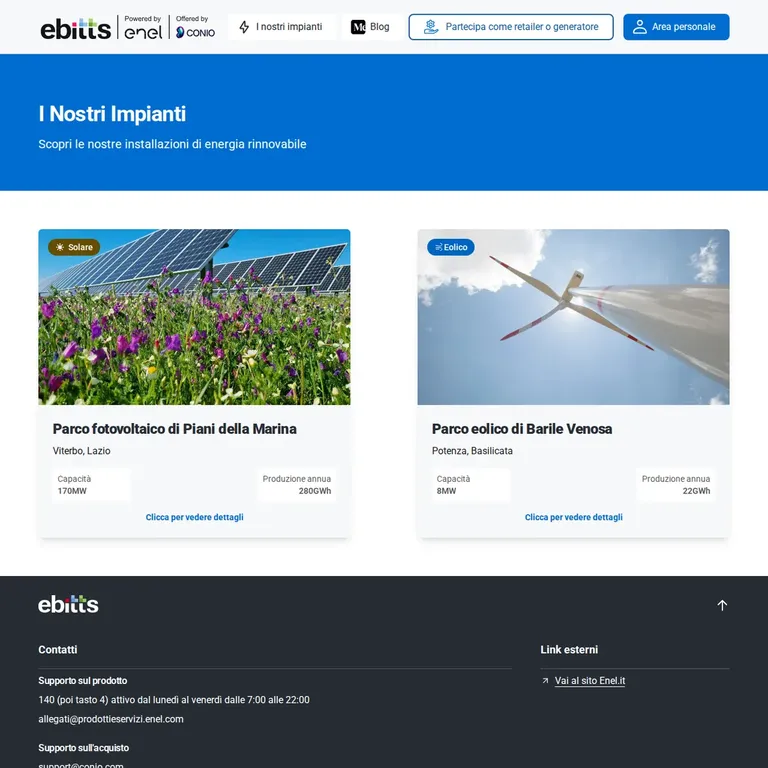
Italian households can buy a bundle of Algorand tokens tied to the output of a real solar park or wind farm and have that output credited to their electricity bill. The service is called ebitts1, it is run by the Enel group with the Italian fintech Conio2, and it requires no installation at home.
A customer picks a package sized to the household, pays once, and for the next ten, fifteen or twenty years receives a credit against the power they consume. The two plants behind the packages are the Piani della Marina solar park near Viterbo and the Barile Venosa wind farm in Basilicata. Enel publishes the same offer in English3.
The service opened to the public in July 2026 after a pilot, and the two tokens behind it have been live on Algorand mainnet since May 2026. Because they are Algorand assets, two numbers a customer would normally take on faith can be read by anyone: how many of them exist, and where they move.
What a person buys
The first step is the configurator on the ebitts site4. It asks for a household profile, offers three standard packages or a custom spend, and fixes the term at ten, fifteen or twenty years.
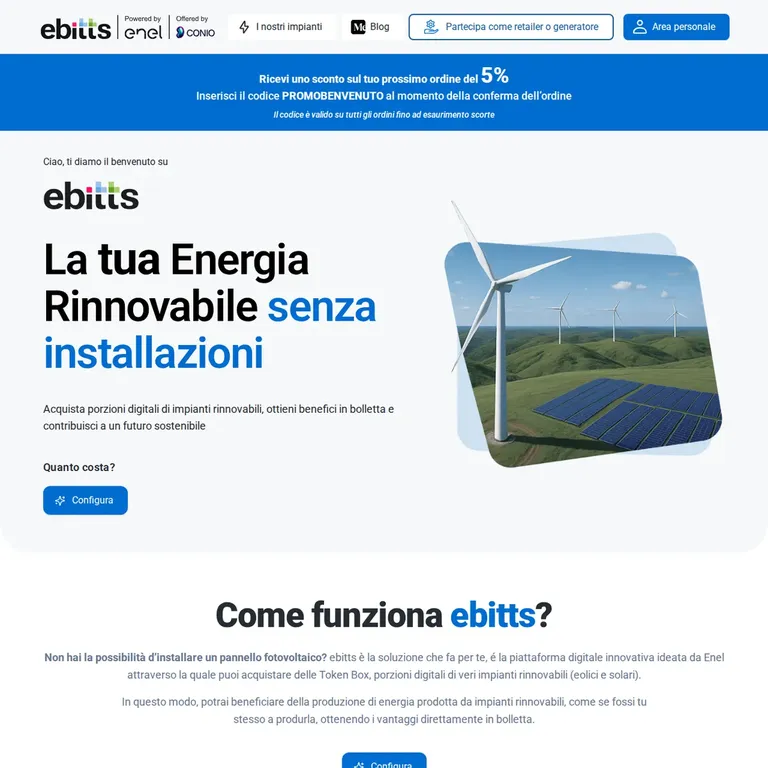
Only Enel customers on a compatible supply contract can buy. An order from anyone else triggers a call offering a suitable tariff, and payment follows confirmation. One Token Box can be linked to up to three supply points, belonging to the buyer or to close relatives, a spouse or a cohabiting partner. The linked homes can be changed later in the app, so the benefits move with the buyer.
| Token Box | Recommended for | Capacity | Estimated output a year | Solar and wind | Estimated saving a year | Price for ten years |
|---|---|---|---|---|---|---|
| Small | 1 to 2 people | 0.34 kW | 632 kWh | 72% solar, 28% wind | €1121 | €599 |
| Medium | 3 to 4 people | 0.65 kW | 1,301 kWh | 50% solar, 50% wind | €2332 | €1,289 |
| Large | more than 4 people | 1.02 kW | 2,201 kWh | 30% solar, 70% wind | €394 | €2,269 |
Source: 1 ebitts.conio.com
Prices and projections read from the configurator on October 12, 2026.
Longer terms cost more and are projected to return more. The Medium box is priced at €1,709 for fifteen years and €2,149 for twenty. Enel puts the estimated saving over those periods at €3,476 and €4,609.
Those figures are estimates built on Enel's own assumptions. The company assumes an average electricity price of €0.182 per kWh for the whole term, and average annual consumption of 1,400, 2,600 or 4,000 kWh depending on the package. Enel warns that the real saving depends on hour-by-hour consumption, on what the plants actually produced, and on market conditions.
The buyer's right to withdraw is set out on the site's payment and withdrawal pages. It runs for 143 calendar days from the order and costs nothing, and it is exercised by writing to Conio's support address. Conio reserves the right to refund the price net of benefits already used.
What the app shows
Production and consumption are watched in the ebitts app, published by Enel X and free on both stores. It shows the Token Box output and the metered consumption of the linked supply points down to the hour, and it suggests moving use to hours of higher production. A dedicated chart breaks the result down into self-consumed energy, surplus and energy bought from the grid.
On Google Play5 the app shows more than 1,000 downloads and an update dated September 3, 2026. On the Italian App Store6 it holds 4.4 stars from 22 ratings. One reviewer wrote that the numbers refresh only every 48 hours and that support was slow, while calling the project itself valid.
Who built it
Enel ideated and launched the service, and Conio handles the tokenization, sells the Token Boxes and holds the tokens in its wallet. Conio is an Italian fintech backed by Poste Italiane4 and Banca Generali5. It holds a MiCAR license7 to operate as a crypto-asset service provider in Italy, granted with Consob involved and the Bank of Italy's approval. Its founder and president is Christian Miccoli, and Alessandro Nardi, Enel's head of demand and pricing for Italian retail, is credited as the inventor of ebitts.
Conio's own description of its tokenization business8 notes that those services fall outside MiCAR's customer-protection measures, while its custody and crypto services sit inside them. Press coverage of the July debut places the Token Boxes themselves under the MiCAR framework and presents the product as one of the first energy utility tokens.
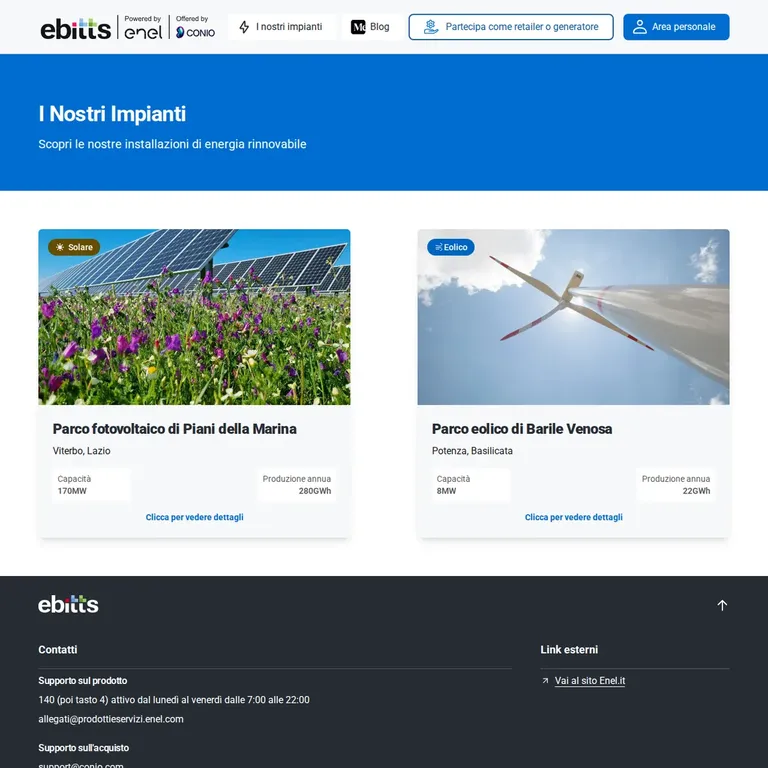
The two plants are real and named. Barile Venosa, in the province of Potenza, runs four turbines with about 86 MW of capacity and produces over 227 GWh a year. The product's plant pages9 say that covers roughly 1,800 households and avoids about 9,0008 tonnes of CO2 a year. Piani della Marina, near Viterbo, is listed at 170 MW and 280 GWh a year, and Enel Green Power Italy operates both.
What the chain shows
Each plant has its own token, named after it: ebitts Barile Venosa, with the wallet ticker EBT-BVEN, and ebitts Piani della Marina, with EBT-PDM. Both are Algorand tokens whose rules live in a smart contract rather than in a person's hands, the pattern Algorand's standards call a Smart ASA. Both are on mainnet.
The counts that matter are public. The wind token is capped at 8,000,0009 units and the solar token at 115,000,00010. Those caps sit in the controlling contract's public state, not in the asset's own fields, where a placeholder meaning "no fixed number" remains.
Who holds them
The wind token has 36111 holders. The solar token has 369. Units keep moving between them: 1,58712 and 1,49513 real transfers since the tokens were created on May 4, 2026, the most recent on October 12, 2026. Some of those are the operator moving tokens between its own accounts rather than customers receiving them.
Neither token trades. Tinyman and Pact, the two largest Algorand exchanges, list neither, and no market data exists for them, so there is no secondary price. The only value a holder can realize is the credit on the bill.
Algorand's case study goes further than Enel's own pages, describing a product "for the fractional ownership of solar panels and wind farms". The Foundation's video about the project says a customer can buy a solar panel from Enel, who will install it in their solar park. Enel's own pages stay with the credit, describing tokens that give access to benefits tied to the plants' generation. That is the version the app and the bills reflect.
How it compares
Buying a share of a distant power plant is an old idea with a mixed record. The Sun Exchange10 in South Africa sold individual solar cells from about $5 and paid people monthly for the electricity their cells produced, using bitcoin as the payment rail. It raised a $4 million14 Series A in 2020, and its customers were schools and businesses rather than households.
Italy already has a regulated route for producing in one place and consuming in another. A plant of up to 1 MW feeds the grid and its output is assigned virtually to consumption points on the same primary substation, with the grid operator doing the accounting. Enel's own guide11 to that scheme does not mention ebitts.
On Algorand, the nearest comparable is Lofty12, which tokenizes fractions of US rental homes. Its case study counted 14815 properties, an average of about 23116 buyers per home, and around 7,00017 monthly active users. That is the scale of a mature Algorand fractional-ownership product, and a fair ceiling for ebitts later.
Against both, ebitts has a distribution advantage and a visibility gap. The same case study describes Enel as the largest private electricity distributor in the world, with 12 million18 customers in Italy alone. No figure has been published for how many Token Boxes have been sold since the July debut. The monitoring app's download count is the only public measure of reach, and it sits a little above a thousand.
Testing the savings claim
The central claim is that a Token Box lowers a household bill. The mechanism is credible: the plants generate, the output is metered every hour, and the value is credited. The estimate itself comes from the seller, on the seller's assumptions, so a buyer is taking Enel's arithmetic on trust.
Who controls the tokens
The contracts are administered. One address is named in each contract's public state as the party that can freeze a holder's balance, take tokens back, and act as manager and reserve. That address created both contracts, and tokens are issued frozen by default, so they can only reach a holder through the contract.
That same address still holds nearly all of both tokens: about 97.7% of the wind token and about 99.8% of the solar token. Customer units move out through contract calls, and every one of those calls is visible. One call carries a plaintext note naming a specific Token Box, so at least some activity is tagged on chain. No readable mapping from a box to a customer's wallet is published.
The two plants also share one back end. Both contracts point to the same application that pays out the energy credit, the same credit token and the same identity application, so a small set of contracts serves distinct physical plants. The payout application has recorded more than 600,000 transactions since November 2024. Two earlier token contracts from that November reference the same shared applications, so the pattern is not a one-off.
The bigger idea
What is new here is not that an energy company sells a share of a plant's output. It is that the enforceable limit on how many shares exist sits in a contract anyone can read, and the credit those shares earn is recorded on the same public ledger. A customer who distrusts the seller's arithmetic can check half of the deal, the supply, without asking permission.
The design also scales sideways. Both plants already share one payout application, one credit token and one identity application. The next plant is a contract that points at the same back end rather than a new one built from scratch. The two token contracts from November 2024 that reference the same applications suggest the service was built that way from the start.
The limit is the customer end. The call that tags itself with a Token Box identifier does not say which wallet received the units, so the public record shows what has been issued rather than what any one household holds. A customer can watch the system move; they cannot yet point at their own part of it.
The verdict
ebitts is a real product with real plants behind it. The chain confirms the parts a buyer cannot check at home: which contracts govern the tokens, how many units exist, and that units were moving on October 12. The bigger idea holds where it is checkable. The enforceable cap on each plant sits in a contract anyone can read. A second plant was added by pointing another contract at the same shared back end. That is the pattern that makes many small assets practical for one operator. Where it stops is the customer: no public link runs from a Token Box to a wallet, and the savings figures are Enel's estimate on Enel's assumptions. The test to watch is narrow: whether a household can one day point at its own tokens on chain. Until then a buyer is paying for a ten, fifteen or twenty-year service, not an asset.
Sources (12)
- algorand.coEnel: Tokenizing renewable energy assets on Algorand
- algorand.coAlgorand can bring retail customers into the sustainable energy economy
- en.cryptonomist.chEnel embraces blockchain: a partnership with Algorand
- agendadigitale.euBlockchain e fotovoltaico virtuale: come ebitts rende l'energia rinnovabile a portata di tutti - Agenda Digitale
- technologyreview.itEbitts, in Italia arriva il token dell’energia pulita - MIT Technology Review Italia
- ebitts.conio.comebitts: /faq
- energiamercato.itEnergia green tokenizzata: ebitts al lancio dopo un anno di test
- en.spaziocrypto.comEnel and Conio Launch ebitts: Renewable Energy Tokens on…
- ebitts.conio.comebitts: /partecipa-come-retailer-o-generatore
- ilgiornale.itebitts: l’autoproduzione virtuale di energia rinnovabile senza nessuna installazione – il Giornale
- enel.itebitts: autoproduzione energia rinnovabile | Enel
- elettricomagazine.itEbitts, le rinnovabili di Enel e Conio senza pannelli né impianti - ElettricoMagazine
Sources (12)
- 1 ebitts.conio.com ebitts Cited in the text ↩
- 2 conio.com Conio Cited in the text ↩
- 3 enel.it publishes the same offer in English Cited in the text ↩
- 4 ebitts.conio.com ebitts site Cited in the text ↩
- 5 play.google.com Google Play Cited in the text ↩
- 6 apps.apple.com Italian App Store Cited in the text ↩
- 7 conio.com MiCAR license Cited in the text ↩
- 8 conio.com own description of its tokenization business Cited in the text ↩
- 9 ebitts.conio.com product's plant pages Cited in the text ↩
- 10 techcrunch.com The Sun Exchange Cited in the text ↩
- 11 enel.it Enel's own guide Cited in the text ↩
- 12 algorand.co Lofty Cited in the text ↩
Further sources
- algorand.co Enel: Tokenizing renewable energy assets on Algorand
- algorand.co Algorand can bring retail customers into the sustainable energy economy
- en.cryptonomist.ch Enel embraces blockchain: a partnership with Algorand
- agendadigitale.eu Blockchain e fotovoltaico virtuale: come ebitts rende l'energia rinnovabile a portata di tutti - Agenda Digitale
- technologyreview.it Ebitts, in Italia arriva il token dell’energia pulita - MIT Technology Review Italia
- ebitts.conio.com ebitts: /faq
- energiamercato.it Energia green tokenizzata: ebitts al lancio dopo un anno di test
- en.spaziocrypto.com Enel and Conio Launch ebitts: Renewable Energy Tokens on…
- ebitts.conio.com ebitts: /partecipa-come-retailer-o-generatore
- ilgiornale.it ebitts: l’autoproduzione virtuale di energia rinnovabile senza nessuna installazione – il Giornale
- enel.it ebitts: autoproduzione energia rinnovabile | Enel
- elettricomagazine.it Ebitts, le rinnovabili di Enel e Conio senza pannelli né impianti - ElettricoMagazine