DorkFi runs 35 Algorand lending markets and a contract-minted stablecoin
The pitch: credit without selling
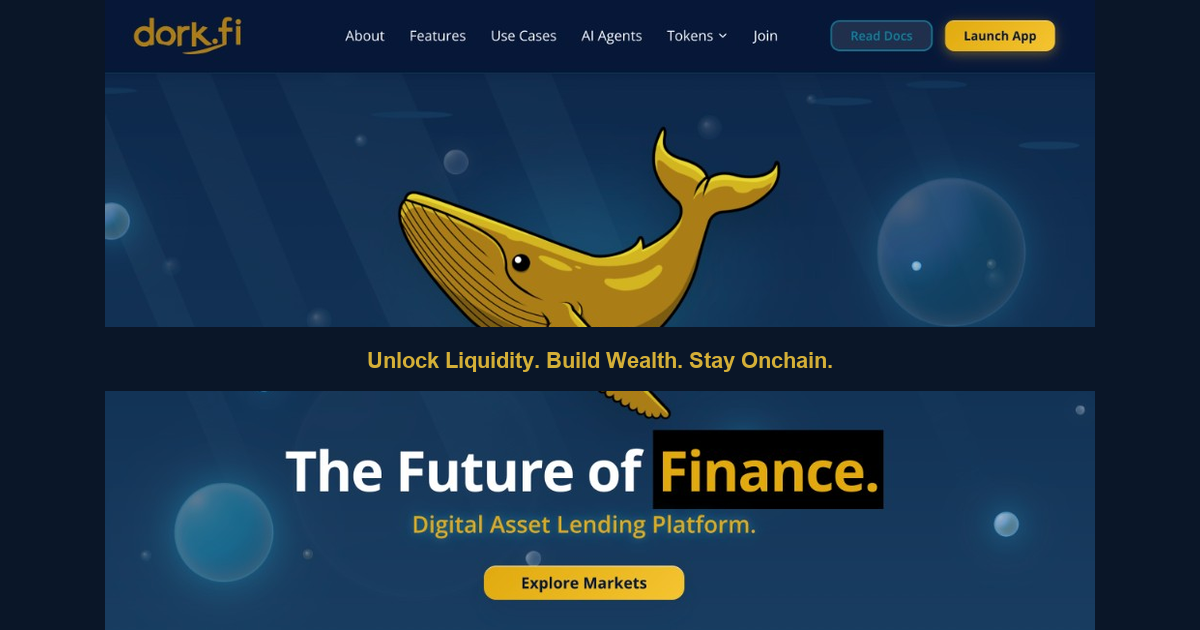
DorkFi's homepage leads with a two-word promise: 'Unlock Liquidity Without Selling.' The mechanics behind it are classic decentralized finance — deposit crypto as collateral, borrow against it, hold the position rather than cashing out — but the project packages that standard lending stack as a 'decentralized credit layer enabling users and AI agents to access liquidity on-chain,' a phrasing aimed as much at software as at people. The protocol runs on the Algorand Virtual Machine, the smart-contract execution environment shared by Algorand and the compatible Voi chain, and is the product of Dork Labs Inc., a Web3 development shop whose three co-founders — CEO Matthew Armstrong, CTO Nicholas Shellabarger and COO Michael Pappalardo — also sell contract-engineering services. The dork.fi domain was registered in January 2025, and the project's whitepaper says it is 'inspired by proven models like AAVE, MakerDAO, HyperLiquid, and Compound.'
Everything is non-custodial: users keep their own assets, and every action — supply, borrow, repay, liquidation — executes in a smart contract rather than through an intermediary. Supplying to a market mints nTokens, interest-bearing deposit receipts whose value grows as the market accrues interest; borrowing locks up collateral and introduces liquidation risk. Each market sets its own collateral factor, the share of an asset's value that counts toward borrowing power, ranging from 85% for USDC down to 40% for goETH. Interest rates move mechanically with utilization, the share of a market's deposits currently lent out, through the formula rate = base rate + slope × utilization. Positions are tracked by health factor, a ratio of collateral value to debt; below 1.0 a position becomes eligible for liquidation, where third parties repay part of the debt in exchange for discounted collateral. DorkFi's version supports cross-market liquidation, letting a liquidator repay in one asset and seize collateral from another.
Four market tiers, one credit layer
The docs segment the protocol into four market classes with different risk postures, which is what turns a plain lender into the 'credit layer' the site advertises.
| Market class | Real-World Implication |
|---|---|
| A-Markets (core liquidity) | Where WAD can be minted; typical assets include ALGO, USDC, goBTC and goETH |
| B-Markets (isolated) | Higher-volatility or lower-liquidity assets face stricter collateral factors, borrow caps and no WAD minting |
| C-Markets (LP collateral) | Tinyman v2 LP tokens can be supplied as collateral on Pool C — for example, borrowing WAD against UNIT LP positions |
| D-Markets (dynamic routing) | A planned abstraction layer that would route deposits across A and B markets to the best available yield |
The C-market design is the distinctive piece: a liquidity provider can deposit a Tinyman LP token — itself a claim on two assets inside an automated-market-maker pool — and borrow against it, extending credit to positions most lending protocols ignore.
Live on mainnet, at modest scale
What separates DorkFi from the average landing-page protocol is that it is running. app.dork.fi connects to a dedicated Algorand mainnet API — its code calls mainnet-api.algorand.dork.fi — and renders a live table of 35 markets, with Voi as a second supported network. The protocol went live on November 20, 2025, when its go-live announcement promised simultaneous deployment of lending markets, WAD minting and portfolio-health tooling on both Algorand and Voi, with liquidation markets following on December 15. To use it today, connect a Pera or Defly wallet and supply any listed asset. USDC is the most actively used market — $30,521 supplied, $14,154 borrowed, 43.5% utilization — while the goBTC market holds the largest pile of deposits ($49,794) at 0.3% utilization: liquidity parked, not deployed. The protocol's own analytics dashboard, viewed in mid-August 2026, reports:
| Metric (app analytics, mid-Aug 2026) | Real-World Implication |
|---|---|
| $253.7K total value locked | The app's own count; independent tracker DeFiLlama logged about $110.5K for August — the definitions differ, and both are small |
| $72.1K total borrowed | Roughly a quarter of deposits on the app's own count |
| $36.3K WAD in circulation | The stablecoin's live supply, up 4% on the day |
| 247 active wallets | The app's count of wallets active on the protocol |
| 6 borrowers with health factor below 1.0 | Six positions currently eligible for liquidation; 48 more sit above 1.5 |
| $46.2K deposits vs. $6.20 withdrawals | As displayed on the dashboard, deposits far outpace withdrawals — a net inflow |
DeFiLlama's tracking shows DorkFi oscillating between roughly $82,000 and $126,000 since March, peaking in April — a young protocol at small scale, whichever figure you use. The comparison that matters on Algorand: incumbent lender Folks Finance, which also supplies several of DorkFi's wrapped-asset markets through adapter contracts, holds about $46 million in total value locked. The tokens are still moving, though — WAD and UNIT each saw real transfers in the early hours of August 19.
Chart: DorkFi total value locked by month, per DeFiLlama's tracker (Mar–Aug 2026)
WAD: the contract-minted stablecoin
Whale Asset Dollar — WAD — is DorkFi's native stablecoin, minted only through overcollateralized borrowing in A-Markets: a user supplies eligible collateral, borrows WAD against it, and repays to burn it, so supply expands and contracts with demand rather than by discretionary issuance. The minting contract is visible on-chain: a 'Whale Asset Dollar' application whose owner is the same deployer account behind the lending pools, with its pause flag currently off. The docs are unusually blunt about what WAD is not — not legal tender, not redeemable for fiat, not issued or backed by any bank, not insured by the FDIC or any government entity, and 'no party, including DorkFi or Dork Labs Inc., is obligated to support, redeem, or stabilize WAD.' The homepage still describes it as 'designed to target a $1 value,' and the market broadly agrees: on Tinyman it traded at about $0.97 with roughly $6,900 in pool liquidity and $172 of volume in the past day, plus a separate WAD/USDC pool holding about $10,300. A circulation as small as the $36.3K noted above means the peg rests on thin liquidity — one large borrower can move it.
UNIT: governance token with a concentration problem
The governance side runs on UNIT, a fixed-supply Algorand Standard Asset of 420,069 tokens that trades on Tinyman at about $0.55 with $6,900 of liquidity. The whitepaper lays out a distribution tilted heavily toward the core team:
| Allocation | Share | Real-World Implication |
|---|---|---|
| Early incentives | 10% | Testnet rewards, capped at 100 UNIT per person |
| Pool funding | 19% | VOI pools, FINITE LP, and an initial LP position locked in a DORKHJ wallet |
| NFT staking | 16% | Dorks v1 and v2 holders earn UNIT on a linear two-year release |
| DorkFi (platform) | 45% | The protocol's own allocation; not circulating |
| Founder | 10% | Held by the project's 'Haroof' in a wallet on Voi |
On-chain, the concentration is sharper than the table suggests: the UNIT asset's creator address still holds 314,865 UNIT — just under 75% of the fixed supply — and is the sole holder of the asset's manager, freeze, clawback and reserve roles, meaning it could freeze or claw back tokens if it chose. Governance is nominally open — proposals pass when yes votes reach 69% of the voting power cast, with Dork NFT holders able to multiply their weight — but the governance page showed no active on-chain proposals, and the docs describe a hybrid model that is 'socially decentralized' but 'operationally controlled,' with execution performed by authorized operators rather than by the vote itself. Voting power also requires UNIT supplied into the protocol, not merely held in a wallet. For a token whose stated job is to govern risk parameters, the gap between the voting portal and the operator is the thing to watch.
The audit: critical findings, all closed
Before launch, DorkFi commissioned Entersoft, a Singapore security firm, to review its LendingPool contract — a single file written in Algorand Python, tested between August 12 and November 7, 2025. The published report's vulnerability summary counts 0 critical, 0 high, 2 medium, 0 low and 1 informational finding, and its executive summary notes that the assessment initially turned up critical- and high-severity issues — among them an incorrect token burn address, a redeem-function accounting bypass, and, most seriously, a 'fully centralized' price oracle: the contract owner could 'set market prices arbitrarily without validation,' which would enable unfair liquidations. Every finding is marked closed, the report states 'all identified findings have since been addressed,' and it rates the overall security posture 'GOOD.' The caveats are standard: the legal page notes no audit can guarantee the absence of vulnerabilities, and oracle and pricing risk remain on the protocol's own risk list. One transparency gap: the audited source file lived in a repository that returns a 404 today, so the report itself is the main public artifact of what was reviewed.
The AI-agent angle
DorkFi's most distinctive bet is that its next users won't be human. The dorkfi-agent-kit repository, released as v0.1.0 in July 2026, packages the protocol for AI agents via the Model Context Protocol (MCP), an open standard that gives assistants like Claude clean, readymade functions instead of low-level blockchain client code. A public API at dorkfi-api.nautilus.sh serves market data, per-wallet health factors and a list of undercollateralized positions, and the MCP server turns those into tools: get_markets for live rates, get_liquidation_candidates for liquidation bots, and transaction-building tools for deposit, borrow, repay, withdraw and liquidate flows that an agent pipeline can sign and broadcast. The docs sketch the resulting workflows — a health-monitoring agent that alerts before a position approaches liquidation, an automated liquidation bot that scans and executes on a schedule, or a leverage loop that borrows WAD, swaps and re-supplies. One honesty note: the kit declares an npm publish workflow in its package manifest, but the package was not found on the npm registry at the time of writing — for now it is consumed from the repository.
Where DorkFi sits
The roadmap points beyond the AVM: a df-evm repository carries a minimal Solidity lending pool built with Foundry, and the docs' xChain pages walk an EVM-wallet user through bridging USDC from a chain like Base to Algorand via Allbridge in order to supply a DorkFi market — a sign that EVM expansion is being built, not just promised. The community is small but present: the DorkHUB Discord counts 338 members, and the project raised small amounts from community members via tiered 'Dork Labs Investor' badges starting at $1,000. At the scale noted above, with a governance token concentrated in one address and an operator-controlled execution layer, this is an early-stage protocol whose real differentiators are the things a reader can verify: an audited contract, a live stablecoin with on-chain minting, and an agent toolkit that few Algorand DeFi protocols offer.
Source
- DorkFi
- DorkFi app
- DorkFi docs
- DorkFi whitepaper
- Entersoft audit report
- DorkFi GitHub
- Dork Labs Inc.
- DorkFi go-live announcement
- DorkHUB Discord
- Unlock Liquidity Without Selling | DorkFi
- DorkFi - The Future of Finance on Voi Network
- raw.githubusercontent.com
- https://dorkfi-api.nautilus.sh/analytics/tvl
- https://dorkfi-api.nautilus.sh/user-health/algorand
- https://api.llama.fi/protocol/dorkfi
- Create Fungible Token On Algorand Using JavaScript SDK | by Reveation Labs | Medium
Source: https://dork.fi/