Gora pivots from oracle feeds to a verifiable execution network for AI agents
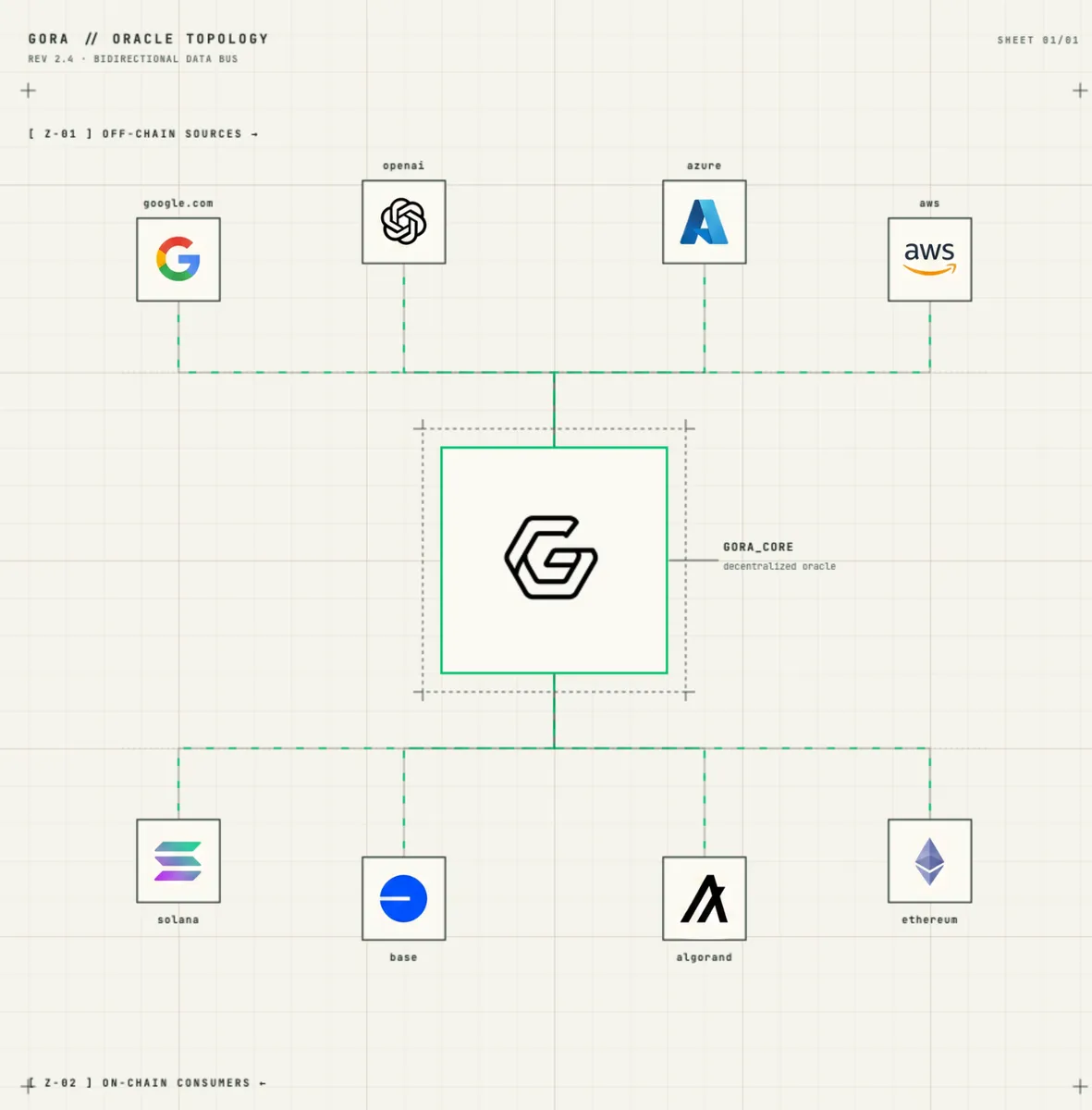
'Agents will trade, farm, bridge, and much more. They need a space to do it verifiably.' That is the entire pitch on Gora's homepage — the slogan of a five-year-old oracle project betting its next act on autonomous AI agents. Below it sits a 'Launching Soon' badge that has been in place since at least June 11, when the Internet Archive captured the identical page. The gap between that promise and what Gora has actually shipped — a ground-up network rewrite, full developer documentation, and a working local devnet — is this story.
From price feeds to agent infrastructure
Gora began in 2021 as Goracle, winner of that year's Algorand hackathon, building oracles: services that supply smart contracts with data from outside the blockchain, such as prices, sports scores, or sensor readings. It issued its $GORA token on Algorand in July 2023 as a fixed supply of 100 million tokens, rebranded to Gora that September, and took a strategic investment from Algorand Ventures in January 2024. The network then expanded outward — an ERC-20 version of the token on Ethereum in April 2024, an Arbitrum testnet in August 2023, and an oracle deployment on Base mainnet in late 2024.
An AI direction predates the current rebrand. A partnership post on the company blog frames Gora as a 'multichain compute and machine learning oracle' joining forces with AIT Protocol's AI marketplace, and Gora ran a machine-learning competition with Giza on DeFi liquidation-risk modeling. The most consequential enterprise milestone came in 2025, when Gora became the first Algorand-based project in Mastercard's Sandbox as a Service program, bringing its Enterprise Digital Asset Verification (EDAV) product to the program's network of fintechs and institutions.
The current chapter is a reset, not an incremental update. In December 2025 the team announced on its Telegram channel that it was 'moving from a classic oracle model to application-specific oracles, with a strong focus on powering on-chain AI applications,' adding it was 'prioritizing execution and revenue over aggressive marketing spend' — pulling liquidity off centralized exchanges, concentrating it on Tinyman and Uniswap, and starting $GORA buybacks. By April 2026 the Algorand Foundation's monthly ecosystem report had summarized the change in one line: 'Gora shifted focus to decentralized AI agents.'
Why agents need a different trust model
A manifesto published on April 20, 2026 makes the argument for the pivot. AI is producing a new kind of software, Gora writes — 'not apps that wait to be opened, but agents': programs that observe, decide, and act continuously, managing portfolios, executing trades, and monitoring contracts at a speed no human operator could match. The infrastructure under them was built for ordinary smart contracts. An agent that reads from Solana, fetches data from an API, computes a result, and writes it to an Algorand contract currently has to be stitched together from separate services, each with its own failure modes and each controlled by a different party. And when an agent acts — executes a trade, settles a payment — the people affected need to know it happened correctly, not because someone vouched for it but because the execution can be checked independently. Gora's line: 'Trust in agents cannot be a matter of reputation. It has to be architectural.'
The design Gora describes works like this. Execution is assigned through a verifiable random function (VRF), a cryptographic process that selects a validator unpredictably but in a way anyone can independently check; selection is weighted by stake. The chosen validator runs the program and proposes a result, a committee of independent validators verifies it, and if two-thirds or more of the committee's voting power agrees, the result is committed with a signed attestation — a proof binding the request, the app, and the output that any chain contract can verify. The same mechanism extends to AI: validators run models on their own hardware, and the output committed on-chain is the one a supermajority of independent validators agreed on, rather than the answer from a single centralized API provider. Gora estimates agents will consume roughly 25 times the per-user oracle demand of today's smart contracts — a projection the network has yet to be in a position to test.
| Concept | Real-World Implication |
|---|---|
| Verifiable execution | A validator is picked by verifiable random function, its result checked by a committee; anyone can audit the outcome without trusting the operator |
| Native identity | Every agent holds a wallet-rooted cryptographic identity, so it can receive payments, spend on services, and publish an auditable history |
| Cross-chain reach | One agent can read from Solana, call an API, compute, and write to an Algorand contract in a single verified execution |
| Local AI inference | Smart contracts get AI outputs verified by multiple independent validators running the model locally, not by one hosted API |
| Honest economics | The network's stated commitment — and its least-tested claim: token liquidity today is thin, so the economics have yet to be demonstrated |
What has actually shipped
Behind the manifesto is real tooling. Gora's developer documentation describes a network where apps are ordinary code — JavaScript, TypeScript, Python, or WASM — that reads input and returns JSON. 'Your app code makes a decision. It does not move money directly,' the docs state; the result is an intent that a wallet, gateway, or chain contract then executes. Key capabilities are verifiable randomness for every request, sandboxed HTTP calls to allowlisted endpoints, and attestations signed by the evaluating committee. The docs are explicit that 'the Gora network is not a blockchain — it agrees on app outcomes and writes attestations to whichever chain the result targets': Solana, Base, or Algorand, with staking entry points on all three. A validator stakes GORA on the chain it already uses; a cold owner key signs a delegation certificate binding a hot participation key, so the validator process can sign votes without ever touching the cold wallet, and a compromised participation key can be rotated without affecting stake. A request is processed by a committee of typically five validators.
A developer can today scaffold an agent with the Gora CLI (gora init my-agent --template agent-mobile-signing --chain algorand), deploy it, and invoke it against a Gora Devnet that runs local copies of the three chains plus the network node behind ngrok tunnels; the docs walk through the full build-validate-package-deploy-invoke loop and how to inspect the request, result, and attestation. Each app ships a policy.json that acts as a rule book — allowed chains, per-transaction and daily amount caps, recipient allowlists, and execution modes ranging from manual mobile signing (a human reviews and signs each action) to pre-approved agent or smart wallets. Gora's mobile apps render app interfaces as HTML in a WebView and keep keys and signing in native code; the flow the docs recommend first for anything that moves value is manual mobile approval. In March 2026 the team announced a 'completely rewritten, ground-up version of Gora - and it's built for the agent era,' telling developers there are 'no private keys in your code' and that they can 'scaffold an agent, deploy, and let it act on-chain with verifiable results.' In June it demoed a futures-trading app built on the Tinyman API and running through a 'Gora Super App' mobile client, plus validator-management screens, saying it would be available to everyone 'soon.' One caveat from the docs themselves: for the MVP, slashing on detected misbehaviour is deferred — misbehaving validators are detected and excluded from tallies but not financially penalized.
One practical gap remains for anyone wanting to try the Devnet today: the documentation's typical public endpoint (gora-dev.ngrok.app) returned 404s for the documented health and contract-registry paths when checked in August, suggesting the Devnet is spun up on demand by its operator rather than continuously public.
Where the launch stands
The homepage's 'COMING 05/01' marker, echoed in search-result snippets of the site, points to a May 1, 2026 testnet launch. The countdown never resolved: as of mid-August 2026 the site still shows the pre-launch badge captured in June, testnet.gora.io resolves to a generic hosting landing page, and the most recent public update — a June 20 Telegram post about the Super App — still describes the new network as coming. The public GitHub organization, meanwhile, has been quiet since spring 2025: 15 repositories with 21 stars in total, last pushed in April 2025, even as the v2 documentation lives on a separate Mintlify site. The team behind the rewrite is a small one — roughly 19 people per Tracxn's May 2026 snapshot.
The token side shows why 'honest economics' is the least-tested pillar. GORA trades on Tinyman with about $2,965 of liquidity and roughly $205 of volume in the last 24 hours at a price near $0.00078; its pools on Pact report zero TVL. In November 2025 the community's DAO — launched on Aragon in July 2025 — approved a proposal to inject 50,000 ALGO and 388,000+ GORA into the Gora/ALGO pool on Tinyman, yet the pool remains thin. The DAO also runs a rewards program that pays GORA to holders of the project's 870-item GoraBots NFT collection, a structure that incentivizes holding the project's own assets, and delivered its eighth rewards batch at the end of December 2025. GoraFi, the earlier DeFi front end, still shows a staking screen listing 36 validator operators for an ERC-20 staking product marked 'Coming Soon!'. A separate consumer product, GoraAlpha — pitched in December 2025 as an AI app 'that helps you understand what's really happening behind the charts' — had a landing page archived in January 2026, but its live site did not respond when checked in August. Gora's Discord remains the liveliest community surface: 19,849 members with 190 online at the time of checking.
None of this makes the pivot a hollow one. The documentation is substantive, the Mastercard program is a genuine institutional foothold, and announcements have flowed continuously through June 2026 — a company shipping while its flagship network is still unlaunched. The promised testnet date passed without a launch; whether the next one holds is the checkpoint that will decide whether 'built for agents' reads as a roadmap or a record.
Source
- Gora homepage
- The network built for agents (manifesto)
- Gora developer docs
- GORA Announcements (Telegram)
- Gora Network on Medium
- Algorand Foundation, April 2026 Algo Insights Report
- Algorand Ventures invests in Gora Network (Blockchain.News)
- Gora and AIT partnership
- GoraFi
- Gora Network GitHub
- Gora Network Discord
- Gora Network Official: X, Facebook, Twitter | Linktree
- Stake GORA | GoraFi
- Agentic Infrastructure - Vercel
- Launchpad | GoraFi
- Learn | GoraFi
- www.gora.io
- Transfer | GoraFi
- GORA Announcements – Telegram
- gora.mintlify.app
- How Gora apps work - Gora Docs
- Validators and consensus - Gora Docs
- Deploy to Gora - Gora Docs
Source: https://gora.io/