Four ways to earn on Algorand, and the four pockets that pay for them
Staking ALGO solo needs 30,000 coins and pays 4.57%, about $113 a year on a $2,471 stake. Lending USDC on Folks Finance earns 4.42% against 1.29% for ALGO, and the deepest ALGO/USDC pool yields about 6.64% before divergence risk. Check the pool size beside every rate.
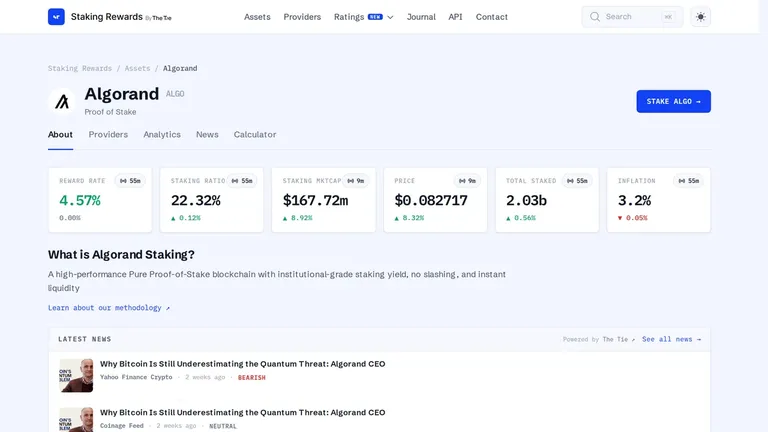
An ALGO holder who meets the 30,000✓1-coin line can earn about 4.57%✓2 by staking, but on November 27 that stake was worth about $2,471 and the rate came to roughly $113 a year. That gap between a percentage and a cheque is the first thing to understand about earning on Algorand. The second is that the four common routes are paid out of four different pockets.
Staking is paid from transaction fees plus a Foundation bonus. Lending is paid by borrowers. Liquidity provision is paid by traders passing through a pool. Staking a platform's own token is paid by that platform's revenue or by new tokens it hands out.
Two pages can both print 4.5% and mean entirely different things. One is a fee stream that thins when trading thins; the other is a subsidy with an end date. Everything below is ordered from the simplest route to the most mechanical.
Part 2 of this series covered wallets, a first swap and the shape of lending and staking. This piece is about the ways to earn.
1. Staking ALGO: one hard rule, one drifting number
Bringing ALGO online to help confirm blocks is the plainest route. Algorand's terms are unusually kind: no slashing, no lockup, and rewards paid as each block finalizes every 2.8✓3 seconds, compounding as they land. The reward has two parts. 50%✓4 of each block's transaction fees go to its proposer, plus a bonus that started at 10✓5 ALGO a block and decays 1%✓6 every million blocks until January 2028.
The hard rule is the floor. Solo rewards need an account holding at least 30,000✓7 ALGO and no more than 70 million✓8, a threshold set by community vote in Governance Period 10. Going online also carries a 2 ALGO key-registration fee, which Staking Rewards' methodology gives as the mark of a reward-eligible account. Delegated staking, where you pay someone else to run the node, carries the same floor.
Thirty thousand ALGO was worth about $2,471 at the day's price of about $0.0824✓9. At the 4.57%✓10 reward rate it earns about 1,371 ALGO, or roughly $113, a year, against inflation of 3.2%✓11. The real return on the money is close to nothing. The headline rate is also falling, and the panel below is one month of it.
Staking Rewards' 30-day panel, read on 27 November 2026. All three figures are annual percentages.
- Reward rate: 30 days earlier: 4.66%; 27 Nov 2026: 4.57%.
- Share of ALGO online: 30 days earlier: 22.16%; 27 Nov 2026: 22.32%.
- Inflation: 30 days earlier: 2.95%; 27 Nov 2026: 3.2%.
The Foundation bonus shrinks on a fixed schedule, so the part of the reward that does not depend on usage gets smaller each month.
A holder at or above the line who would rather not run a node can hire one.
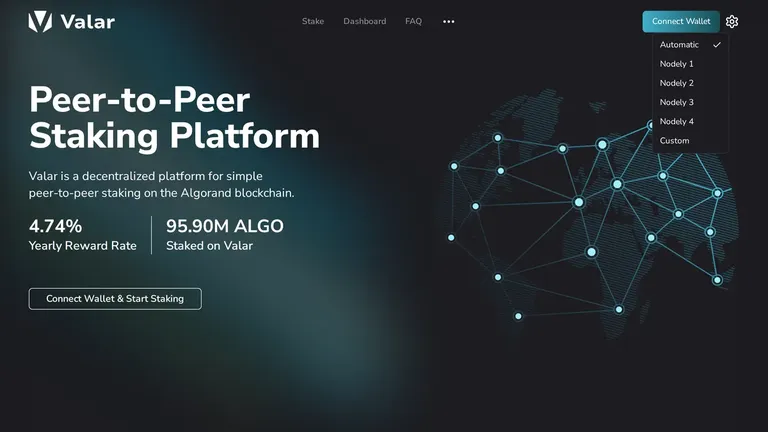
Valar1 runs a peer-to-peer marketplace: your ALGO stays in your wallet, a node runner elsewhere does the consensus work, and Valar says it takes no commission from the rewards. Its site showed a 4.74%✓12 yearly reward rate and 95.90 million✓13 ALGO staked through the platform on 27 November.
No commission on rewards is not the same as no cost. Valar's platform overview, dated January 15, 2025, sets out a commission with a minimum on the platform's noticeboard, a one-off setup fee, and an operational fee made of a flat amount per block round plus a variable amount per ALGO per round. That fee is paid up front, in ALGO or in USDC. Treat the 4.74% as a figure before the operator's charge rather than after it.
Below 30,000 ALGO: a custody choice, not a rate choice
Pools and liquid staking accept any amount, which is how most holders earn at all. The difference between them is who holds the coin while it works.
Réti pooling2 is one open door. The Nodely dashboard listed pools whose minimum entry ranged from 1 ALGO to 20,000✓14 ALGO, with operator fees from 0% to 10%✓15, and showed estimated returns of roughly 4.9%✓16 to 5.4% where it showed one at all. Many listings showed no estimate, so on that page the minimum and the fee are the reliable numbers.
Liquid staking swaps the coin for a token. Folks Finance3 issues xALGO and Tinyman4 issues tALGO. Both tokens have empty manager, freeze and clawback roles that can never be set again, with their reserves held by contract accounts rather than a person's key. The trade is a slice of the rewards: Folks keeps 10% of xALGO staking rewards, and Tinyman applies an 8%✓17 fee to tALGO's block rewards before they are distributed.
2. Lending: the dollar out-earns the coin
Folks Finance is the deepest lending venue on the chain, and its market table on 27 November showed the asymmetry plainly. About $3.92 million✓18 of USDC was deposited against about $2.82 million borrowed, and lenders were paid 4.42%. Folks' ALGO market held about 119 million ALGO in deposits, roughly $9.87 million, and paid 1.29%.
Which asset you lend matters more than which venue is biggest, and the published parameters explain the gap. A depositor's rate is utilization times the borrow rate times one minus the protocol's retention, and Folks keeps 20% of ALGO interest against 10% of USDC's. Its optimal utilization is 90% for ALGO and 85% for USDC.
The rule Folks Finance publishes for its lending markets.
- Formula: d = u × b × (1 − k).
- d: the rate paid to depositors (%).
- u: utilization: the share of the deposits that is out on loan (%).
- b: the rate borrowers pay (%).
- k: retention: the share of the interest the protocol keeps (%).
Folks Finance's two main Algorand markets, as its app showed them on 27 November 2026. All figures are annual percentages.
- Lending USDC: Deposit APY: 4.42%; Variable borrow APY: 6.17%; Stable borrow APY: 10.19%.
- Lending ALGO: Deposit APY: 1.29%; Variable borrow APY: 2.81%; Stable borrow APY: 8.49%.
The other side of that table is where the risk sits. A borrower may draw up to 65% of ALGO collateral or 80% of USDC collateral under Folks' General loan type, with higher limits in its efficiency modes. The loan becomes liquidatable once total borrowed passes the collateral's value times that factor. Folks states there is no grace period. A liquidation is capped at 50% of the borrow balance and pays the liquidator a bonus of 8% on ALGO or 6% on USDC, a tenth of which the protocol keeps.
For the lender the claim is narrower: only the wallet that made a deposit can withdraw it.
The venue is shrinking too. DeFiLlama put Folks' Algorand TVL at about $66.8 million✓19 at its May 2026 peak and about $40.4 million✓20 on 27 November, a partial month.
- TVL in USD: starts at 65694326 (Dec 25) and ends at 40379260 (Nov 26).
- TVL in USD: high 66792983 (May 26), low 40379260 (Nov 26).
How a loan works, step by step
You hand over an asset and someone else pays to borrow it. First you deposit, and that deposit becomes collateral while a loan is open. The collateral factor then sets the ceiling: 65% of ALGO's value or 80% of USDC's in Folks' General loan type. Next you borrow, choosing a stable or a variable rate. On 27 November USDC borrowers paid 6.17%✓21 variable or 10.19%✓22 stable, and ALGO borrowers 2.81%✓23 or 8.49%✓24.
Interest then accrues on the debt, so the room between what you owe and what your collateral supports shrinks. Once the debt passes collateral value times the factor, a third party can repay part of the loan and take collateral at a discount, up to 50% of the borrow balance, with a bonus of 8% on ALGO or 6% on USDC. Nothing pauses at that point: Folks states there is no grace period.
Your interest as a lender comes from the borrower's payments, minus the protocol's retention, scaled by how much of the pool is out on loan.
3. Providing liquidity to a pool: how it pays you, step by step
A liquidity pool holds two assets in a ratio. First you deposit both, in whatever proportion the pool already holds, and the contract gives you a token representing your share of everything in it. Then each trade pays a fee into the pool, and because the fee stays there, your share is worth slightly more. The deepest ALGO/USDC pool on Tinyman's v2 contracts held about $1.41 million on 27 November and traded about $95,300 in 24 hours, charging 36✓25 basis points of which 27 go to depositors.
A pool always keeps its two coins balanced in value. When ALGO rises, traders buy ALGO from the pool and leave USDC in its place; when ALGO falls, the reverse. So the pool is constantly selling whichever coin is going up and collecting the one going down, and it does this with your money.
That is the risk. When you withdraw you get your share of whatever the pool holds at that moment, not the amounts you put in. If one coin has moved a lot against the other, you hold less of the winner than if you had simply kept both in your wallet.
In figures: at that volume the depositors' share of the fees works out to about 6.64% a year before any price move. But if the two prices move apart by half in either direction, you end up 5.72% worse off than if you had simply held both coins. At the current fee flow that takes roughly 314 days of fees to recover.
So the fee is payment for a risk. The risk is that the pair does not stay calm, and the 6.64% also assumes traders keep arriving at the same pace. The fee rate is fixed by the pool; the volume is not.
4. Staking a platform's own token, where the big numbers live
The last route is the noisiest. Pact5's stake page listed 36 active farms, including a single-token ALGO farm with no pair and so no divergence risk, with rates across the list running from 1.7%✓26 to 999.9%✓27.
Farms come in two kinds, and the difference matters. In a single-token farm you deposit one coin and earn rewards on it; your coin stays your coin. In an LP-token farm you first put two coins into a pool, receive the token that stands for your share, and stake that token. You then earn the farm's rewards on top of the pool's trading fees, and you carry the pool's risk from the section above as well as the farm's.
Haystack6's HAY pool showed 18.76%✓28 APR across 245✓29 wallets holding 70.6%✓30 of the circulating supply, with most of that paid in USDC. Those rewards come from Haystack's own swap fees, arriving a few times a day and spread over about a week.
Haystack's yield directory showed the same spread, from USDC at 4.42% on about $3.92 million✓31 to memecoin farms above 400% on pools of tens of dollars.
Across both pages the highest rates sat on the smallest pools. Both are one day's snapshot from two venues, and both mix APR with APY labels, so read each as that venue's own claim rather than a league table. What funds rewards at those rates is not something either page states.
What the rates are worth
Four routes, and none of them is free money. Thirty thousand ALGO earns about $113 a year at 4.57%, a dollar lent on Folks earns 4.42%, a depositor in the deepest ALGO/USDC pool earns about 6.64% against a divergence risk of the same size, and the farm rates in four figures sit on pools of tens of dollars.
The check worth doing before any deposit is the one these pages already print for you: the size of the pool behind the rate, next to the rate itself. A 4% return on a large pool and a 900% return on a small one are not the same offer, and on Algorand today both can appear on the same screen.
- Solo staking, $167m online: 4.57%.
- Valar staking, $7.9m staked: 4.74%.
- Folks, lend USDC, $3.9m market: 4.42%.
- Pact ALGO farm, $28.2k: 4.4%.
- Folks, lend ALGO, $9.9m market: 1.29%.
- Haystack HAY stake, $177k: 18.76%.
31 figures in this story are checked.See every check
Sources
- 1Valar stake.valar.solutions↩
- 2Réti Pooling | Dashboard reti.nodely.io↩
- 3Folks Finance app.folks.finance↩
- 4Tinyman | Decentralized trading protocol on Algorand tinyman.org↩
- 5Pact app.pact.fi↩
- 6Haystack hay.app↩
Further sources (10)
- Algorand SRB | Staking Data docs.stakingrewards.com
- Algorand (ALGO) Staking — Live 4.57% APY | Staking Rewards stakingrewards.com
- Stake HAY | Haystack hay.app
- Yield | Haystack hay.app
- Isolated Pools docs.folks.finance
- Algorand (ALGO) Staking Analytics | Staking Rewards stakingrewards.com
- Stake · Pact app.pact.fi
- Stake Your ALGO For Rewards | No Slashing Risk | Algorand algorand.co
- What to do with Algo: A Complete Guide to Staking on Algorand algorand.co
- raw.githubusercontent.com/ValarStaking/valar/master/Valar-Platform-Overview.pdf raw.githubusercontent.com