Derova.algo's dashboard tracks one Algorand node's pending pool and the next state proof
Derova.algo's free dashboard shows one Algorand node's pending transaction pool live, plus the last 20 blocks, node health and a countdown to the network's next state proof. No wallet needed — but the pool count is one node's view, not the network's.
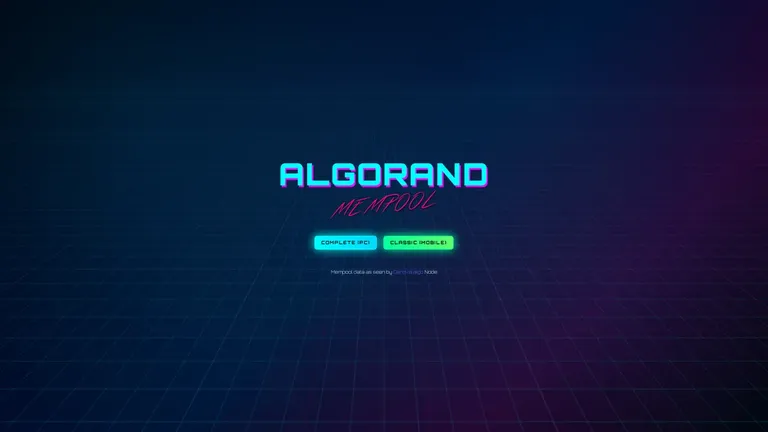
mempool.algorand.ing is a free web page that shows, live, what is sitting in one Algorand node's pending transaction pool — the queue of transactions that have been broadcast to the network but not yet written into a block. Next to the queue it counts down the network's next state proof, a compact certificate of what the chain currently contains, and lists the last twenty blocks with the number of transactions each carried, their size and the fees they collected. Nothing on it asks for a wallet, a login or a payment.
The page belongs to Derova.algo1, a community node runner, and it is explicit about whose numbers these are: the footer credits 'Mempool data as seen by Derova.algo Node'. It is one of four free tools on the personal domain algorand.ing2 — a node status page, a Grafana metrics dashboard3 and a link to Valar4's peer-to-peer staking are the others — published under a disclaimer that the site is 'independently owned and operated by a member of the Algorand community' and is not connected to Algorand Technologies or the Algorand Foundation.
What a reading of the page looks like
A type-distribution panel fills the left of the screen: how many pending transactions are payments, how many are asset transfers, how many are calls to smart contracts, and how many fall into the categories nothing is using at that moment — key registrations5, asset configuration, asset freezes, state proofs, heartbeats.
Three loads of the page, minutes apart, each showed a different queue. The first caught 49 transactions: 15 payments, 18 asset transfers and 16 app calls.
Minutes later the same panel read 78, of which 57 were app calls. A third read caught 39. The swing is the point: Algorand writes a block roughly every 2.8 seconds, so a transaction rarely waits long, and the count you see is not the count the next visitor sees. A payment moves ALGO; an asset transfer moves a token issued on Algorand, which the network's Algorand Standard Asset mechanism lets anyone create without writing a contract; an app call invokes a smart contract. Those three were the whole of the pool at every reading, and the five zeroed categories are ordinary Algorand transaction types that simply were not happening in that minute.
Three more panels carry the rest of the page.
| Concept | What it shows | Real-world implication |
|---|---|---|
| Pending pool by type | Transactions this node has received but not yet placed in a block, split by type | A queue that lasts a second or two, and that no block explorer keeps a record of |
| Recent blocks | The last twenty rounds, with transaction counts, size and fees collected | A fee total near the 0.001 ALGO floor means the chain is quiet and nobody is bidding to get in6 |
| Network health | Node online or offline, consensus healthy or not, and the exact software build it runs (version 5.0.1, commit e763fb0d) | Tells you whether the node supplying these numbers is itself keeping up with the chain |
| Quantum security | When the last state proof was posted, how many blocks until the next, the block height it attests to, and whether any are waiting in the pool | The visible half of Algorand's post-quantum work, on a countdown you can watch |
Source: 6 dev.algorand.co
Block sizes stay modest: across the twenty-block windows this research watched, per-block counts ran from 8 transactions to 57. One of those windows included a 54-transaction block that collected 0.115 ALGO in fees. Algorand's base fee7 is 0.0018 ALGO per transaction when the network is quiet, so 54 plain transactions would pay 0.054 ALGO — less than half that block's total. Some of its transactions therefore paid above the floor, and the documented ways that happens are a voluntary higher fee, a Falcon-1024 post-quantum signature (minimum 0.0039 ALGO, three times the base) or congestion pricing, which applies only once blocks start filling.
The Classic view and the three things that can happen to a transaction
A second page at mempool.algorand.ing/classic strips the dashboard to five numbers — PENDING, CONFIRMED, DROPPED, CONNECTED and the current block — and is the better view on a phone. It is also where the machinery shows. Its code opens a websocket to api.algorand.ing10 and listens for updates to the pool; each new transaction is logged as pending along with its last valid round, and the page subscribes to that specific transaction so it can report one of three outcomes: confirmed, with the round and how long it took; dropped from the pool; or expired.
Expiry is the one worth understanding. Algorand transactions carry a first and a last valid round11 instead of a nonce, and the window between them is the only period in which a transaction can be committed; reach the last valid round without it being included and the transaction is no longer eligible, and it has to be resubmitted. That is what a live view buys you: you can watch your own transaction sit in the queue and see whether it is about to fall out of its window.
At one reading the Classic page showed 20 pending, 14 confirmed and 0 dropped; an earlier crawl of the same page recorded 49 pending, 43 confirmed and 4 dropped. The counters move.
Why a pending-pool view means something different on Algorand
On Ethereum, a mempool viewer is largely a spectator sport: blocks fill, users bid fees to jump the queue, and the interest is in who is paying what for the next slot. Algorand runs the other way. In a November 2021 forum thread12 that is still the plainest explanation of it, a question about viewing pending transactions drew a reply from the developer handle fabrice noting that 'contrary to Ethereum, there is no prioritization of transactions by gas fee and there is currently no congestion', and a second reply, from tsachi, warning that 'there is no guarantee that your node would see all the transactions which would go to the next (effective) block.'
The fee rules make the same point from the other end: a transaction pays the larger of a per-byte congestion charge and the minimum fee, the per-byte charge is zero while the chain is quiet, and payments, asset transfers and app calls are all priced the same way. So this page is not a front-row seat to a bidding war. What it tells you is whether a transaction was seen at all.
The general-purpose explorers cover the settled chain instead. Allo13, Pera Explorer14 and Algo Surf15 list blocks, accounts, assets and network throughput — Algo Surf reported 10.2 transactions per second and a 2.80-second average block time at one read, against the 13 TPS and 2.73 seconds Nodely's public dashboard16 measured across 100 blocks. All of that is history: by the time a block appears, its transactions are final. The pending pool is the part before it, and it has been the harder thing to keep alive. An Algorand mempool explorer at iamnotabot.com/pool was online from December 2021 — a developer building the same tool for TRON17 in 2022 cited it as the one to copy — and the domain no longer resolves. Another live-transaction view, chaintrail.io, now serves an unrelated gambling site.
The catch: one node is not the network
Everything here is one node's view, and the page says so itself. Those 2021 forum answers12 explain why the qualifier does real work: different Algorand nodes can hold different versions of the pending pool, and their contents are not guaranteed to match. The two pages did not agree with each other either: read a minute apart during one research session, the front page's type panel and the Classic page's pending counter differed by a factor of two and a half. That looks like a difference in what each page counts — the front page reports the node's pool as the node sees it, while the Classic page keeps its own tally of the transactions one open browser tab has watched, clearing counters as blocks land — but neither figure could be reproduced from outside. Two neutral endpoints, the free algod service from AlgoNode (the team behind Allo) and one from Nodely18, each returned a single pending transaction at roughly that moment, while every endpoint listed at api.algorand.ing asks for an X-API-Key header and returns a 401 without one. Whether the difference reflects timing, peering or a genuinely larger view from Derova's node is something the public endpoints cannot settle. The live feed is reproducible through the page itself.
Two more things cannot be checked from the outside. The dashboard's code is not published: Derova's public GitHub19 holds two repositories, a fork of the Ré'ti staking-pool project and a set of guides to running an Algorand node, neither of them this page, so how the counts are computed is not inspectable. And the page carries no published figure for how many people look at it. The operator is a verified community account rather than a company — the derova.algo20 name was registered in June 2022 and links to an X account with 477 followers — but the account behind it is a real consensus participant: it holds about 44,969 ALGO, is registered online to participate, and its recent history includes heartbeat transactions, the type Algorand introduced so a node can explicitly signal it is online even when it does not propose a block. His node status page21 lists two mainnet stacks, labelled Valar EU and Myth Finance, with node, algod service, host and carrier each reading 100 per cent.
He has retired a service before rather than leave it stale: a Ré'ti staking-pool interface he ran at reti.algorand.ing22 now displays a notice that it was never meant to be the official interface, and points visitors to reti.nodely.io23. None of this is a custody risk — the page holds no wallet connection and no funds, and the only third parties its code loads are a web-analytics service and Google Fonts. What is at stake is the accuracy of a free read-only display.
What to open first
Start with the front page and give it a minute. The type distribution redraws as transactions arrive and clear, and the block list underneath refills every few seconds. On a phone, load the Classic view: five numbers and a connection status, no charts. If you run an Algorand node, its algod service exposes the same pending-transaction list this page is built from, so Derova's count is something you can check against your own node's view rather than take on faith.
The panel to leave open is the quantum one. Algorand has produced state proofs24 on mainnet since 2022, signed with Falcon, a lattice-based scheme chosen for its resistance to quantum computers, and posts a new one every 25625 rounds — about twelve minutes at the chain's recent pace. Derova added the tracking in an April 3 update, writing at the time26 that the page 'has been updated to track the State Proofs so you can track when they'll occur in real-time.' The Algorand Foundation's roadmap27 targets broad quantum resilience by the end of 2027, with the first milestones due from the third quarter of 2026.
4 figures in this story are checked.See every check
Sources
- 1Derova.algo x.com↩
- 2algorand.ing algorand.ing↩
- 3Grafana metrics dashboard metrics.algorand.ing↩
- 4Valar stake.valar.solutions↩
- 5key registrations dev.algorand.co↩
- 7base fee dev.algorand.co↩
- 10api.algorand.ing api.algorand.ing↩
- 11first and a last valid round dev.algorand.co↩
- 12November 2021 forum thread forum.algorand.co↩
- 13Allo allo.info↩
- 14Pera Explorer explorer.perawallet.app↩
- 15Algo Surf algo.surf↩
- 16Nodely's public dashboard tps.nodely.io↩
- 17the same tool for TRON devpost.com↩
- 18Nodely nodely.io↩
- 19Derova's public GitHub github.com↩
- 20derova.algo app.nf.domains↩
- 21node status page status.algorand.ing↩
- 22reti.algorand.ing reti.algorand.ing↩
- 23reti.nodely.io reti.nodely.io↩
- 24Algorand has produced state proofs dev.algorand.co↩
- 26writing at the time x.com↩
- 27The Algorand Foundation's roadmap algorand.co↩