LeakSwap trades ALGO for Monero directly, but only on testnet
LeakSwap is a public beta that lets two people swap ALGO for Monero directly, with no bridge or wrapped token. Mainnet is disabled, so a reader can follow the guide and walk a testnet swap from start to finish with the project's own Zebgen wallet.
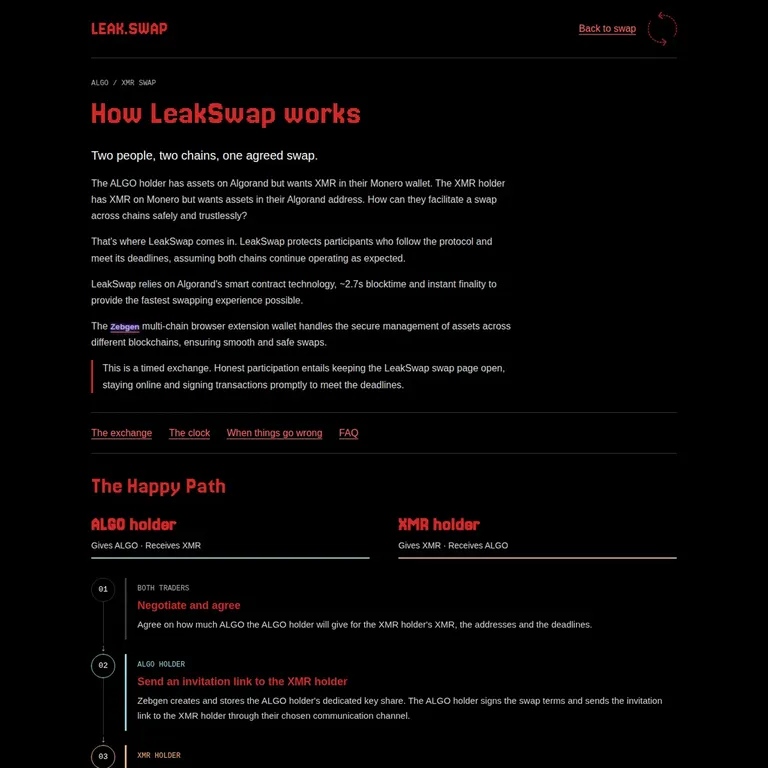
LeakSwap1 is a public beta that lets two people trade ALGO for Monero directly, with no exchange between them and no wrapped token. Its swap page2 states the limit at the top: 'Test networks only. Mainnet is disabled.✓1' The page offers two network pairs: Algorand testnet paired with Monero's stagenet, or a local pair for developers.
So a reader holding real ALGO cannot swap it here today. What they can do is read the guide3, install Zebgen4, the project's own browser wallet, take test coins from two faucets and walk a swap from start to finish with money that is not money.
You cannot connect without the project's own wallet
The swap page will not go further without Zebgen, a browser wallet for Algorand and Monero that its makers call 'Tailor-made for LeakSwap'. It is in no browser extension store. You download a release archive from GitHub5 and load it unpacked through your browser's developer mode; the releases run from late October to November 7, 2026.
Until then the page simply reports 'Zebgen wallet extension was not detected.✓2' That gate says as much as the header does: a prototype handed to testers, not a service. The site itself is not broken. It loads with no console errors and no failed requests, and its only Algorand connection points at a testnet node.
A swap is not a bridge
A bridge takes your coin on one chain and issues a stand-in on the other. Someone holds the original, and you trust them, or a set of validators, to hand it back. LeakSwap mints nothing and pools nothing. Two people agree a price between themselves, and each moves their own coin. The ALGO side locks ALGO in a small smart contract whose rules are public. The XMR side pays XMR to a Monero address. No order book, no market maker, no rate set by anyone but the two of them.
The hard part is Monero, which has no smart contracts to hold a rulebook. LeakSwap runs the Monero side on keys instead of code.
- Step 1: Two people agree terms directly. Price, two Algorand addresses, two Monero key shares, two deadlines.
- Step 2: Each side generates a Monero key share. Only public halves travel; the 2-of-2 address needs both private halves.
- Step 3: ALGO is locked in a smart contract. The ALGO side escrows its coin in an app with published rules.
- Step 4: XMR is sent to a 2-of-2 Monero address. Neither party can move it alone.
- Step 5: XMR side reveals a half and claims ALGO. The revealing signature is checked on chain; ALGO goes to the XMR seller.
- Step 6: The ALGO side recovers the XMR. A separate action, not automatic.
Each side generates a fresh Monero spend key for the swap and shares only the public half. The two public halves together define one address that neither party can spend from alone. On the Algorand side the contract holds the ALGO and can check a Monero signature, which is how it pays out only to someone who really holds a Monero key.
The leak is the payment
The name describes the settlement, not a flaw found in it. To take the ALGO, the XMR holder must send the contract a Monero signature built on a deliberately broken nonce: the value 1, whose curve point is a fixed constant. Only the holder of that private key can produce the signature, and once it sits on Algorand anyone can read the key half out of it. Publishing that half is what lets the ALGO holder combine the two halves and spend the XMR.
The reverse works the same way: an ALGO holder taking an early refund publishes their own half so the XMR holder can recover a deposit. The guide tells users to dedicate a fresh Monero wallet to each swap, because settlement exposes a spend key that could otherwise put other funds it controls at risk.
The contract has four exits, and they differ in who may call them, when, and what the caller gives away.
- setReady: Who can call it: ALGO side only; When it works: before t0; What it reveals: nothing.
- leakyRefund: Who can call it: ALGO side only; When it works: up to t0, if not ready; What it reveals: its Monero key half.
- leakyClaim: Who can call it: XMR side only; When it works: after t0, before t1; What it reveals: its Monero key half.
- punishRefund: Who can call it: ALGO side only; When it works: at or after t1; What it reveals: nothing at all.
No exit lets either side take the other's coin while keeping its own key half secret. That is what stands in for a middleman: rules both sides can read before funding, and one secret each side chooses to reveal in order to be paid.
Deadlines carry the risk
Two deadlines bound a swap. Both are absolute Algorand round numbers. Both are fixed when the invitation is created. t0 is the deadline for the ALGO side: mark the contract ready, or take an early refund. t1 is the deadline for the XMR side to claim. Rounds, not a device clock, decide, at 20✓3 rounds per configured minute. Every step is a transaction someone has to send, and nothing fires on its own.
Missing t1 is the expensive mistake. At or after t1 the ALGO side can take its coin back without revealing anything, and the XMR stays at the combined address with nobody able to spend it. The project's own answer says that without the ALGO holder's cooperation, 'the XMR is effectively lost to the XMR holder✓4'. The loss lands on the side that gave Monero.
The contract cannot see Monero at all. The ALGO side has to watch the combined address with both view keys. If the XMR never arrives, it must refund before the deposit deadline. Past that deadline the XMR side can claim without having deposited anything.
What a finished swap costs
A successful claim keeps 0.5%✓5 of the escrowed ALGO, rounded down. Refunds and punish refunds cost nothing. On one testnet claim the escrow paid 5,000 microALGO to the fee address and closed the remaining 995,000 microALGO to the XMR-side account, which is that rate on a one-ALGO escrow. The ALGO side also funds a settlement sponsor, which the protocol README6 puts at 209,000✓6 microALGO, up from 204,000✓7. Network fees come on top on both chains.
What has run, and what has not
On Algorand testnet the path has executed. The fee address that a successful claim pays shows at least five claim transactions between October 26 and November 3, 2026. One swap can be followed from creation to payout. A contract escrowing 5 testnet USDC paid out on November 3, 2026. The claim sent the tokens to the XMR-side account and closed 200,000 microALGO back to the ALGO side.
Past that, the record thins. No tool used for this piece could read Monero's stagenet, so the XMR deposit, the combined address and the recovery step are described here from the project's guide and from Algorand-side records, not observed. The project is candid about the state of things. The protocol README says 'Mainnet operation is not certified'. Its token development note says no testnet or public-chain USDC/XMR swap 'has been certified yet'. The guide warns that the swap page 'does not yet provide a complete guided XMR recovery entry point✓8', and that 'Wallet seeds alone may not reproduce the combined-wallet context.✓9'
The two newest token swaps never finished. One escrow held 5 testnet USDC and 200,000 microALGO; the other held 3 testnet USDC and 200,000 microALGO. Both still held their funds when the escrows were read on November 28, 2026. Whether that is a test left running, an abandoned attempt or something else is not in the record.
Those tokens come from a short curated list. Agreements admit mainnet USDC, Meld Gold (GOLD$) and Meld Silver (SILVER$), plus testnet USDC, and the contract checks the asset id, its six decimals and its default-freeze setting rather than trusting a ticker. Meld Gold and Meld Silver were each issued with 100,000,000,000✓10 units, and every one of the nine tokens that issuer created carries a manager, a freeze address and a clawback address. Those role addresses hold the powers, and the creator holds none of them by being the creator. A set freeze address can freeze a holding; a set clawback address can move tokens out of an account without its consent. The project's development note names that as an outside risk: a frozen escrow or a frozen recipient 'can prevent settlement; this contract cannot override the issuer.'
No independent security review turned up. The repository's security notes are the author's own constraints and threat model, and they say the test suite does not certify an expired punish refund, public-chain execution, or wallet and swap-page integration.
One developer, with a day job
LeakSwap has one public author. The Algorand forum's xGov-34 post7, 'Algorand-Monero Swaps', created in June 2023, lists a single author, the developer who publishes the code on GitHub as HashMapsData2Value. It states 'ALGO Requested 100,000✓11 (Milestone 1 of 2)', to turn his proof of concept into production code. Asked whether a team could start as soon as funding landed, he answered 'Yes, I can. (There's just me, no team.)✓12'
The design is older than the beta. The same handle opened an issue in the ARCs standards repository8 in April 2022. It set out how a Bitcoin-to-Monero swap could be adapted to Algorand, including the deliberately leaky signature and the two deadlines. The 2026 repositories descend from it. The thread shows no funding decision. Its last reply, from September 2023, answers a different question.
He works at the Algorand Foundation. His GitHub profile says he is 'currently working for the Algorand Foundation, doing applied cryptography and fullstack development', and lists LeakSwap and Zebgen among his personal projects. No Algorand Foundation statement about either was found, so this is an employer named on a profile, not a backer.
What a reader can do today
Since the beta takes no real coin, a reader risks only time. The guide is more specific about failure modes than most shipped products are, and the contract source sits beside it for anyone who wants to check the rules themselves. Running a swap needs only the wallet and the test funds described above.
Watching is the honest default for most holders, given the project's own caveats. When a mainnet version is announced, three questions will separate a launch from a demo. Has anyone outside the author completed a swap? Does XMR recovery work without hand-holding? And has the wallet that keeps Monero keys in a browser been reviewed by someone who did not write it?
13 figures in this story are checked. 1 was read straight from the chain.See every check
Sources
- 1LeakSwap leakswap.com↩
- 2swap page beta.leakswap.com↩
- 3Swap Page: /how-it-works beta.leakswap.com↩
- 4zebgen | Algorand & Monero Wallet zebgen.com↩
- 5release archive from GitHub github.com↩
- 6BREAKING CHANGES github.com↩
- 7xGov-34 Algorand-Monero Swaps - Algorand Forum Archive forum.algorand.co↩
- 8Discussion & Feedback on adapting Bitcoin<->Monero atomic swap protocol for Algorand <->… github.com↩