Algorand DeFi for newcomers: start in your wallet, then swaps, lending and staking
A guide to Algorand DeFi, from wallets and swaps to lending and staking, framed by Vestige Labs switching off its swap platform on December 31 while the pools it routed through keep trading. Start with a small swap in Pera or Defly, then read a token's roles before you hold it.

DeFi series, part 2 — how DeFi works on Algorand, for newcomers.
DeFi is what you get when the trading, lending and staking a bank does for you is done by smart contracts that anyone with a wallet can call. Algorand has a working version of it, and this month brings a clean demonstration of the rule underneath. On December 31 Vestige Labs switches off its swap platform, taking its frontend, its API, its aggregator and all related services offline, and the pools its router traded through carry on✓1 without it.
That is the idea in one event. The venue is a website and a router. The money sits in contracts that answer to your key rather than to a company's. What follows is what each part of DeFi does on Algorand, in the order a newcomer meets it.
The Keys Come First
Nothing here starts with an account. It starts with a wallet, and the key inside it is what a contract checks before it moves anything. A contract account, whose address is a program rather than a key, can send transactions too, but a person's funds move on their signature. Pera and Defly are the two the Algorand Foundation lists as wallets, Pera as a general-purpose app with a built-in browser for dApps and Defly as a trading wallet with DEX support and multi-signature security.
Because the key is yours, the venue is not holding your money. Tinyman's own site says that although TM Distributed Development Ltd. wrote much of the initial code, it does not provide, own or control the protocol, which runs on smart contracts on Algorand. Folks Finance makes the same point from the lending side: only the wallet that deposited funds can remove them.

So a front end can close while the money stays put. Humble DeFi merged into Pact in August 2024 and its Algorand interface was wound down to withdrawals, with its liquidity providers asked to move to Pact's pools, yet HumbleSwap's pools still trade.
Every Algorand token also publishes which roles are set on it, and that is the first thing worth reading before you hold one. LiquiHog's HOG token has no freeze role and no clawback role, and the asset record says neither can ever be set again. USDC is different: its freeze role is set, so an issuer can stop a balance from moving, though with no clawback role it cannot pull tokens out of a wallet. Part 1 covered what backs it and who can freeze it.
Three changes that reshaped which Algorand venues a newcomer meets.
- 2024-08-12: Humble and Pact merge; Humble's UI winds down.
- 2024-11: Staking rewards replace governance rewards (launch).
- 2026-12-31: Vestige Labs' swap platform goes offline (shutdown).
A Wallet, and the Smallest First Step
Choose the wallet first, because everything else happens inside it. Pera's US App Store listing carries about 7,950✓2 ratings averaging 4.77, and Defly's about 176✓3 at 4.8. Both are non-custodial, which means the key stays with you and no support desk can reset it.
Two costs arrive before your first trade. A token your account has not held before needs an opt-in, which costs the 0.001✓4 ALGO network fee and keeps an extra 0.1 ALGO in the account for as long as you hold it. Every transaction then costs 0.001✓5 ALGO, whatever its size.
The first trade is a swap, and it can happen without leaving the wallet. Pera's support pages walk through it. Pick what you pay, what you receive and how much. Then read the quote screen before you sign: it shows the rate, the price impact, your slippage tolerance, the fee, the provider and the minimum you will receive.
An Algorand transaction is final once it is in a block, so a swap sent with the wrong asset or the wrong amount cannot be recalled. A failed swap is the safe kind of failure. If the price moves past your slippage setting before the trade lands, nothing goes through and the tokens stay in your wallet.
Swaps, and the Pools Behind Them
The wallet does not fill the trade itself. Pera's P.E.R.A. aggregator checks Vestige, Tinyman, Folks Finance and Deflex and takes the best rate it finds. Haystack's router1 checks Tinyman, Pact, HumbleSwap, Folks Finance and the xALGO and tALGO contracts. When splitting an order across them pays more, it splits. The trade goes out as one atomic group, so it completes in full or not at all.
Whichever route it takes, the tokens come from a pool that other people funded, and the fee you pay goes to them. That is the business of a decentralized exchange. Depositors put two assets in, traders pay a small cut on the way through, and the depositors collect it. Pact describes itself as routing across every DEX on Algorand, including its competitors, and LiquiHog runs a router of its own with a 0.05% fee floor.
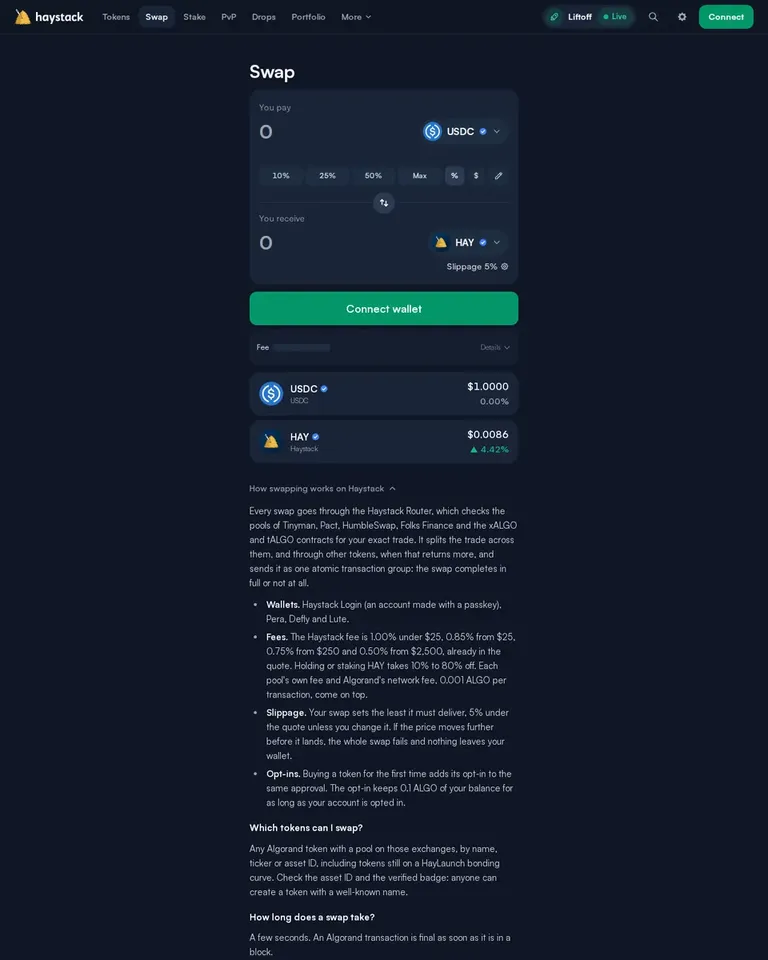
The costs stack, and on a small trade the wallet's cut is the largest. Pera's own worked example puts a $100✓6 ALGO-to-USDC swap at the full 1% fee at roughly $1.00✓7 to Pera, $0.25 to $0.30 to the pool's depositors and under a cent to the network. Haystack charges by size instead: 1.00% under $25, 0.85% from $25, 0.75% from $250 and 0.50% from $2,500, already in the✓8 quote, with the pool's fee and the network fee on top.

Rates as each source states them, 24 Nov 2026. The pool fee is charged on top of whichever wallet or router you use.
- Pera swap fee (up to): Rate: 1%; Who gets it: Pera.
- Haystack fee on a $100 swap: Rate: 0.85%; Who gets it: Haystack.
- Tinyman ALGO/USDC pool fee: Rate: 36 bps; Who gets it: The pool's depositors.
- Network fee per transaction: Rate: 0.001 ALGO; Who gets it: The Algorand network.
What a pool charges is a property of the pool rather than the venue's front page. The deepest ALGO/USDC pool on Tinyman's v2 contracts2 charges 36 basis points, 27 of them to depositors.
Depositing is a different job from swapping, and the fee is payment for a risk. The two prices can move apart and leave a depositor worse off than if they had simply held both tokens.
The Dollar in the Middle
Most trades on Algorand start or end with a dollar, and the dollar here is USDC. It is a native Algorand token issued by Circle, and DefiLlama reported its dominance of Algorand's stablecoin market at 98.86%✓9 on November 17.
What matters for DeFi is narrower. It is the asset you swap into when you want out of ALGO's price, and the asset the lending markets are mostly priced in.
It is also not a deposit. Holding USDC earns nothing by itself. The way to earn on it is to lend it, which is the next block.
Lending: Interest, and a Margin Call
Lending is where DeFi stops being a swap and starts being a position. On Folks Finance3 you deposit an asset and borrowers pay you interest for it, or you post collateral and borrow against it, which is how someone gets dollars without selling their ALGO.
The deposit side4 is the calmer half. The borrow side5 is where the edge is. Folks' FAQ is blunt that there is no grace period when a loan becomes undercollateralized, and that if the liquidation margin reaches zero a liquidator can sell the collateral. The liquidator buys some of it to keep the protocol's reserves whole and earns the difference between the price it paid and the price it sold at.
The per-asset thresholds that decide when that happens are not published in Folks' documentation, so a borrower should find them before opening a loan. Folks also runs Lending Pools with Tinyman and Pact, where a depositor earns the lending interest and the pool's swap fees at once.
Staking: One ALGO to Join, 30,000✓10 to Be Paid
Staking is the block most likely to disappoint a beginner's expectation. Anyone with as little as 1 ALGO can take part in Algorand's consensus and help secure the network, but an account must commit 30,000 ALGO to be eligible for rewards. Pera's staking support page says that threshold was set by community governance vote in Governance Period 10. At $0.0797 on November 24, 30,000 ALGO was worth about $2,390✓11.
Below that, the routes are liquid staking and pools. Pera's staking menu offers liquid staking, staking pools and delegated staking, all run by third parties rather than by Pera, and it does not offer solo staking. The Foundation's staking page points to Folks' xALGO6, Tinyman's liquid staking, Pact's consensus-compatible pools, Retí pooling with Nodely and with Valar, and several exchanges. Governance, the older programme where holders committed ALGO to vote for rewards, has ended, and staking now means taking part in consensus.
Liquid staking is the route most small holders take. You deposit ALGO and receive a token that represents the stake and keeps earning, so the position can still be traded or lent. Tinyman's documentation says an 8%✓12 fee is applied to total block rewards before distribution to tALGO holders. Folks Finance's documentation says it retains a 10%✓13 fee on xALGO staking rewards, directed to its community treasury.
Those tokens are assets whose powers sit with contracts. tALGO's manager role is empty, so no role on it can ever change. Its reserve sits with a contract account rather than a person's key. On November 24, 2,352✓14 wallets held a balance of it.
Rewards come from the protocol rather than from a borrower. The Foundation's staking page says they come in two parts: a block reward drawn from transaction fees, set at 50%, and a supplementary bonus starting at 10✓15 ALGO per block that decays 1%✓16 every million blocks, committed until January 2028. About 2.02 billion✓17 ALGO was online securing the chain on November 24, roughly a fifth of the 9.82 billion✓18 ALGO held in accounts. What that pays in practice, and whether it is worth the contract risk, is where the series goes next.
What You Are Taking On
Three risks are worth naming before anyone deposits. A liquid staking or lending position means trusting that protocol's contracts, and Pera's staking pages say so plainly: bugs or exploits could put the funds at risk. A loan can be sold out from under a borrower once its collateral falls far enough, and a front end can vanish while the contracts keep running.
Slippage is the one setting that is yours. A loose tolerance is how a beginner pays more than the quote suggested, and a tight one is how a swap fails three times in a row on a thin pair.
Your First Move
The cheapest way to learn this is a small swap inside a wallet you control. Set up Pera or Defly, fund it with a little ALGO, and swap a few dollars of it for USDC in the app, reading the quote screen before you sign.
Then read the token before you trust it. Every Algorand asset publishes its roles, and one with no freeze and no clawback cannot be stopped or taken from your wallet by anyone, including its creator. That check separates a token you can hold from one you are trusting someone else to leave alone.
The details
DefiLlama put Algorand's chain-wide DeFi TVL at $25,063,629 on 24 November 2026. Its protocol rows are counted on a different basis and are not a sum of that headline, as our August piece on the gap set out. Tinyman read $4,210,769✓19 on Algorand, which was also its all-chain total, Pact $879,677✓20 on both, and Folks Finance $39,177,355✓21 on Algorand out of $41,622,954✓22 across all chains. DefiLlama records no TVL for Haystack, because a router holds no pools of its own.
The deepest ALGO/USDC pool on Tinyman's v2 contracts, read at round 67,255,228, held 8,721,538.215087✓23 ALGO against 691,451.331799 USDC✓24, charged 36 basis points with 27 to depositors, and showed $1,382,902.66 of liquidity and $375,260.45 of volume in 24 hours. Tinyman's fee page7 states 0.3% with 0.25%✓25 to depositors, while the pool's own state is what a trade pays. Pact's weighted ALGO/USDC pool charged 36 basis points and its constant-product pool 30.
Staking's threshold was worth $2,389.74✓26 at an ALGO price of $0.079658✓27 on 24 November 2026. At round 67,255,752, 2,021,237,093.120227✓28 ALGO was online against 9,821,954,263.256533✓29 ALGO held in accounts, or 20.58% online.
tALGO is asset 25370137348✓30, total supply 10,000,000,000.000000, with its manager role empty so no role can ever change and its reserve held by the contract account. HOG is asset 31788951779✓31, total supply 1,000,000.000000✓32, with freeze and clawback empty and permanently so.
Humble DeFi and Pact completed their merger on 12 August 2024, and HumbleSwap V2 still showed $36.07K of TVL, $60.35K of 1-day volume and 1,683 trades on 24 November 2026. LiquiHog's HOGSWAP router10 has a 0.05%✓33 fee floor, and its documentation says a platform that routes swaps through it keeps a share of the fee above that floor, accrued in the router and claimed by the platform.
36 figures in this story are checked. 4 were read straight from the chain.See every check
Sources
- 1Trending Algorand tokens | Haystack hay.app↩
- 2Tinyman's v2 contracts docs.tinyman.org↩
- 3Folks Finance docs.folks.finance↩
- 4Deposit | Folks Finance docs.folks.finance↩
- 5Loan | Folks Finance docs.folks.finance↩
- 6xALGO - Liquid Staking | Folks Finance docs.folks.finance↩
- 7Fees | Tinyman Docs docs.tinyman.org↩
- 82537013734 allo.info↩
- 93178895177 allo.info↩
- 10GitHub - LiquiHog/defi-passport-docs: User-facing documentation for DeFi Passport… github.com↩
Further sources (11)
- defillama.com/protocol/folks-finance defillama.com
- Pera Wallet – Understanding Swap Fees and Slippage in Pera support.perawallet.app
- Pera Wallet – How do I stake on Pera? support.perawallet.app
- Pera Wallet – Staking ALGO with Pera — Setup, Rewards & FAQ support.perawallet.app
- Defly Wallet App - App Store apps.apple.com
- FAQ | Folks Finance docs.folks.finance
- What are Staking Rewards? A Comprehensive Guide for Algorand Users algorand.co
- docs.tinyman.org/liquid-staking docs.tinyman.org
- Stake Your ALGO For Rewards | No Slashing Risk | Algorand algorand.co
- Pera Wallet – Introduction to Staking support.perawallet.app
- HOGSWAP v3 API hogswap-v3.liquihog.dev