HesabPay launches free Visa virtual cards, targets 1M in Afghanistan
A Wallet Built Where Banks Stopped
When Afghanistan's banking system seized up after the Taliban's return to power in August 2021 — sanctions, frozen assets, a paralyzed sector, a shortage of physical currency, and more than 22.8 million people facing starvation — the country's aid economy hit a wall. Only about 6 percent of Afghans have bank accounts, while roughly 60 percent own a smartphone or feature phone, and Gallup estimated that 97 percent of the population lives below the poverty line. HesabPay, a Kabul mobile wallet founded by Afghan-American entrepreneur Sanzar Kakar — a University of Pennsylvania and Warwick Business School graduate who worked at Merrill Lynch before leading state-funded economic programs in Afghanistan — was designed to route around that wall: money moves between phone numbers, approved by PIN and two-factor authentication, with no bank in the middle. The Algorand Foundation dates the founding to 2016; the company's own releases say 2018.
In September 2022, with Algorand Foundation grant funding, HesabPay migrated from the Stellar network to Algorand, which it uses as its settlement layer — the component that finalizes and records transactions. The choice was driven by the chain's mechanics: Algorand's [Pure Proof-of-Stake](/glossary/pure-proof-of-stake-ppos "A consensus mechanism used by some blockchains to validate transactions and secure the network. Unlike traditional proof-of-work, it relies on validat") consensus finalizes blocks in roughly 4.5 seconds at near-zero cost, so a disbursement settles while the recipient's need is current rather than days later, and there is no probabilistic settlement to wait on. 'Transaction fees on Algorand are very low and consistent. Settlement is extremely fast, and the network is never down, making it the perfect solution for our needs,' Kakar told the Foundation. Algorand's venture arm made a strategic investment a year later, and the company now says it processes roughly $160 million across more than one million transactions per month.
The architecture is custodial: HesabPay creates an Algorand wallet for each user and holds the private keys itself, with funds described in its terms as held 1:1 in the banking system. The value that settles [on-chain](/glossary/on-chain "Describes transactions that are recorded and permanently stored on a blockchain ledger, making them publicly visible and tamper-resistant.") is [HAFN](/glossary/hafn "A digital currency issued by HesabPay, pegged to the Afghan afghani and minted on the Algorand blockchain against fiat deposits, used to pay aid recip"), a [stablecoin](/glossary/stablecoin "A cryptocurrency whose value is designed to stay stable, usually by being pegged 1:1 to a traditional currency like the US dollar (e.g. USDC) or, in H") pegged to the Afghan afghani, alongside a dollar-pegged sibling HUSD — minted against fiat deposits, with the platform holding manager and freeze authority over balances. HAFN is not listed on Algorand's public DEXs, its registered supply is an uncapped sentinel rather than a fixed economic total, and balances are spread across roughly 98,000 distinct holder accounts. That is the honest shape of 'Algorand-powered': the chain is the settlement spine and audit log of a centrally managed stored-value system, not an open retail cash float — and the ledger shows it is a live one, with transfers flowing as recently as August 22, 2026.
From Aid Disbursements to a National Payments Stack
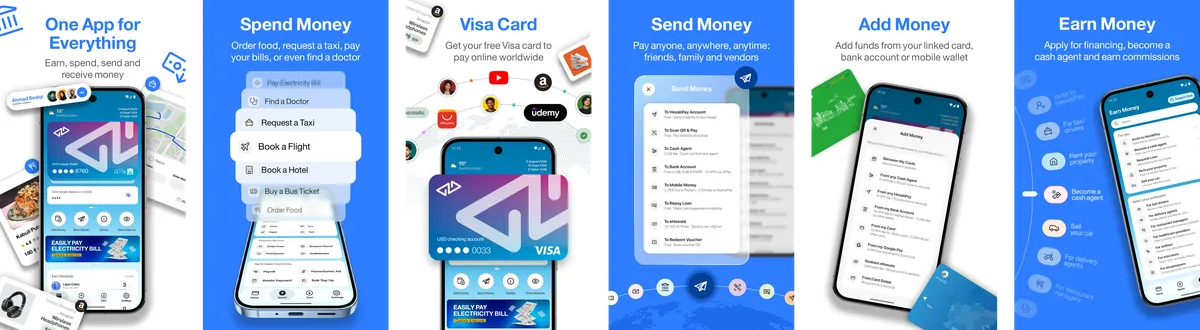
The product has grown well beyond humanitarian transfers. A user can reach the service from any phone through [USSD](/glossary/ussd "A mobile phone protocol that lets users access text-based services on basic feature phones without an internet connection, often used for mobile payme") *580# — the text-menu protocol built into feature phones that works with no internet connection — or from the smartphone app and web portal. The E-Hawala channel lets a sender pay someone with no wallet at all: the recipient gets an SMS and collects cash from any of 1,200+ agent locations. Everyday payments span electricity bills from Da Afghanistan Breshna Sherkat, telecom top-ups for every licensed Afghan mobile operator, government taxes and customs, TV subscriptions, gift e-vouchers, and loan repayments, and the terms add hotel, flight, and intercity bus bookings, food delivery, and taxi and doctor appointments — more than 100 services in all, funded through 20+ channels including bank transfer, cards, Apple Pay, Google Pay, and crypto.
For businesses, HesabPOS terminals accept QR, NFC, cards, and cash across the major international networks — Visa, Mastercard, American Express, UnionPay, Discover, JCB, Apple Pay, and Google Pay — and the enterprise portal disburses salaries and bulk payments to up to 100,000 recipients in a single upload with multi-level approval, funded by wire, cash, or USDC. Developers are offered RESTful APIs, WooCommerce and WordPress plugins, and split payments for marketplaces, though the developer portal at developers.hesab.com currently sits behind a sign-in wall with no public documentation.
Four free web tools round out the platform: a three-calendar date converter (Gregorian, Solar Hijri, Islamic), a live exchange-rate board comparing Sarai Shahzada market rates with Da Afghanistan Bank reference rates and refreshed every ten minutes, and two payment-verification checkers for electricity bills and government tariffs. In-app, Ask HesabPay executes transfers, top-ups, bill payments, and balance checks from natural-language commands; the company bills it as the world's first AI-powered payment assistant — a self-described superlative — and its terms require standard authentication before any AI-initiated transaction executes.
Adoption signals come in different flavors. The app carries 1,078 ratings on Apple's App Store at an average of 4.62 out of 5 — a third-party, if narrow, measure of real user experience. The Foundation's aggregate claims — that 30 percent of Afghanistan's electricity bills are paid through the platform and that cumulative transaction value has reached $10 billion — are Foundation figures the company itself has not broken down, which is worth bearing in mind when they circulate as HesabPay's own numbers.
The Visa Card Brings Digital Balances to Global Checkouts
On August 13, 2026, HesabPay unveiled its virtual Visa card, according to Pajhwok Afghan News. The rollout follows Visa's July 1 announcement expanding Visa Pay — the issuance software kit that bundles card management, processing, and 3-D Secure — to Afghanistan among eleven markets across Africa and Central Asia, with HesabPay the named Afghan issuer. Kakar told Visa the company planned to launch up to one million cards and 'scale quickly without relying on multiple third-party vendors for card management, processing, 3-D Secure and other capabilities'; the company's own release, dated July 24 and published August 10, framed the card as the final mile of financial access.
The card is issued automatically once an account passes verification against a national ID — no separate application — appears in the app within 24–48 hours, and spends the wallet's existing balance: afghanis are converted to US dollars at checkout, so there is nothing to load separately. The FAQ advises keeping roughly 650–700 AFN in the wallet so authorizations do not fail, and spells out the economics.
| Concept | Real-World Implication |
|---|---|
| No issuance or monthly fee | The card itself is free; the constraints are limits and conversion, not cost of entry |
| ~1% foreign-exchange fee (AFN→USD) | Every purchase carries a small conversion cost, quoted in advance |
| Weekly limit 20,000 AFN (~$300); monthly 80,000 AFN (~$1,200) | Set by the Central Bank; caps apply to total usage per period, not per transaction |
| Virtual-only today; no card-to-card transfers | A physical card and card-to-card sending are on the roadmap, not yet shipped |
The intended uses are online shopping, courses, streaming subscriptions, and travel bookings — and pointedly, Umrah and Hajj pilgrims, of whom more than 20 million visit Makkah and Madina each year: pilgrims can tap to pay and receive top-ups from home through Visa Direct instead of carrying cash in ihram. Kakar told Pajhwok the platform now spans more than 60 types of payments and services, previously reached through 7Pay and ATMs, and that the Visa work had taken around five years. At the Kabul unveiling, board member Tariq Mujaddidi and CEO Ahmad Khalid Wadan also announced an agreement with AfghanPAY to route transfers to Türkiye, where users could eventually spend lira and pay with afghanis digitally. Visa's Country Manager for Pakistan and Afghanistan, Umar Khan, said the solution lets organizations 'deliver funds securely, efficiently, and transparently to the people who need them most, while enabling recipients to use those funds seamlessly for everyday purchases.'
Proof at Scale: What the Pilots Measured
The humanitarian record is the strongest evidence that the architecture works in the field. In early 2025, Mercy Corps Ventures ran a three-month pilot in Zurmat district, Paktia province, where 100 families received aid on plastic cards linked to wallets holding HAFN — no smartphone, no internet, no prior digital experience — and spent at four local merchants; 872 people were reached, aid delivery costs fell 29 percent and funds arrived 10 hours faster than the cash route, and 98 percent of recipients preferred digital. In northeast Syria, a Mercy Corps program distributing aid to 100 smallholder farmers via HesabPay wallets cut delivery time by 96 percent (from 28–45 days to under one day), lowered costs 60 percent versus cash agents and 40 percent versus e-vouchers, and put 94 cents of every aid dollar in participants' hands. The pilots were candid about friction — in Syria, local networks could not deliver SMS PINs, forcing a WhatsApp workaround — but the World Food Programme named HesabPay among its ten most promising innovations, a London School of Economics study of 2,500 women found fewer skipped meals among families receiving digital aid, and the [CGAP](/glossary/cgap "Consultative Group to Assist the Poor: a global partnership for financial inclusion and a research hub housed at (and closely linked to) the World Ban") research group at the World Bank noted that HAFN's local-currency peg shifts foreign-exchange risk from recipients to the implementing agency.
The Algorand Question: Today's Rails, Tomorrow's Bank
The Visa program is framed by Hesab as part of a broader 'Global Self-Custody Bank' strategy — and the company has designated a different chain for that bank. On July 7, 2026, Hesab announced it had selected Movement as its 'exclusive stablecoin settlement layer' for the new bank, with DFNS supplying [non-custodial](/glossary/non-custodial "A system where users retain control of their funds or assets at all times, rather than handing them over to a third party to manage.") wallet infrastructure, Circle's CCTP moving native USDC, and Tether supplying USDT, built atop licensed payment rails in the United States, Canada, and the European Union. 'We chose Movement as our exclusive stablecoin settlement layer because it gives us the speed, composability, and emerging-market focus to offer something the world has never had — a bank account that truly belongs to its user,' Kakar said. The company's own Visa release states the strategy plainly: Hesab 'is building a Global Self-Custody Bank on the Movement blockchain.'
Algorand, by contrast, is not named anywhere in the Visa program materials. The Foundation still calls HesabPay 'the Algorand-powered payments platform' — most recently on July 15, 2026, when UNHCR data showed more than 625,000 refugee returnees and over 17,500 internally displaced people supported through reloadable cards, with more than $35 million in assistance delivered. The ledger agrees: HAFN transfers continue to settle on Algorand as of this week. But the honest read is a fork — the Afghan stored-value business settles on Algorand today, while the company's global expansion targets a different chain as its exclusive settlement layer, a point Algorand community members have already raised, with one putting it directly: 'that doesn't mean Algorand is involved in the new Visa card program.' There is also a branding gap worth naming: the 'self-custody' narrative sits uneasily beside today's [custodial wallet](/glossary/custodial-wallet "A digital wallet model where a company (here, a payments platform like HesabPay) holds the private keys to users' funds on their behalf, like a bank h"), where HesabPay holds users' keys and its terms state funds sit 1:1 in the banking system. The terms assert a Da Afghanistan Bank electronic-money license that could not be independently verified from public records, and the footer is careful to say HesabPay 'is not a bank' and that balances 'may not be eligible for deposit insurance.' None of this diminishes the deployed-scale evidence — UNHCR's numbers are the only figures sourced from an aid agency rather than from the Foundation's own releases — but it is the difference between a chain powering an operating national payments system and one positioned for a bank that does not yet exist. For now, HesabPay's Algorand rails are the working system; the Movement bank is the bet.
Source
- HesabPay
- Visa Card FAQs
- HesabPay product news: Visa Pay virtual cards
- HesabPay Terms and Conditions
- Visa press release, July 1, 2026
- Pajhwok Afghan News, August 13, 2026
- Hesab selects Movement as exclusive stablecoin settlement layer (GlobeNewswire), July 7, 2026
- Algorand Foundation: UNHCR scale-up through HesabPay, July 15, 2026
- Algorand Foundation case study: How HesabPay became Afghanistan's interoperable payments platform
- tech-ish: Visa Pay reaches Africa and Central Asia, July 6, 2026
- HesabPay Developer Portal
- HesabPay
- Send Money to Afghanistan: Sanctions & HesabPay | HesabPay
- Download HesabPay | HesabPay
- HesabPay
- January 2026 Algo Insights Report
- How to Use the Card Section? - HesabPay
- Hesab Seleciona a Movement como Camada Exclusiva de Liquidação de Stablecoin para seu Global Self-Custody Bank
Source: https://hesab.com/